

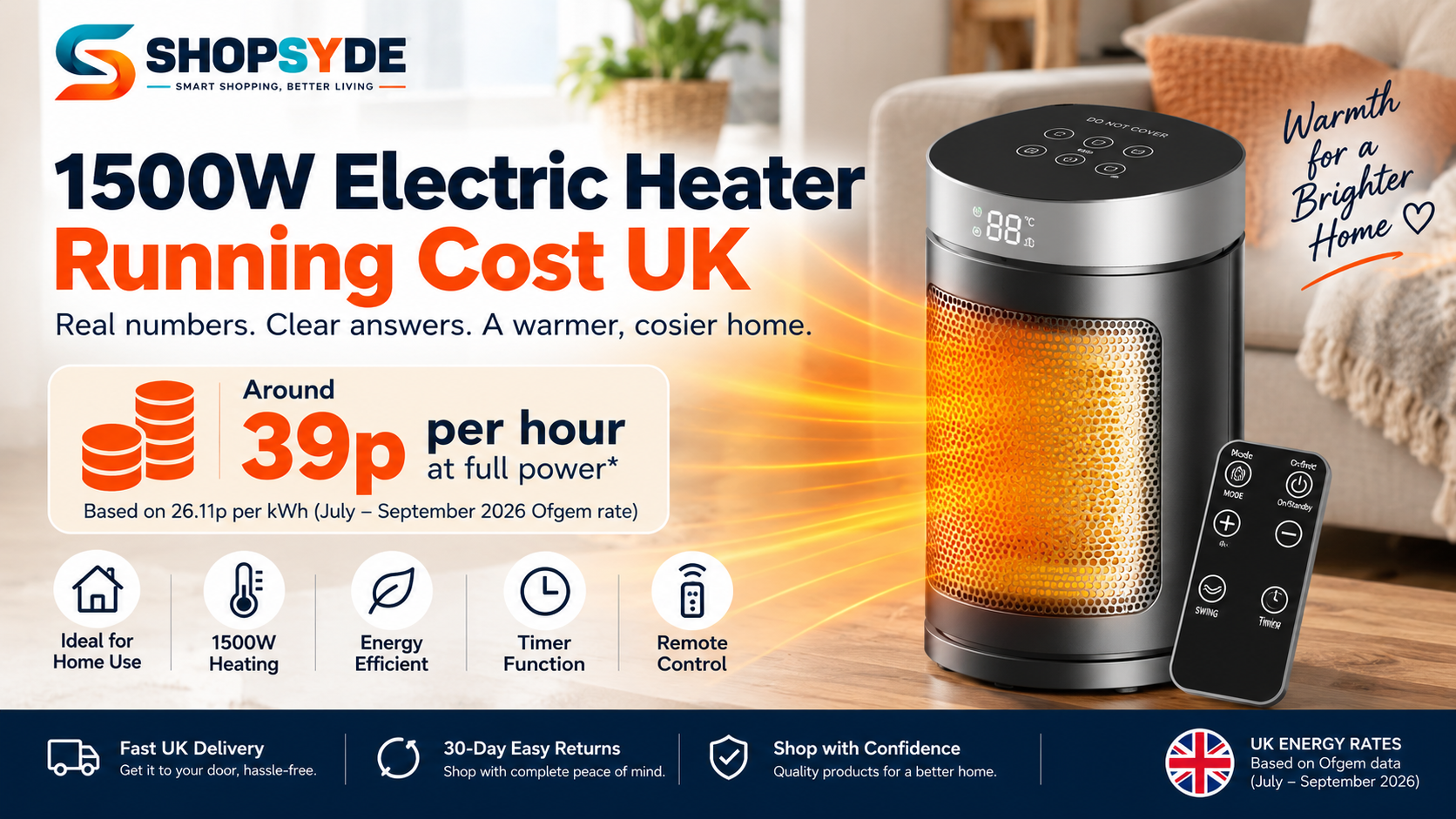
Wondering about the 1500W heater cost to run UK households can expect? Using Ofgem's July–September 2026 average electricity unit rate of 26.11p/kWh, a 1500W electric heater running continuously at full power costs approximately 39.2p per hour. This guide explains the hourly, daily and monthly costs and how to calculate them using your own electricity tariff.if you're thinking about buying a 1500W electric heater, one of the first questions is usually not how powerful it is, but how much it will add to your electricity bill.
The calculation is actually quite simple.
For 1 July to 30 September 2026, Ofgem lists the average electricity unit rate for a household on a standard variable tariff paying by Direct Debit at 26.11p per kWh, averaged across England, Scotland and Wales.
At that rate, a 1500W (1.5kW) heater running continuously at full power costs approximately 39.2p per hour.
The calculation is:
1.5kW × £0.2611 = £0.39165
So that's approximately:
39p per hour at full 1500W output.
Your actual cost can be different because electricity tariffs vary by region, payment method and tariff type. A thermostatically controlled heater also may not draw its full rated heating power continuously once the selected temperature is reached.
1500W Heater Cost to Run in the UK: Hourly & Daily Breakdown
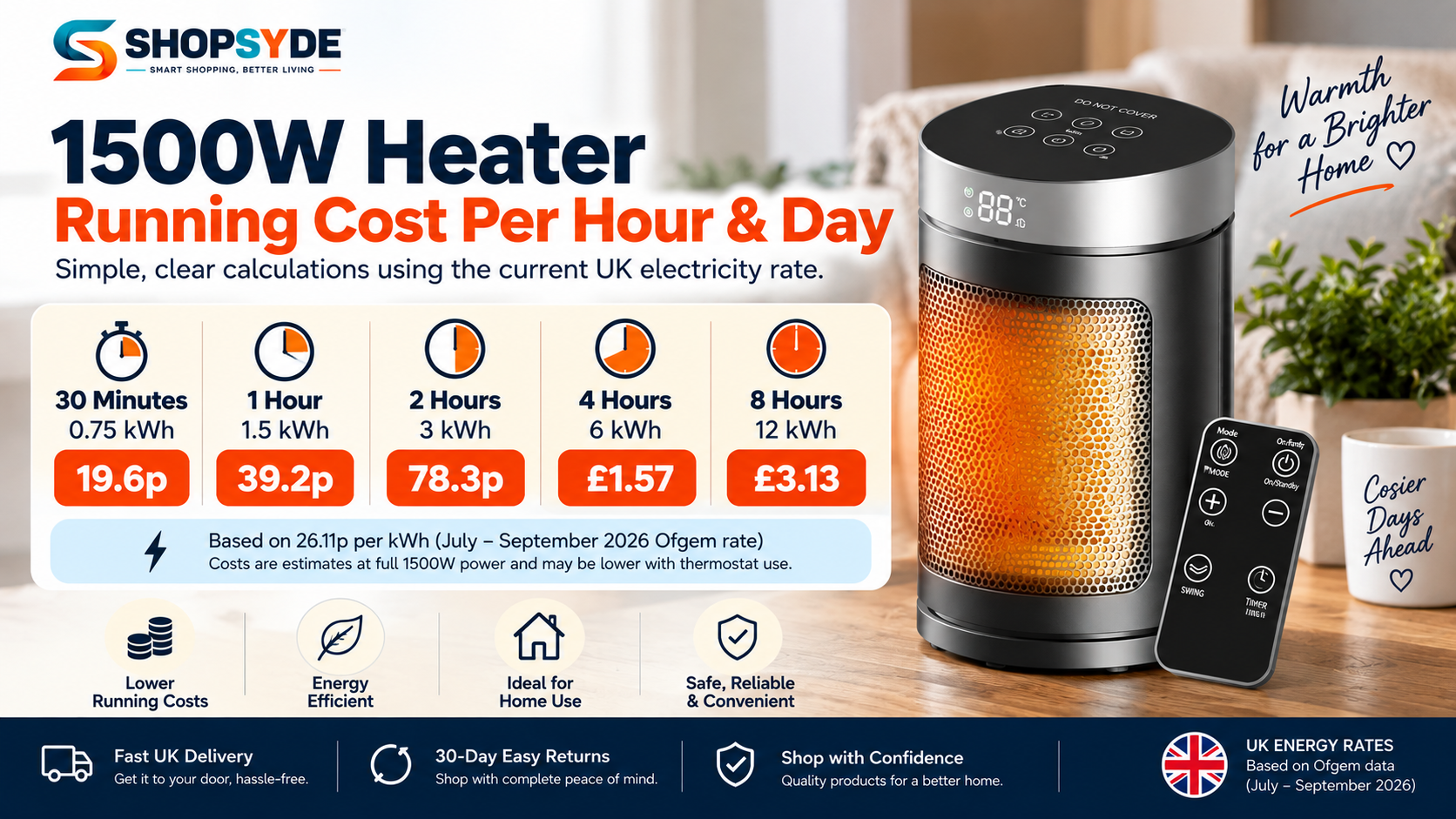
Using Ofgem's 26.11p/kWh July–September 2026 average Direct Debit electricity rate:
| Continuous use at full 1500W | Approx. electricity used | Approx. cost |
|---|---|---|
| 30 minutes | 0.75 kWh | 19.6p |
| 1 hour | 1.5 kWh | 39.2p |
| 2 hours | 3 kWh | 78.3p |
| 4 hours | 6 kWh | £1.57 |
| 6 hours | 9 kWh | £2.35 |
| 8 hours | 12 kWh | £3.13 |
These figures assume the heater is drawing the full 1500W continuously for the entire period.
They should therefore be treated as simple full-power estimates rather than a prediction of your actual bill.
How Do You Calculate the Cost of Running a 1500W Heater?
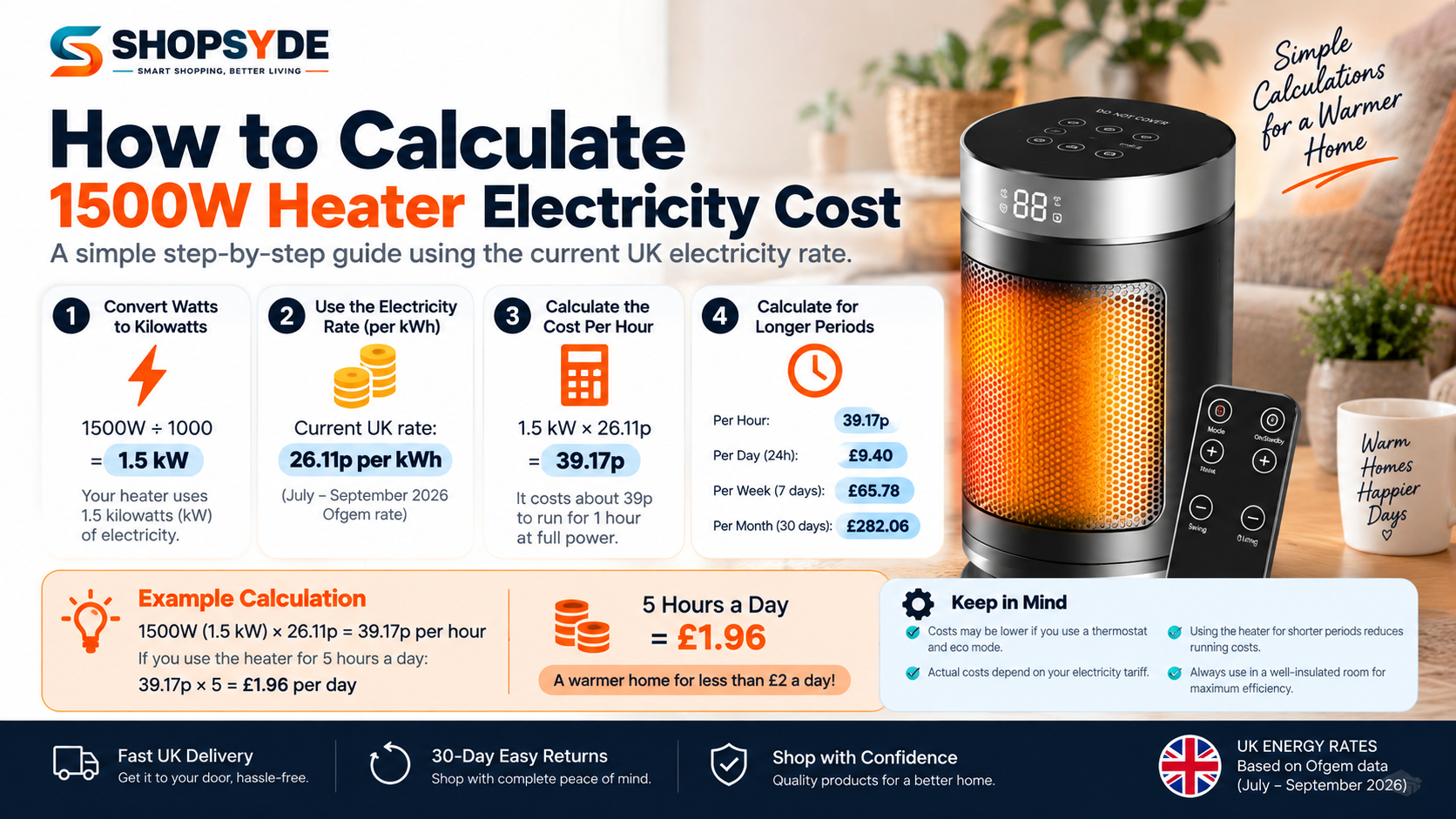
You can calculate the cost yourself using:
Heater power in kW × hours used × electricity price per kWh
A 1500W heater is:
1500W ÷ 1000 = 1.5kW
If your tariff is 26.11p/kWh:
1.5 × £0.2611 = £0.39165 per hour
If your own electricity tariff is different, simply replace 26.11p with the unit rate shown on your electricity bill.
For example, at 30p/kWh:
1.5 × £0.30 = £0.45
So the heater would cost approximately 45p for one continuous hour at full output.
How Much Electricity Does a 1500W Heater Use?
At full rated output, a 1500W electric heater uses 1.5kWh of electricity during one continuous hour of operation.
That means:
1 hour = 1.5kWh
2 hours = 3kWh
4 hours = 6kWh
8 hours = 12kWh
However, there's an important difference between a heater's rated maximum power and what happens during real-world thermostatic operation.
Does a Thermostat Reduce a Heater's Running Cost?
A thermostat allows a heater to respond to the selected temperature rather than necessarily heating continuously.
For example, a thermostatically controlled heater may heat the space until the target temperature is reached and then cycle its heating element according to its design and the surrounding conditions.
That means calculating:
1500W × 8 hours
can overstate actual consumption if the heater isn't drawing its full heating power continuously for all eight hours.
But you shouldn't assume a particular saving percentage.
Actual consumption depends on factors including:
- selected temperature
- room temperature
- insulation
- room size
- heat loss
- outside temperature
- how often doors/windows are opened
- the heater's control behaviour
This is why measuring actual consumption with a suitable electricity-monitoring device can give a more useful picture than relying on wattage alone.
How Much Would a 1500W Heater Cost Per Month?
Suppose you used the heater at full 1500W output for two hours every day.
Using the current 26.11p/kWh figure:
1.5kW × 2 hours = 3kWh/day
3kWh × £0.2611 = £0.7833/day
Over 30 days:
£0.7833 × 30 = £23.50
So the theoretical full-power electricity cost would be approximately £23.50 per month.
At four continuous full-power hours per day, the same calculation would be approximately £47 per 30 days.
Again, these aren't guaranteed bills. They're mathematical examples based on continuous full-power operation.
What Happens to the Cost From October 2026?
Ofgem has already published the next price-cap period.
From 1 October to 31 December 2026, the average electricity unit rate for Direct Debit customers on default tariffs will be 26.32p/kWh, averaged across England, Scotland and Wales.
At that rate:
1.5kW × £0.2632 = £0.3948
So a 1500W heater running continuously at full power would cost approximately:
39.5p per hour
That's only slightly different from the current approximately 39.2p calculation.
We'll update this guide when Ofgem's applicable rates change.
1500W vs 2000W Heater: Which Costs More to Run?
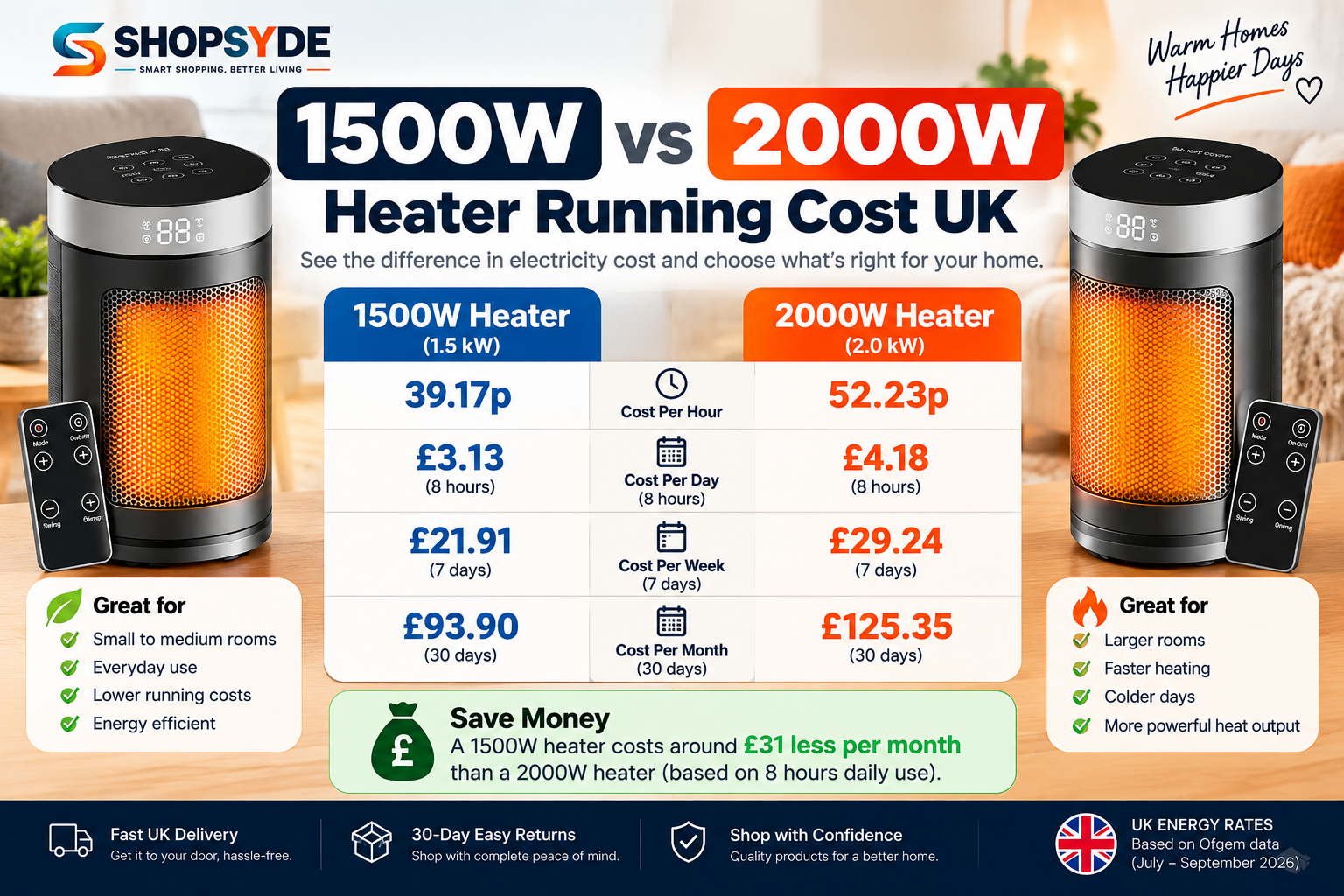
At the same electricity price, a 2000W heater draws more power at full output than a 1500W heater.
Using 26.11p/kWh:
| Heater | Energy used in 1 hour at full power | Approx. cost/hour |
|---|---|---|
| 1500W | 1.5kWh | 39.2p |
| 2000W | 2kWh | 52.2p |
So, during one continuous hour at their respective maximum outputs, the 2000W heater costs approximately 13p more under this example.
But this does not automatically mean a 1500W heater is always cheaper for every heating job.
A higher-powered heater may deliver heat differently or reach a target temperature differently, while room conditions and thermostatic cycling affect actual consumption.
Choose a heater based on the space and heating requirement rather than wattage alone.
Is a 1500W Heater Suitable for a Bedroom?
Wattage alone isn't enough to answer this accurately.
Whether a 1500W heater is appropriate depends on factors such as:
room dimensions, insulation, ceiling height, glazing, outside temperature and how much additional heat the room needs.
We therefore don't recommend assuming that every 1500W heater is suitable for a particular square-meter room size unless the manufacturer specifies that coverage.
For customers looking for a compact supplementary heating option, Shopsyde's 1500W Portable Electric Heater with Thermostat & Remote Control includes 1500W heating, thermostat control, oscillation, timer and remote operation.
View the 1500W Portable Electric Heater
You can also browse our portable electric heaters.
How Can You Use a Portable Electric Heater More Sensibly?
Avoid thinking only about wattage.
For example, heating an occupied room while allowing unnecessary heat to escape through open windows can increase the amount of heating required.
Using the thermostat appropriately, reducing unnecessary heat loss where practical, and heating according to your actual needs can help avoid unnecessary consumption.
Don't compromise safety in an attempt to save electricity.
Portable Heater Safety Matters

Running cost isn't the only consideration when using an electric heater.
Electrical Safety First recommends placing portable heaters on a level surface and keeping them at least one metre away from combustible materials such as furniture, paper and curtains. It also advises against powering a heater from an extension lead and says portable heaters shouldn't be left unattended or used while you're asleep.
Always follow the instructions supplied with your particular heater.
The Bottom Line
At the July–September 2026 Ofgem average electricity rate of 26.11p/kWh, a 1500W electric heater costs approximately 39.2p per continuous hour at full power.
The easiest way to estimate your own cost is:
1.5 × your electricity unit rate × hours of use
Remember that this calculation assumes full 1500W consumption throughout the period. Real-world electricity use can differ when thermostatic controls cycle the heating element.
If you're looking for a portable option with convenient controls, explore the Shopsyde 1500W Portable Electric Heater with Digital Thermostat, Oscillation, Timer & Remote Control.