

When comparing electric heater vs central heating, many UK households want to know which option costs less during winter. The answer depends on how many rooms need heating, how long warmth is required, your electricity and gas tariffs, and the efficiency of your existing heating system.
A portable electric heater can be convenient when you only need supplementary warmth in one occupied room. Gas central heating, meanwhile, is commonly used to heat several rooms through a boiler and radiator system.
But an electric heater isn't automatically cheaper simply because it's portable. Equally, switching on central heating for a short period isn't necessarily the most economical choice in every household.
The best option depends on the total energy required to provide the warmth you need, not just the price per kilowatt-hour.
This guide explains the differences, compares illustrative running costs and helps you decide when portable electric heating or central heating may be more practical.
Electric Heater vs Central Heating: What Is the Difference?
A portable electric heater and a gas central heating system provide warmth in different ways.
A portable electric heater uses electricity to generate heat directly. Depending on the model, it may include a thermostat, fan, timer, oscillation and selectable heat settings.
A gas central heating system typically uses a boiler to heat water, which circulates through radiators around the property.
Feature | Portable Electric Heater | Gas Central Heating |
|---|---|---|
Energy source | Electricity | Natural gas |
Typical use | Local or supplementary heating | Multiple rooms or whole home |
Installation | Usually plug-in | Fixed system |
Temperature control | Depends on heater | Central and radiator controls |
Portability | Portable | Fixed |
Running cost | Electricity use × tariff | Gas use × tariff |
Maintenance | Appliance care | Boiler and system maintenance |
Best application | Depends on heating needs | Depends on heating needs |
Both options can provide useful warmth, but their running costs depend on how they're used.
If you're considering a new portable heater, our Portable Electric Heater UK Buying Guide explains the main features to compare before purchasing.
How Much Does an Electric Heater Cost to Run in the UK?
An electric heater's running cost depends mainly on its electrical power, operating time and your electricity unit rate.
The formula is:
Power in kW × operating time in hours × electricity price per kWh = estimated cost
For example:
1000W = 1kW
1500W = 1.5kW
2000W = 2kW
A 1500W heater operating continuously at full rated power for one hour consumes approximately 1.5kWh.
A 2000W heater operating continuously at full rated power consumes approximately 2kWh.
Electric heater running-cost comparison
The following figures use an illustrative electricity rate of 25p/kWh.
Heater Wattage | Electricity per Full-Power Hour | Cost per Hour |
|---|---|---|
500W | 0.5kWh | 12.5p |
1000W | 1kWh | 25p |
1500W | 1.5kWh | 37.5p |
2000W | 2kWh | 50p |
These are mathematical examples, not current national tariff figures.
Actual electricity consumption can vary because of thermostat cycling, lower heat settings and the time the heating element operates.
For a detailed explanation of electrical power and consumption, read our How Many Watts Does an Electric Heater Use? UK Guide.
You can also explore our Electric Heater Running Cost UK Guide for more examples.
How Much Does Gas Central Heating Cost?
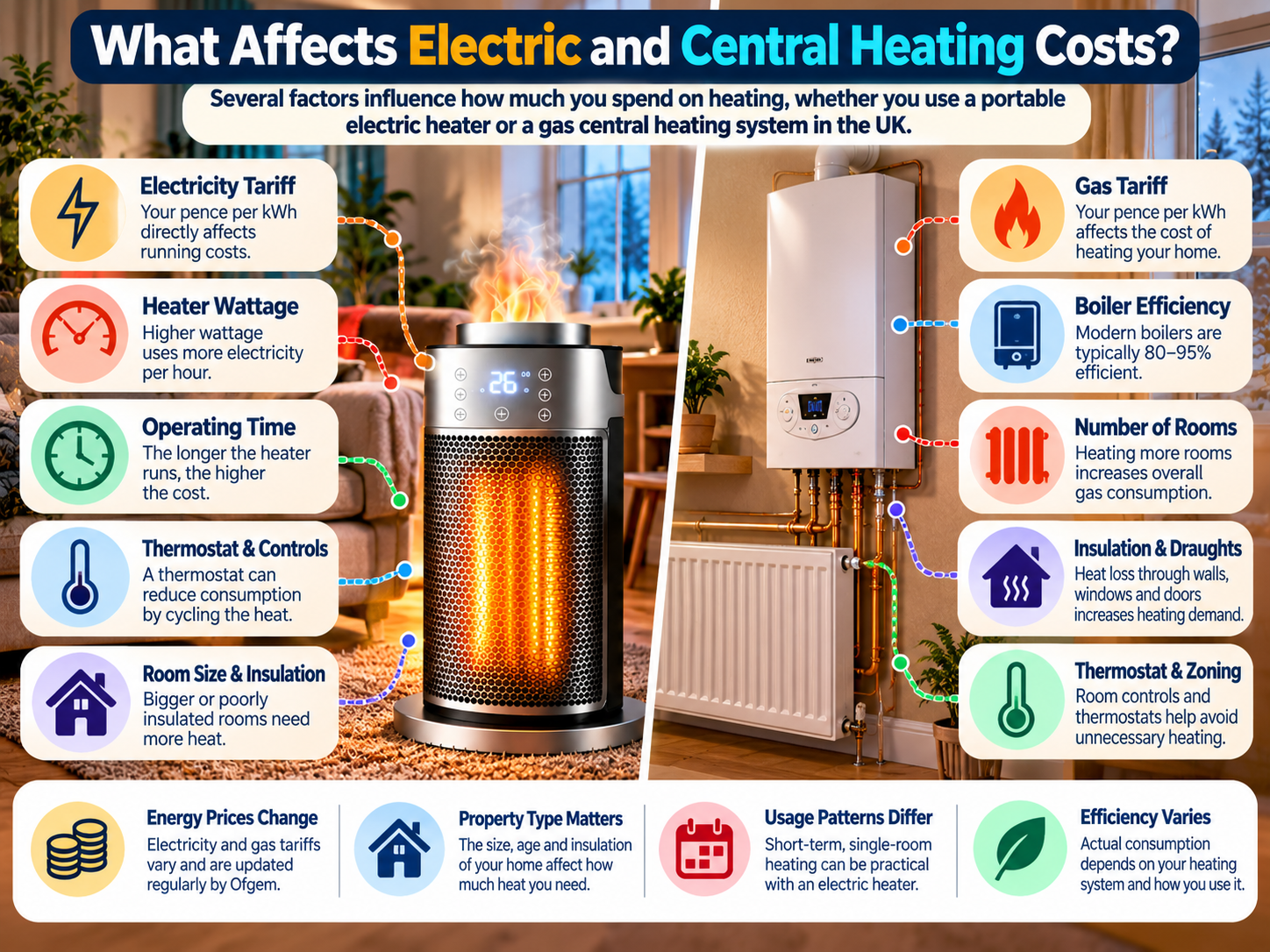
Gas central heating costs depend on the amount of gas the boiler consumes and how efficiently the system converts that energy into useful warmth.
Important factors include:
Property size
Boiler efficiency
Room temperature
Insulation
Radiator controls
Heating duration
Outdoor temperature
Gas unit rate
Unlike a portable electric heater, a gas boiler may provide heat to multiple rooms simultaneously.
Example of boiler efficiency
Suppose a boiler operates at an assumed seasonal efficiency of 90%.
For every 10kWh of gas energy consumed, approximately 9kWh would become useful heat under that simplified assumption.
The remaining energy is lost through the system.
Actual efficiency varies according to the boiler, operating conditions and heating system design.
That means comparing a gas boiler's rated power with a portable electric heater's wattage isn't enough to determine which costs less.
Electricity vs Gas: Comparing the Cost per kWh
Electricity and gas are normally billed using kilowatt-hours, but their unit prices can differ substantially.
For the 1 October–31 December 2026 price-cap period, Ofgem's published average Direct Debit unit rates across England, Scotland and Wales are approximately:
Energy source | Average unit rate |
|---|---|
Electricity | 26.32p/kWh |
Gas | 5.93p/kWh |
These are national averages for the specified price-cap period. Your actual rates may differ by region, tariff, payment method and meter type.
You can check the latest information on the Ofgem energy price-cap unit rates page.
Example: cost of producing useful heat
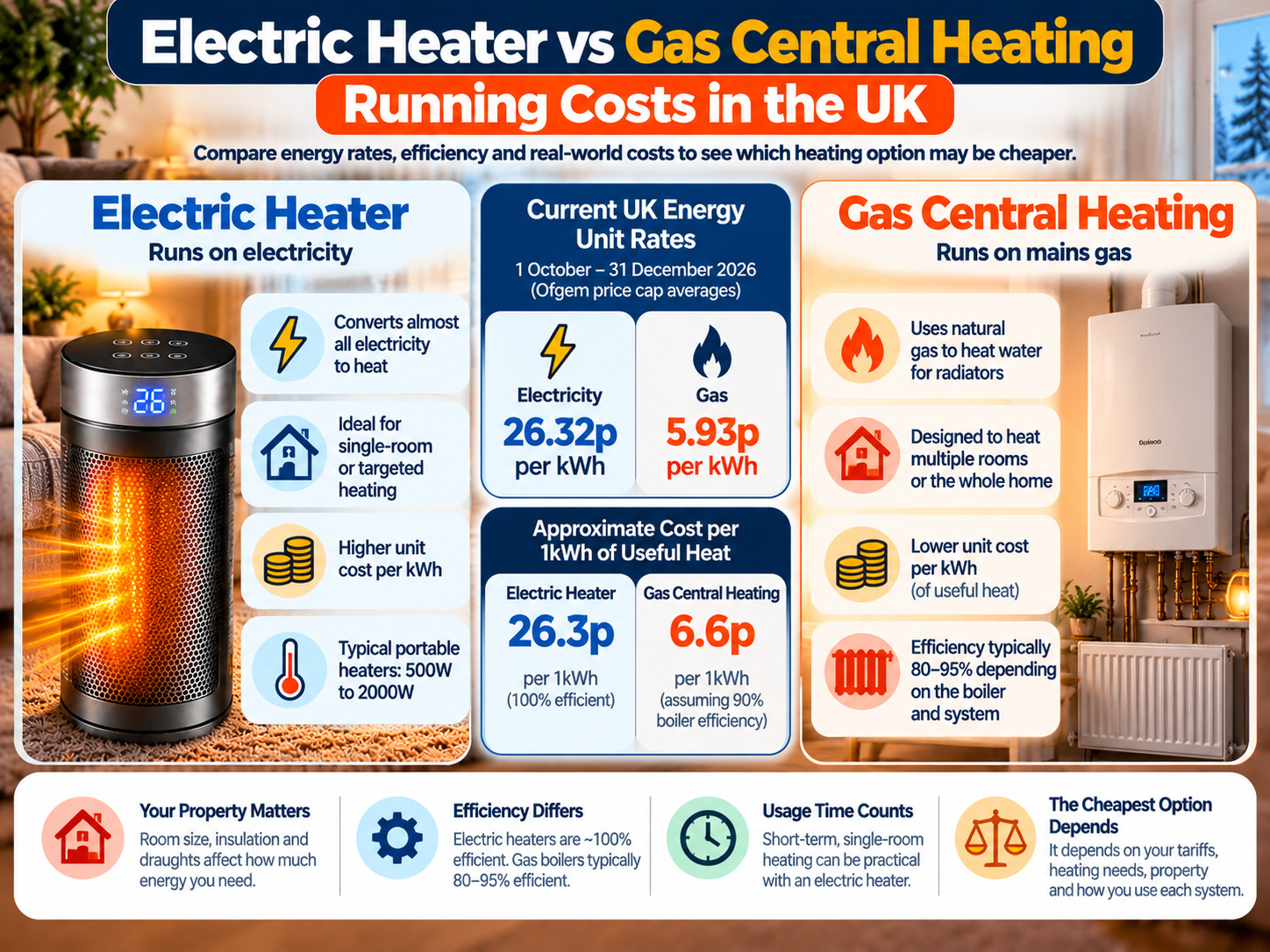
Assuming the rates above and a gas boiler operating at 90% efficiency:
Heating method | Approximate variable cost per 1kWh useful heat |
|---|---|
Electric resistance heater | 26.3p |
Gas boiler at 90% efficiency | 6.6p |
This comparison excludes standing charges, distribution losses, system electricity consumption and other household costs.
It illustrates why gas central heating can be cheaper per unit of useful heat, even when a portable electric heater is more convenient for heating one room.
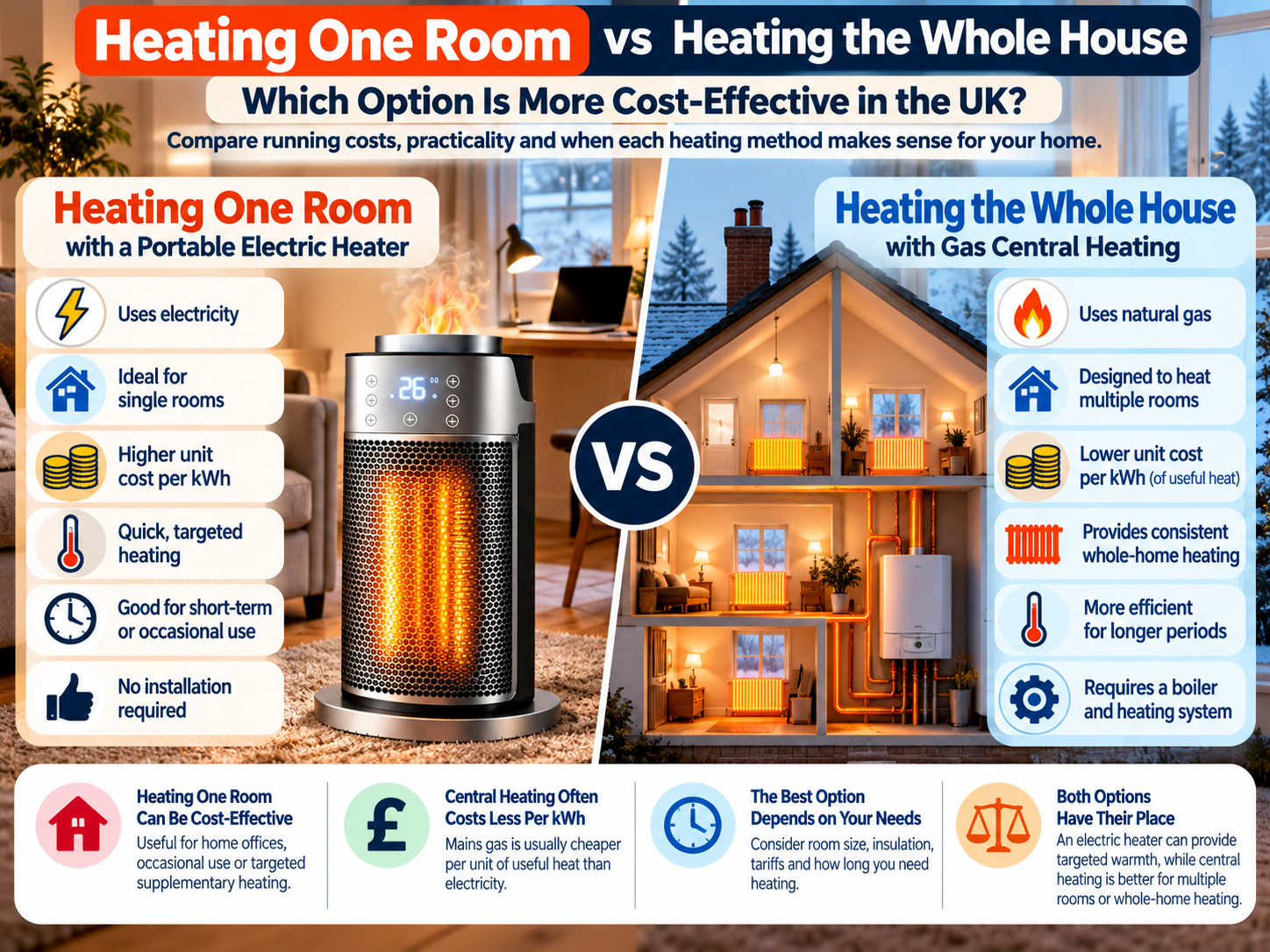
Is It Cheaper to Heat One Room With an Electric Heater?
Sometimes, but not always.
Imagine you're working from home and only need supplementary warmth in one room for a couple of hours.
A portable electric heater can provide targeted heating without deliberately increasing the temperature throughout the whole property.
However, whether this saves money depends on the alternative.
If your central heating system can efficiently heat that one room using radiator controls or zoning, gas heating may still cost less.
The correct comparison is between:
The additional electricity needed for local heating
and
The additional gas and electricity needed for central heating to provide comparable comfort.
Example: two hours of portable heating
Using Ofgem's October–December 2026 average electricity rate of 26.32p/kWh:
A 1500W heater running continuously at full power for two hours uses:
1.5kW × 2 = 3kWh
Estimated cost:
3 × £0.2632 = £0.79
A 2000W heater running continuously at full power for two hours uses:
2kW × 2 = 4kWh
Estimated cost:
4 × £0.2632 = £1.05
Whether central heating could provide comparable comfort for less depends on the heating system and property.
For help choosing a suitable heater output, read our What Size Electric Heater Do I Need? UK Guide.
When Is Central Heating More Cost-Effective?
Central heating may be more economical when several rooms require warmth for extended periods.
For example, a household may need to heat:
Living room
Bedrooms
Kitchen
Hallway
Home office
A properly controlled central heating system can distribute warmth throughout those areas.
Heating each room separately using electric resistance heaters may result in substantial electricity consumption.
However, central heating costs depend on the boiler, radiator controls, insulation, tariffs and heating schedule.
Energy Saving Trust provides useful guidance on electric heating and heating-system choices.
1500W vs 2000W Portable Heaters for Supplementary Heating
When comparing portable electric heaters, wattage matters.
A 1500W heater has a lower maximum power draw.
A 2000W heater provides greater maximum heating output.
At Ofgem's October–December 2026 average electricity rate of 26.32p/kWh:
Heater | 1 Hour | 2 Hours | 4 Hours |
|---|---|---|---|
1500W | 39.5p | 79.0p | £1.58 |
2000W | 52.6p | £1.05 | £2.11 |
These calculations assume continuous full-power operation.
A thermostatically controlled heater may consume less electricity over the same elapsed period because its heating element can cycle.
Not sure which model to choose? Read our 1500W vs 2000W Heater Comparison to understand the differences in maximum heating output, electricity consumption and running costs.
Use the verified URL of your published comparison article for that link.
Does a Thermostat Help Control Heating Costs?
A thermostat helps regulate heating according to a selected temperature.
For example, if you set a portable electric heater to 21°C, the appliance may cycle its heating element as the temperature approaches the selected target.
This means the heating element doesn't necessarily operate continuously at maximum power.
Central heating systems also use thermostats and radiator controls to regulate heating.
However, a thermostat doesn't guarantee a fixed percentage saving.
Actual consumption depends on the room, insulation, outside temperature and equipment.
Want to understand temperature controls in more detail? Read our Electric Heater Thermostat Guide to learn how thermostat cycling and operating time affect heating.
How Insulation Affects Your Heating Bills
Insulation is important regardless of whether you use electric heating or central heating.
Heat can escape through:
Walls
Roofs
Windows
Floors
Doors
Draughty openings
A poorly insulated property may require more heating energy to maintain comfortable indoor temperatures.
Better insulation helps retain warmth, reducing the amount of replacement heat required.
Practical ways to reduce heat loss
Improve loft or wall insulation where appropriate, seal avoidable draughts, use curtains sensibly and close appropriate internal doors when heating individual rooms.
Always maintain necessary ventilation.
Energy Saving Trust offers practical advice on draught-proofing your home.
For more advice on reducing unnecessary heating time, read our How to Use an Electric Heater Efficiently in Winter guide.
Can Portable Electric Heating Replace Central Heating?
A portable electric heater can provide supplementary warmth, but it isn't necessarily a practical replacement for a whole-home heating system.
For example, a single portable heater may be suitable for adding warmth to a home office while someone is working.
However, relying on multiple portable heaters to warm an entire poorly insulated property could result in high electricity consumption.
There are also differences between conventional resistance heaters and permanently installed electric heating technologies.
For example, heat pumps can provide substantially more useful heat per unit of electricity consumed than conventional resistance heaters under suitable operating conditions.
When considering whole-home heating, compare complete systems rather than assuming every electric heating technology has identical running costs.
Which Heating Option Is Better for a Home Office?
A home office is one situation where a portable electric heater may be convenient.
If you only need additional warmth for a limited period, a heater with adjustable temperature controls and a timer can help manage operation.
Useful features include:
Digital thermostat
Multiple heat settings
Timer
Oscillation
Remote control
Suitable dimensions
However, if your central heating can efficiently heat the office without unnecessarily warming the rest of the property, it may still cost less.
If you're considering supplementary heating for your workspace, our Portable Electric Heater UK Buying Guide explains which features to compare before buying.
What About Bedrooms and Living Rooms?
The most suitable heating method can vary by room.
Bedroom heating
A controlled central heating schedule may be appropriate when warmth is required during sleeping hours.
Portable electric heaters should not be left operating while you're asleep or otherwise unattended.
Electrical Safety First advises against overnight portable-heater use.
Living room heating
Living rooms often contain sofas, curtains, rugs and other combustible furnishings.
A portable electric heater can provide supplementary warmth while the room is occupied, provided it is positioned safely.
Home office heating
Portable heaters can be convenient for targeted supplementary warmth while working.
However, safe placement and appropriate electrical connections remain essential.
For detailed placement guidance, read our Portable Electric Heater Safety and Placement Guide.
You can also consult Electrical Safety First's portable-heater safety advice.
Practical Ways to Avoid Unnecessary Heating Costs
Whether you're using central heating or a portable electric heater, several habits can help avoid unnecessary energy consumption.
1. Use Appropriate Thermostat Settings
Avoid selecting unnecessarily high temperatures.
2. Heat Occupied Spaces
Avoid supplementary heating in rooms that aren't being used.
3. Control Operating Time
Use heating schedules or timers according to appliance instructions.
4. Reduce Draughts
Seal avoidable gaps around doors and windows while maintaining required ventilation.
5. Improve Insulation
Better heat retention can reduce heating demand.
6. Check Your Energy Tariff
Use your actual electricity and gas rates when comparing costs.
7. Follow Heater Safety Guidance
Keep portable heaters away from combustible materials and never leave them operating unattended.
For more practical tips, explore our Electric Heater Efficiency Guide.
Shopsyde 1500W Portable Electric Heater
For supplementary heating, Shopsyde offers the 1500W Portable Electric Heater with Thermostat, Oscillation, Timer & Remote Control.
This portable ceramic heater provides convenient controls for everyday indoor heating.
Key features
Up to 1500W heating
Ceramic heating
Digital thermostat
Multiple heat settings
Oscillation
Timer
Remote control
At the October–December 2026 average electricity rate of 26.32p/kWh, continuous full-power operation costs approximately 39.5p per hour.
Actual consumption varies with settings and thermostat operation.
View the Shopsyde 1500W Portable Electric Heater →
Shopsyde 2000W Portable Electric Heater With Humidifier
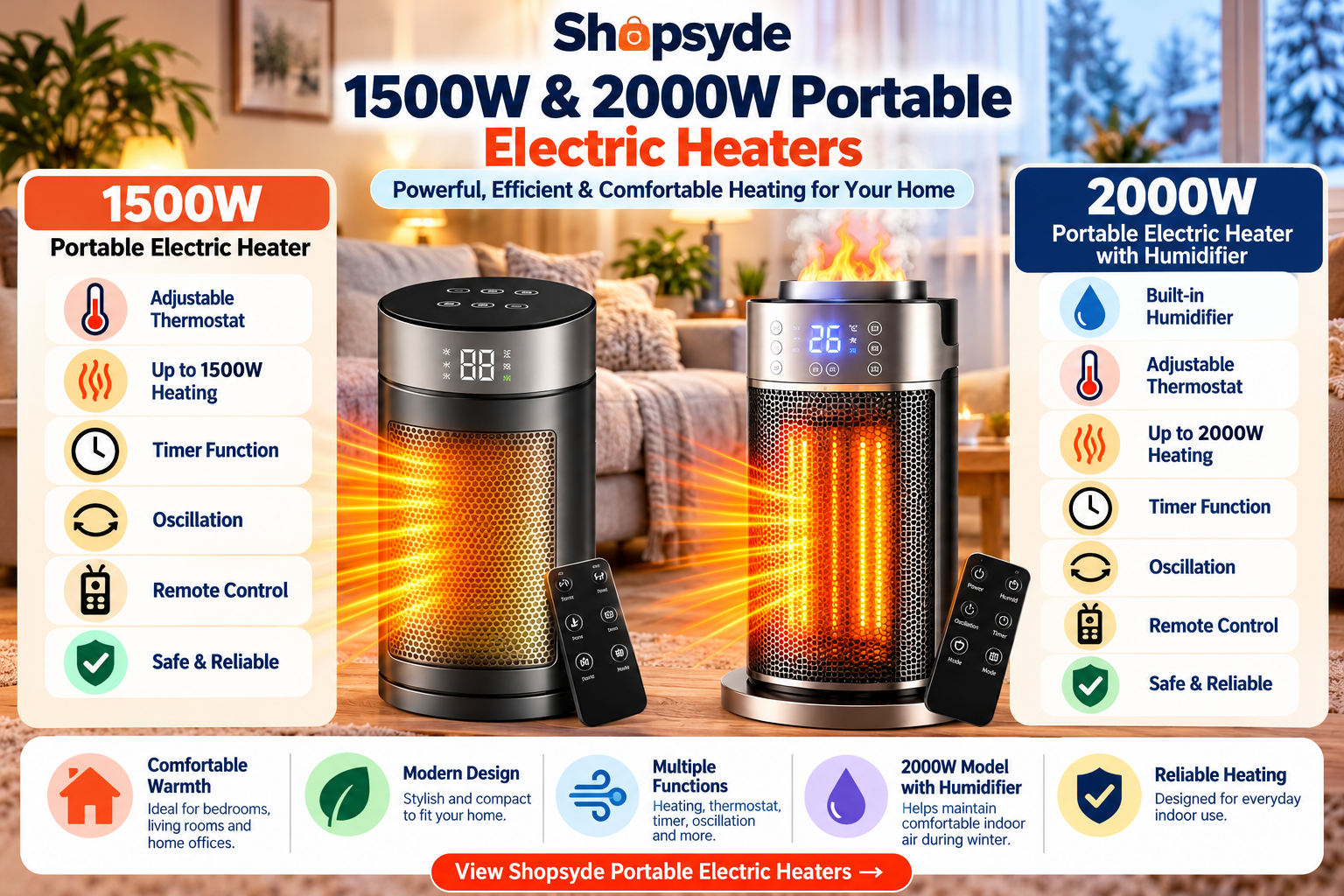
For customers seeking greater maximum heating output, Shopsyde offers the 2000W Portable Electric Heater with Humidifier, Thermostat, Timer & Remote Control.
Key features
Up to 2000W heating
Thermostat control
Timer
Remote control
Humidifier functionality
Portable design
At the October–December 2026 average electricity rate of 26.32p/kWh, continuous operation at a 2000W electrical draw costs approximately 52.6p per hour. Auxiliary functions may affect the appliance's total consumption depending on its specifications.
The 2000W model offers greater maximum heating output than the 1500W model, but the right choice depends on your room and heating requirements.
View the Shopsyde 2000W Portable Electric Heater →
Looking for more options? Browse Shopsyde Portable Electric Heaters.
Electric Heater vs Central Heating: Comparison Checklist
Before deciding, consider:
Factor | What to check |
|---|---|
Rooms requiring heat | One room or several |
Electricity tariff | Your actual pence per kWh |
Gas tariff | Your actual pence per kWh |
Heating efficiency | Boiler or electric system performance |
Operating duration | Short-term or extended heating |
Insulation | How quickly the property loses heat |
Thermostat | Temperature-control functionality |
Heating zones | Whether individual rooms can be controlled |
Safety | Appropriate appliance use |
Total cost | Energy needed for comparable comfort |
The Bottom Line
When comparing electric heater vs central heating, the cheapest option depends on your heating requirements.
A portable electric heater may be convenient for supplementary warmth in one occupied room for a limited period.
Gas central heating may be more cost-effective when several rooms need heating or warmth is required for extended periods, particularly because mains gas often costs less per unit of useful heat than conventional electric resistance heating.
Before deciding, compare your electricity and gas tariffs, system efficiency, heating duration, insulation, thermostat controls and the number of rooms requiring warmth.
For supplementary heating with adjustable controls, browse Shopsyde Portable Electric Heaters.