

Wondering where to place a portable heater safely in your bedroom, living room or home office?
Portable electric heaters can provide convenient supplementary warmth, but positioning matters. Putting a heater too close to curtains, furniture, bedding or other combustible materials can create unnecessary risk, while obstructing airflow can interfere with normal operation.
Electrical Safety First recommends placing portable heaters on a level surface and keeping them at least one metre away from combustible materials, including paper, furniture and curtains.
This guide explains where to position a portable electric heater, what to keep away from it and which common placement mistakes to avoid.
Where to Place a Portable Heater Safely
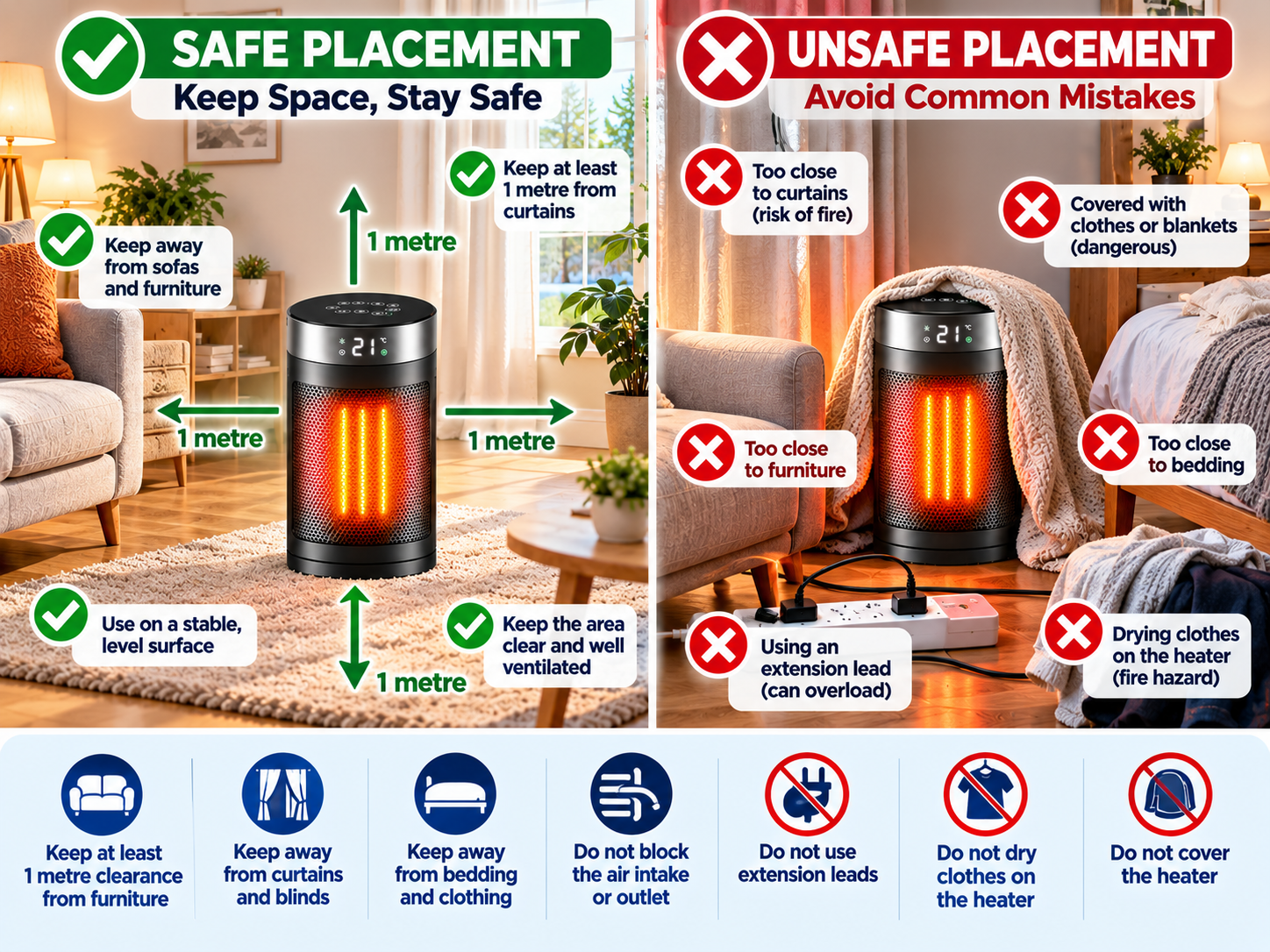
Choose a location that provides the heater with:
a stable position
a level surface
adequate surrounding clearance
unobstructed airflow
distance from combustible materials
access to an appropriate wall socket
The exact requirements of your heater's manufacturer should always take priority.
Don't position a portable heater simply where it feels most convenient without considering what's around it.
Keep at Least One Metre From Combustible Materials
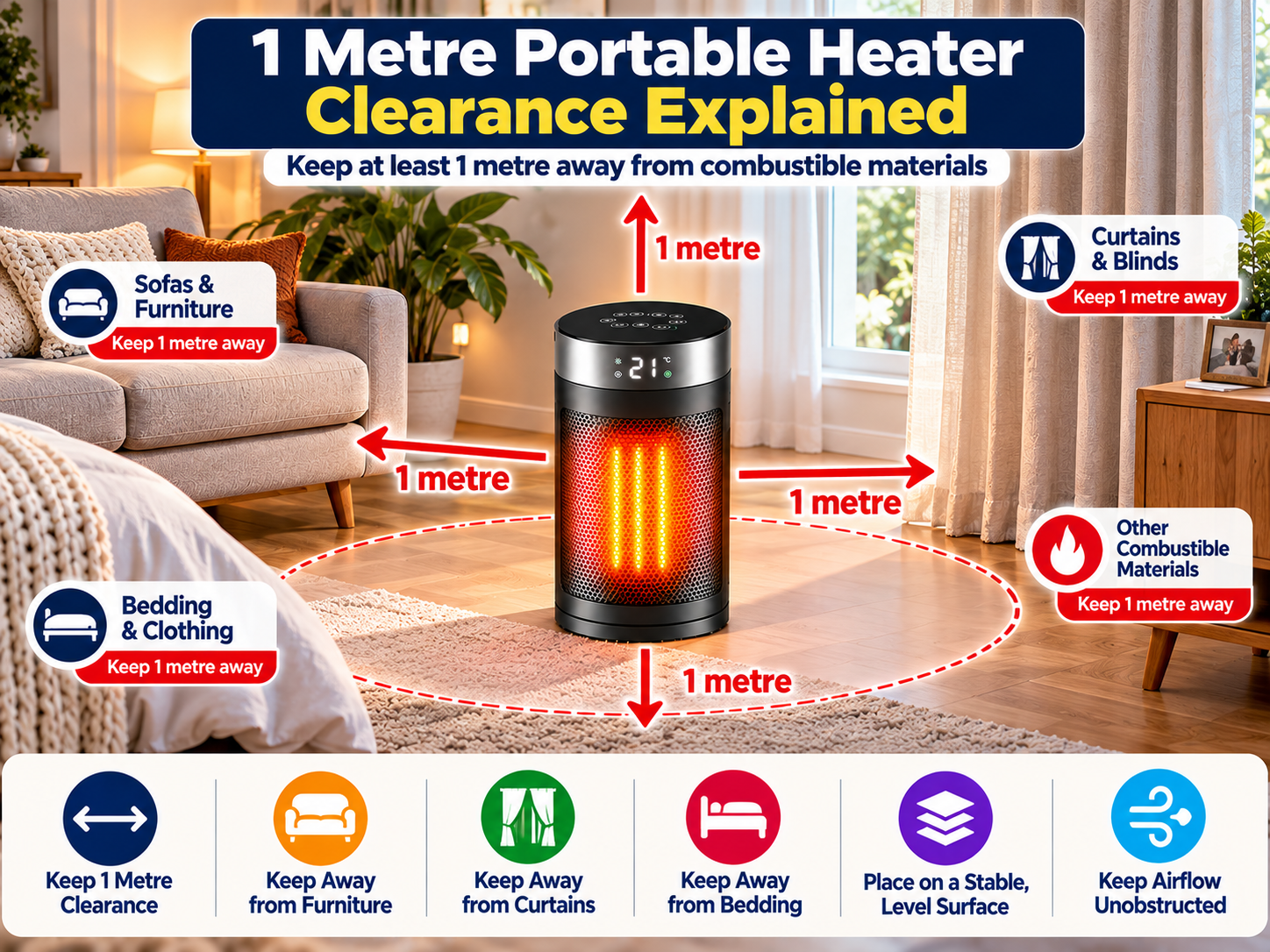
Electrical Safety First recommends keeping portable heaters at least one metre away from combustible materials, including furniture, paper and curtains.
That means maintaining space between your heater and items such as:
curtains
sofas
armchairs
bedding
clothing
paper
cardboard
rugs where prohibited by the manufacturer
other easily combustible materials
Don't treat a small heater as harmless simply because it has a compact design.
For detailed guidance on using portable heaters safely, read the Electrical Safety First portable heater safety advice.
Should a Portable Heater Be Placed on the Floor?
Many freestanding portable heaters are designed to operate on a floor or another manufacturer-approved stable surface.
The important considerations are that the heater is:
level
stable
upright
and positioned according to its instructions.
Avoid unstable surfaces where the appliance could easily fall or be knocked over.
Don't place a heater on a chair, bed or other improvised surface merely to increase its height.
Can You Put an Electric Heater on Carpet?
Don't assume every portable heater can be placed on every type of carpet.
The correct answer depends on the manufacturer's installation and placement instructions for the specific heater.
A thick or uneven carpet may affect stability or potentially obstruct lower ventilation openings on some designs.
If the manufacturer requires a hard, flat surface, follow that requirement.
The key principles are:
stable + level + unobstructed + manufacturer-approved.
Can You Put a Portable Heater Near a Sofa?
Keep appropriate clearance.
A sofa contains combustible materials and can potentially obstruct airflow if a heater is positioned too closely.
Electrical Safety First's one-metre clearance recommendation should therefore be considered when positioning the heater around furniture.
Don't place a heater directly against or underneath furniture.
How Far Should a Heater Be From Curtains?
Keep portable heaters at least one metre away from curtains and other combustible materials, following Electrical Safety First guidance.
Curtains are particularly important because they can move.
A heater that appears sufficiently distant when curtains are open could become much closer when they're closed or moved by airflow.
Consider the full movement of the curtain, not simply its current position.
Can You Put an Electric Heater Near a Bed?
Extra care is required around bedding.
Duvets, sheets, blankets, pillows and clothing are combustible and can shift position easily.
Never position a portable heater where bedding could fall onto it or block its airflow.
If you're using supplementary heating in a bedroom, position the heater according to its manufacturer's instructions and maintain safe clearance from the bed and other materials.
Most importantly, portable heaters shouldn't be left operating while you're asleep.
Can You Leave a Portable Heater On Overnight?
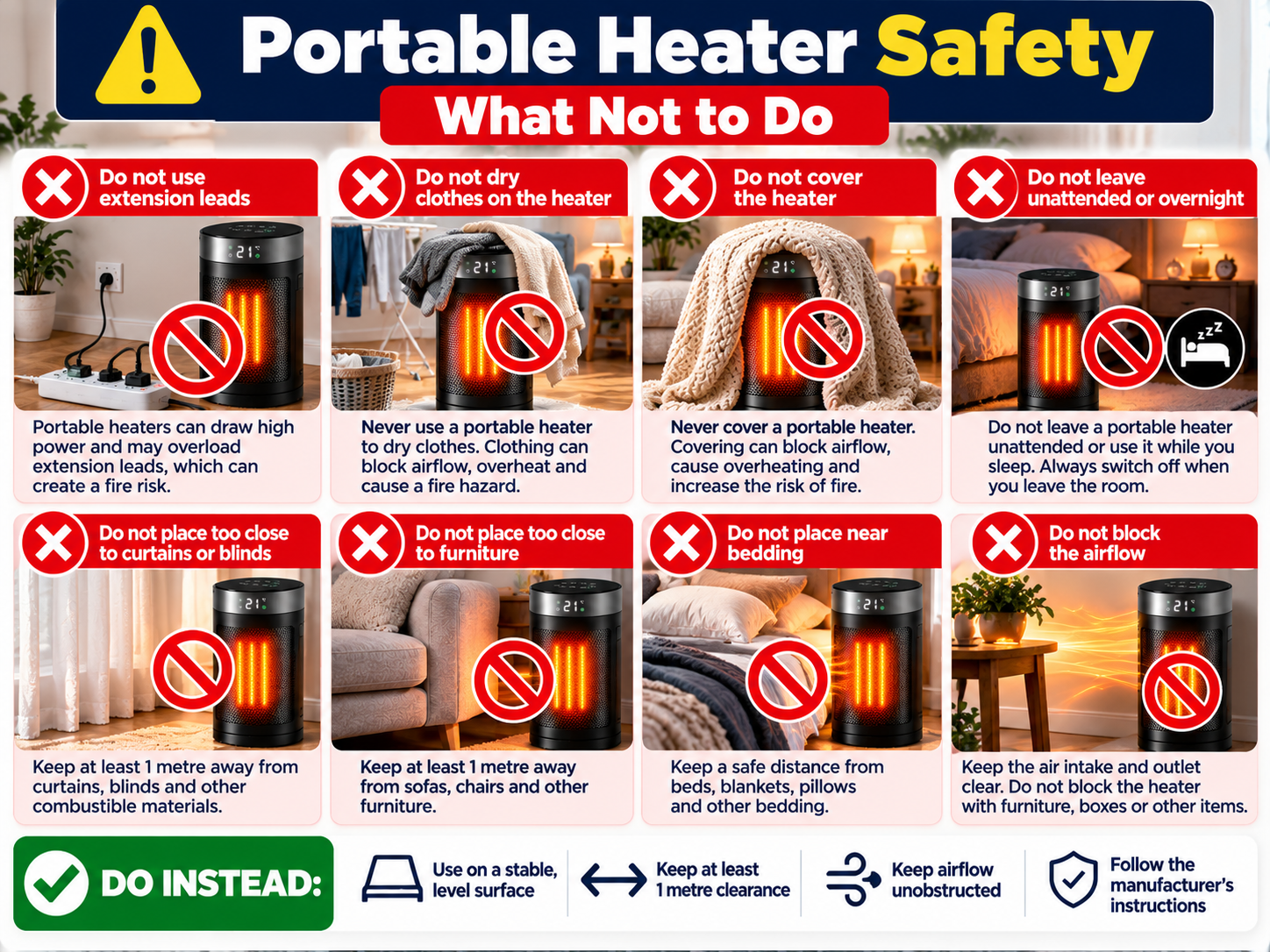
Electrical Safety First advises not using portable heaters overnight and recommends never leaving them unattended while operating.
A heater having:
a thermostat
timer
overheat protection
tip-over protection
doesn't mean safe-use guidance can be ignored.
These features provide additional protection but don't make unattended overnight operation automatically appropriate.
Should You Place a Heater Under a Window?
There's no universal rule saying every portable heater should be placed under a window.
Windows can be associated with:
colder surfaces
draughts
curtains
condensation
nearby furniture
More importantly, curtains around windows can create a combustible-material hazard.
Choose heater placement according to the product instructions, safe clearances and room layout rather than assuming the traditional radiator position is appropriate for a portable heater.
Should a Portable Heater Be Against a Wall?
Not unless the manufacturer specifically permits the required clearance.
Portable heaters need appropriate airflow around their intake and outlet areas.
Placing the appliance directly against a wall could obstruct ventilation depending on its design.
Check where your particular heater:
draws air in
and
releases heated air
then maintain the clearances specified by the manufacturer.
Don't Block the Heater's Airflow
Airflow is particularly important for fan-assisted and ceramic heaters.
Avoid positioning the heater where its vents are obstructed by:
walls
furniture
curtains
clothing
boxes
bedding
accumulated dust or fluff
Electrical Safety First notes that fan heaters require clear vents and recommends checking that they aren't blocked by dust or fluff.
Never cover a portable heater.
Can You Dry Clothes on an Electric Heater?
No.
Electrical Safety First advises never using a portable heater to dry clothes.
Clothing can:
obstruct airflow
overheat
fall onto hot areas
create a fire hazard
Use appropriate clothes-drying methods instead.
Should You Plug a Portable Heater Into an Extension Lead?
Electrical Safety First advises against powering portable heaters from extension leads, because extension leads can be overloaded by high-powered appliances.
Portable heaters can draw substantial electrical power.
For example:
1500W = 1.5kW
2000W = 2kW
Follow the manufacturer's electrical instructions and use an appropriate wall socket.
Don't daisy-chain extension leads or adapters.
Can You Use a Portable Heater Near a Power Socket?
The heater needs an appropriate electrical supply, but its position should still comply with the manufacturer's instructions.
Avoid:
stretching the cable across walkways
trapping the cable under furniture
placing the cable where it can be damaged
positioning the heater where someone can trip over the cable
The power cable should not create a new safety hazard simply because the heater is near a socket.
Where Should You Place a Heater in a Bedroom?
A bedroom heater should be positioned:
on an appropriate stable surface
away from bedding
away from curtains
away from clothing
where airflow isn't obstructed
where it can't easily be knocked over
near an appropriate electrical supply without unsafe extension leads
Avoid positioning it directly beside the bed.
Use supplementary heating while you're awake and follow the manufacturer's instructions.
Where Should You Place a Heater in a Living Room?
Living rooms often contain many combustible items:
sofas
curtains
rugs
cushions
books
decorations
and furniture.
Choose an open location with adequate clearance rather than squeezing the heater between furniture.
If your heater includes oscillation, make sure its moving airflow path doesn't bring heated air directly against nearby combustible objects.
Where Should You Place a Heater in a Home Office?
A home office can be a practical place for supplementary heating, but it also contains electronics and paper.
Keep the heater away from:
computers
monitors
cables
paperwork
cardboard
desks where airflow would be obstructed
Avoid placing a heater directly underneath a desk unless the manufacturer explicitly supports that use and all clearance requirements can be maintained.
Don't surround the heater with cables or office equipment.
Does Heater Placement Affect the Thermostat?
Potentially.
A heater's temperature sensor measures conditions around its sensor location.
Placing it in an unusually cold draught or close to another heat source can affect the temperature it senses relative to other parts of the room.
Good placement therefore matters for both safety and temperature control.
electric heater thermostat
Does Heater Placement Affect How Warm the Room Feels?
Yes.
A heater positioned where airflow is blocked won't distribute warm air in the same way as one positioned with adequate surrounding space.
For oscillating heaters, maintaining an open airflow path allows the appliance to distribute warm air across its intended area.
But don't sacrifice safety just to direct heat toward where you're sitting.
Clearance requirements come first.
What Size Heater Should You Use?
Placement isn't the only consideration.
A heater's wattage should also match the heating requirement.
A 1500W heater has a lower maximum heating output and electrical power draw than a 2000W heater.
However, room size alone doesn't determine the correct wattage.
Consider:
room dimensions
insulation
glazing
ceiling height
draughts
existing heating
outside temperature
What Size Electric Heater Do I Need for My Room? UK Guide
Portable Electric Heater UK buying guide
Shopsyde 1500W Portable Electric Heater
For supplementary heating, Shopsyde offers a 1500W Portable Electric Heater with Thermostat, Oscillation, Timer & Remote Control.
Its confirmed features include:
up to 1500W heating
ceramic heating
digital thermostat
multiple heat settings
oscillation
timer
remote control
portable design
View the Shopsyde 1500W Portable Electric Heater →
Shopsyde 2000W Portable Electric Heater
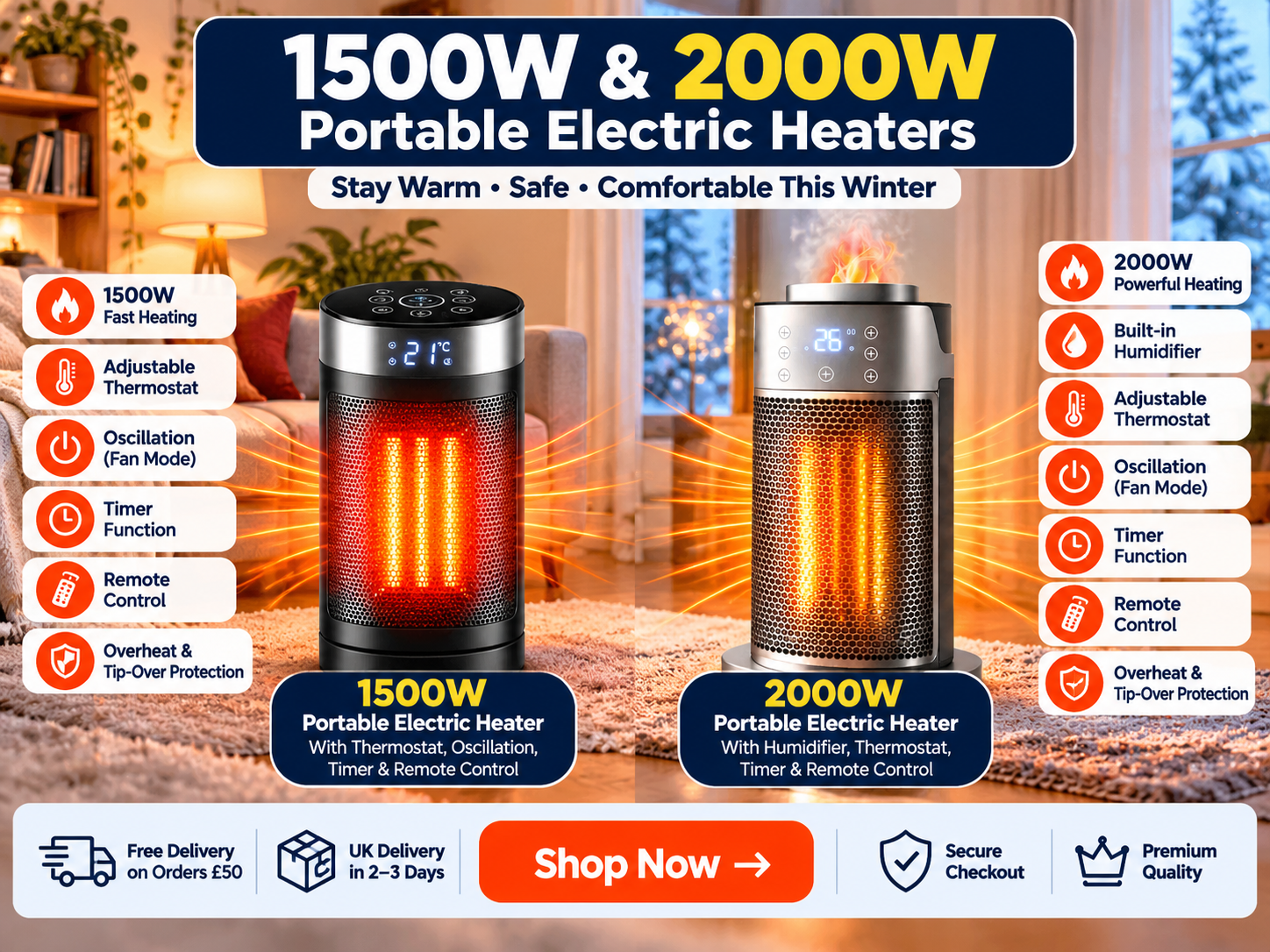
For customers wanting greater maximum heating output, Shopsyde also offers a 2000W Portable Electric Heater with Humidifier, Thermostat, Timer & Remote Control.
Confirmed features include:
up to 2000W heating
thermostat control
timer
remote operation
humidifier functionality
portable design
View the Shopsyde 2000W Portable Electric Heater →
Browse Shopsyde Portable Electric Heaters →
Portable Heater Placement Checklist
Before switching on your heater, check:
| Check | Why it matters |
|---|---|
| Stable surface | Helps prevent accidental tipping |
| Level position | Supports safe operation |
| 1m clearance | Keeps combustible materials away |
| Clear air intake | Prevents airflow obstruction |
| Clear heat outlet | Allows heated air to disperse |
| Curtains away | Reduces contact with combustible fabric |
| No clothing | Heater should never be covered |
| No extension lead | Reduces overload risk |
| Safe cable position | Helps prevent trips/damage |
| Manufacturer instructions | Product-specific requirements take priority |
Use this as a quick check every time you reposition a portable heater.
The Bottom Line
If you're wondering where to place a portable heater, focus first on safety, stability and airflow.
Keep the heater:
on a stable, level surface
at least one metre from combustible materials
away from curtains and bedding
uncovered
away from obstructed airflow
and connected according to the manufacturer's electrical instructions.
Don't use portable heaters with extension leads, don't use them to dry clothes, and don't leave them operating unattended or while you're asleep.
For portable heating options with thermostats, timers and oscillation:
Browse Shopsyde Portable Electric Heaters →