

Choosing a portable electric heater UK shoppers can use for supplementary warmth isn't simply about buying the highest-wattage model available.
Portable electric heaters vary in heating output, heating-element design, thermostats, heat settings, timers, oscillation, controls and safety features.
Your room also matters.
A heater used occasionally in a home office may have very different requirements from one providing supplementary heat in a larger living space.
This guide explains what to check before buying a portable electric heater, including 1500W vs 2000W models, running costs, thermostats, ceramic heating and important safety considerations.
What Is a Portable Electric Heater?
A portable electric heater is a relatively compact electric appliance designed to provide heat without being permanently installed as part of a property's central heating system.
Common types include:
ceramic fan heaters
conventional fan heaters
convector heaters
oil-filled radiators
halogen heaters
Electrical Safety First explains that portable heaters come in several designs with different characteristics and recommends considering where and how a heater will be used before purchasing one.
For Shopsyde's current heater range, our main focus is portable ceramic electric heaters.
What Should You Look for When Buying a Portable Electric Heater in the UK?
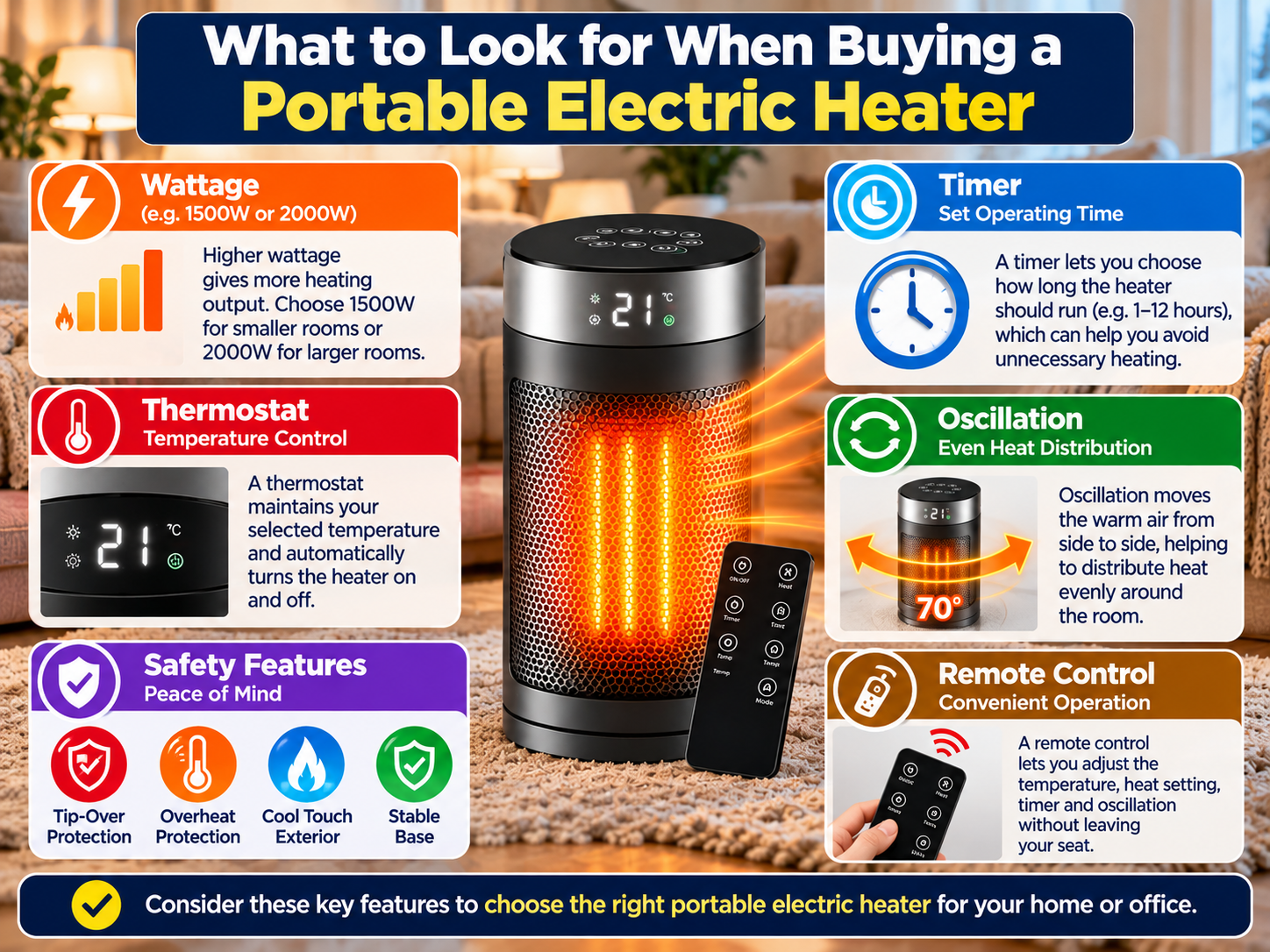
Rather than choosing based only on appearance or price, compare several specifications.
Important factors include:
Maximum wattage
Heating technology
Heat settings
Thermostat
Timer
Oscillation
Remote control
Safety features
Physical dimensions
Room conditions
Running cost
We'll look at each one below.
How Much Heater Wattage Do You Need?
Wattage tells you the heater's rated electrical power.
For example:
1000W = 1kW
1500W = 1.5kW
2000W = 2kW
A 2000W electric resistance heater provides greater maximum heating output than a 1500W heater.
However, don't choose solely based on the highest number.
Your heating requirement depends on factors such as:
room dimensions
ceiling height
insulation
glazing
draughts
outside temperature
existing heating
desired indoor temperature
For a detailed explanation, internally link:
What Size Electric Heater Do I Need for My Room? UK Guide
1500W vs 2000W Portable Electric Heater
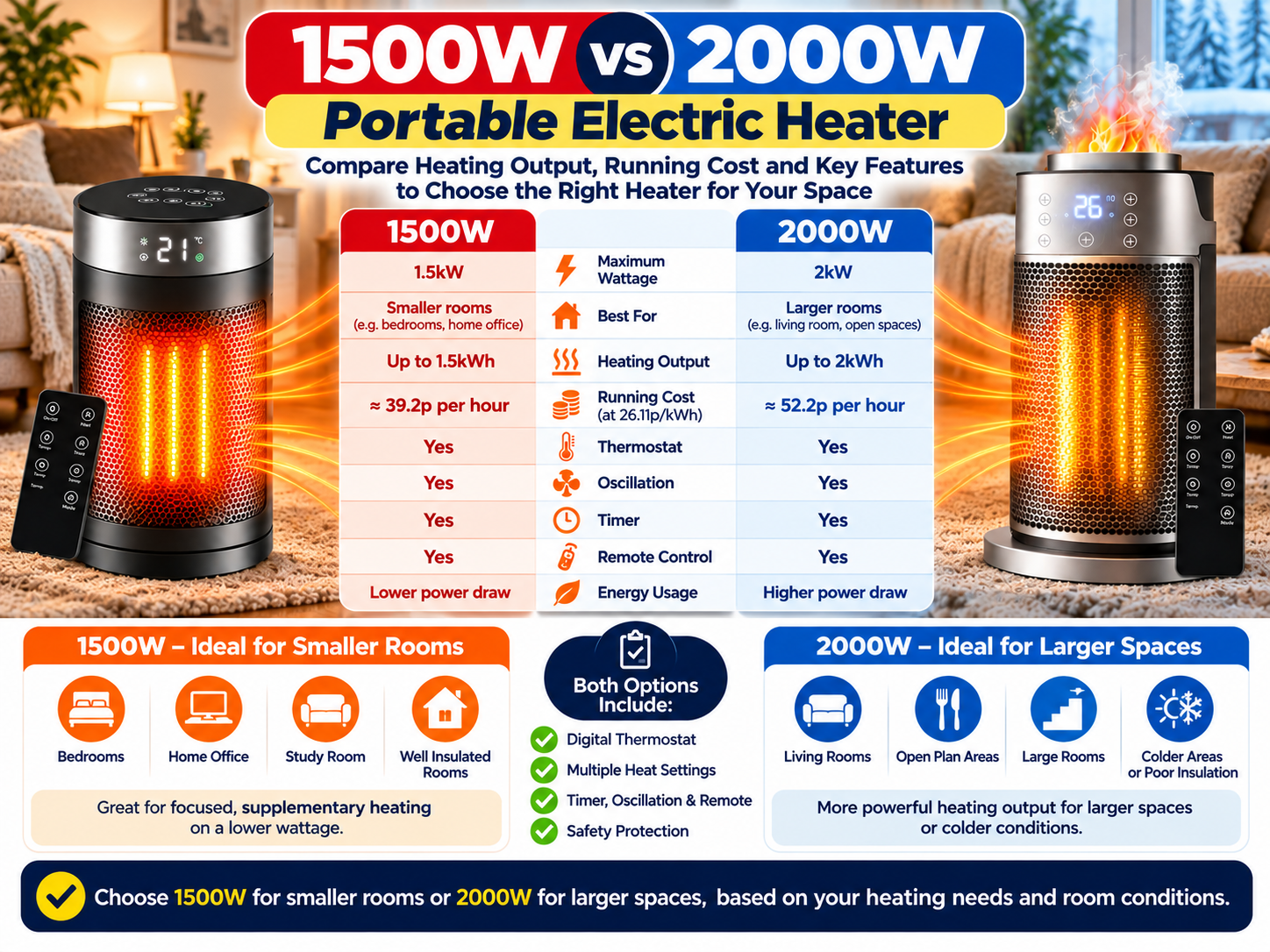
This is one of the most useful comparisons for your Shopsyde range.
| Feature | 1500W | 2000W |
|---|---|---|
| Maximum rated power | 1.5kW | 2kW |
| Electricity at continuous full output | 1.5kWh/hour | 2kWh/hour |
| Maximum heating output | Lower | Higher |
| Thermostat available | Yes, on selected models | Yes, on selected models |
| Portable options | Yes | Yes |
| Best choice | Depends on heating requirement | Depends on heating requirement |
A 1500W heater has a lower maximum electrical power draw.
A 2000W heater provides greater maximum heating capacity.
Neither is automatically the better choice.
How Much Does a Portable Electric Heater Cost to Run?
Running cost primarily depends on:
Wattage × operating time × electricity unit rate
For example, if electricity costs 26.11p/kWh, continuous full-power operation would work out approximately as:
| Heater | Energy/Hour | Approx. Cost/Hour |
|---|---|---|
| 500W | 0.5kWh | 13.1p |
| 1000W | 1kWh | 26.1p |
| 1500W | 1.5kWh | 39.2p |
| 2000W | 2kWh | 52.2p |
These examples use Ofgem's average Direct Debit electricity rate for 1 July–30 September 2026. Actual tariffs vary.
Since this article may remain online after that price-cap period, update these calculations when electricity rates change.
Is a 1500W Portable Heater Expensive to Run?
At 26.11p/kWh:
1.5kW × £0.2611 = approximately £0.392
Therefore, continuous full-power operation costs approximately:
39.2p per hour
Two continuous full-power hours would be approximately:
78.3p
Four hours:
£1.57
But a thermostatically controlled heater may not continuously draw maximum heating power throughout the entire period it is switched on.
1500W Electric Heater Running Cost UK
How Much Does a 2000W Portable Heater Cost to Run?
At the same electricity rate:
2kW × £0.2611 = approximately £0.522
Therefore:
2000W continuous full-power operation ≈ 52.2p/hour
Two hours:
approximately £1.04
Four hours:
approximately £2.09
Again, actual consumption can vary because of heat settings and thermostat cycling.
Should You Choose a Ceramic Heater?
Not sure which heating technology suits you? Read our Ceramic Heater vs Fan Heater UK comparison for a detailed look at heating elements, controls, running costs and practical differences.
Ceramic heaters are popular among compact portable-heater designs.
Many use a ceramic/PTC heating element together with a fan to distribute warmed air.
But don't assume:
ceramic = automatically cheaper electricity
If two electric heaters continuously consume the same wattage for the same amount of time, their electrical energy consumption is the same.
The more useful comparison includes:
wattage
thermostat
heat settings
airflow
controls
noise
room requirements
Ceramic Heater vs Fan Heater: Which Should You Choose?
Why Is a Thermostat Important?
A thermostat allows the heater to regulate heating according to temperature.
For example, if you select 21°C, the heater's control system can respond as conditions change.
A simplified sequence is:
Set temperature
→ heater senses temperature
→ heating operates
→ target approached
→ heating cycles
→ temperature falls
→ heating resumes
This can mean the heating element doesn't necessarily operate continuously for every minute the heater is switched on.
Should You Choose a Heater With Multiple Heat Settings?
Multiple heat settings give you more control.
If a heater genuinely offers different electrical power modes, a lower-power mode consumes less electricity per active heating hour than its maximum-power mode.
However, don't assume the exact wattage of each setting.
Check the specifications for the particular product.
Useful controls may include:
low heat
high heat
thermostat
fan mode
oscillation
depending on the model.
Is Oscillation Worth Having?
Oscillation moves the direction of airflow from side to side.
Its purpose is primarily to help distribute warm airflow across a wider surrounding area rather than directing it continuously toward one position.
Oscillation does not inherently reduce the heater's rated wattage.
Consider it a comfort and heat-distribution feature, rather than an electricity-saving feature by itself.
Is a Timer Useful on a Portable Heater?
Yes, particularly for controlling operating duration.
A timer doesn't make each kWh of electricity cheaper.
Instead, it can help prevent the heater from operating longer than intended.
For example, if you only require supplementary heat while working in your home office for a limited period, a timer can help manage that operating period.
Always follow the heater's safety instructions regardless of whether it has a timer.
Is a Remote Control Worth Having?
A remote control is primarily a convenience feature.
Depending on the heater, it may allow you to adjust:
temperature
heat setting
timer
oscillation
power
without walking over to the appliance.
A remote doesn't inherently make the heating element more energy efficient.
What Safety Features Should You Look For?
Check the verified specifications of the exact heater you're considering.
Depending on the model, features may include:
tip-over protection
overheat protection
temperature controls
stable freestanding base
But safety features do not replace correct use.
Electrical Safety First recommends keeping portable heaters at least one metre away from combustible materials such as furniture, curtains and paper. It also advises against powering portable heaters from extension leads.
Never assume that a heater is safe to use anywhere simply because it contains safety protection.
Where Should You Put a Portable Electric Heater?
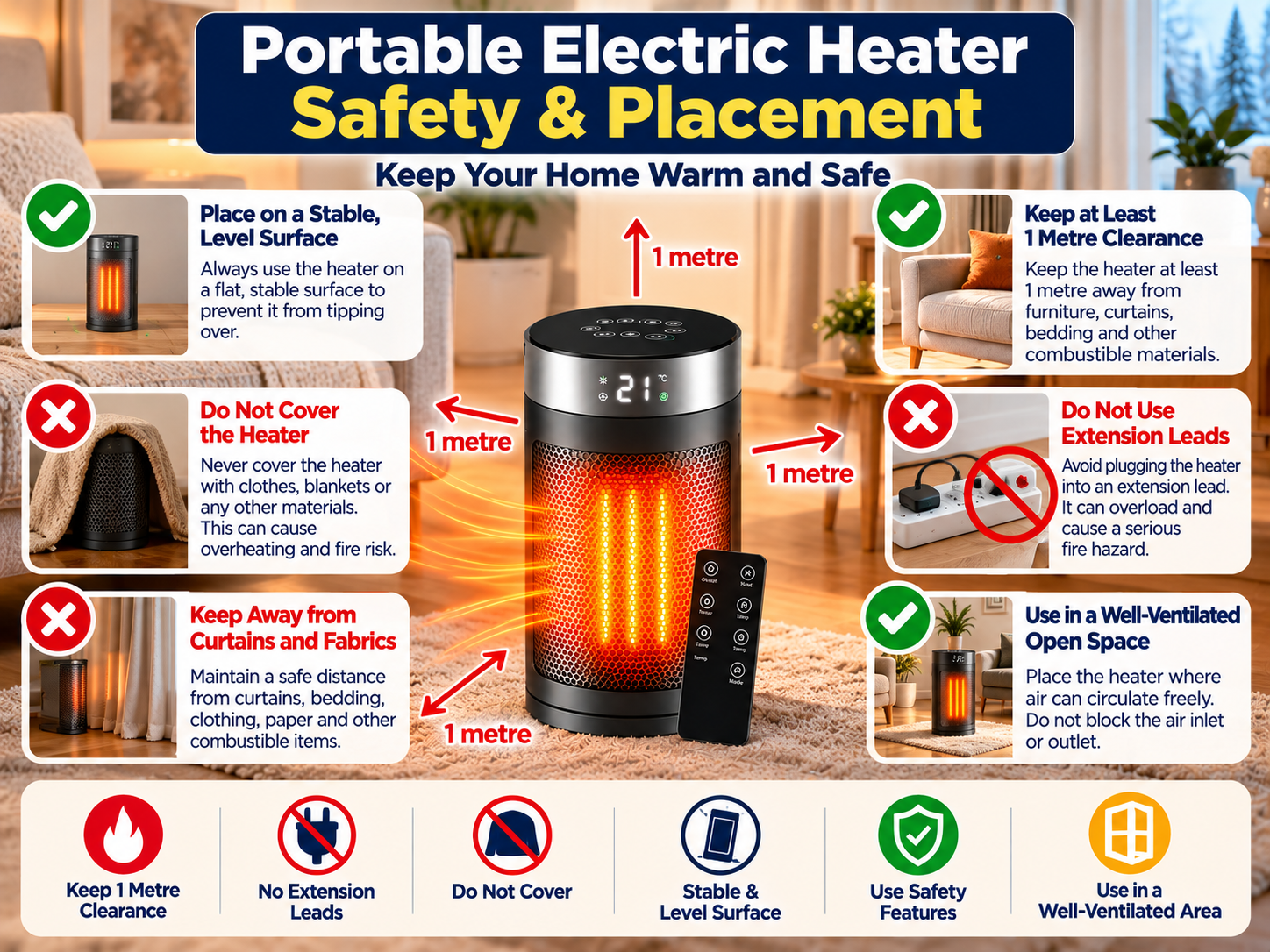
Position the heater according to the manufacturer's instructions.
Generally, it should be:
on a stable surface
on a level surface
away from combustible materials
where airflow isn't obstructed
where it cannot easily be knocked over
Avoid placing portable heaters directly beside:
curtains
bedding
paper
furniture
clothing
Don't cover the heater or use it for drying clothes.
Our upcoming heater-cluster article will cover this topic in more detail:
Where Should You Place a Portable Electric Heater?
Can You Use a Portable Electric Heater Overnight?
Portable heaters shouldn't be treated as appliances to leave operating unattended while you're asleep.
Electrical Safety First recommends not using portable heaters overnight and advises never leaving them unattended.
A:
timer
thermostat
tip-over switch
or overheat protection system
doesn't override safe-use instructions.
Is a Portable Heater Suitable for a Bedroom?
A portable heater can provide supplementary bedroom heating, but suitability depends on the exact product and room.
Consider:
heater wattage
bedroom size
insulation
glazing
controls
fan noise
safe placement
If you plan to use it before going to bed, follow the manufacturer's instructions and switch it off as required rather than leaving a portable heater operating while you're asleep.
Is a Portable Electric Heater Good for a Home Office?
A home office can be a practical application for supplementary portable heating.
Instead of necessarily heating other unoccupied rooms, you may want additional warmth where you're actually working.
Useful features for this situation can include:
thermostat
timer
multiple heat settings
compact dimensions
oscillation
remote control
However, keep the heater safely away from cables, papers, furniture and other combustible materials.
Is a 2000W Heater Better for a Larger Room?
A 2000W heater provides greater maximum heating output than a 1500W heater.
But don't use a simple rule such as:
“Large room = always 2000W.”
Heating requirements also depend on:
insulation
room volume
glazing
heat loss
existing heating
outside temperature
This is why your room-size guide should be internally linked from this section.
Does Better Insulation Reduce Heater Running Time?
Better insulation can help a room retain heat.
In comparable conditions, a room that loses heat more slowly may require less replacement heat than a poorly insulated room.
Factors include:
walls
loft/roof
windows
doors
draughts
This can influence how frequently a thermostatically controlled heater needs to operate.
Shopsyde 1500W Portable Electric Heater
For customers looking for a compact portable option, Shopsyde offers the:
1500W Portable Electric Heater With Thermostat, Oscillation, Timer & Remote Control
Confirmed features include:
up to 1500W heating
ceramic heating
digital thermostat
multiple heat settings
oscillation
timer
remote control
portable design
Product:
View the Shopsyde 1500W Portable Electric Heater →
At the illustrative 26.11p/kWh electricity rate, continuous maximum 1500W operation works out at approximately 39.2p/hour.
Shopsyde 2000W Portable Electric Heater
If you want greater maximum heating output, Shopsyde also offers:
2000W Portable Electric Heater With Humidifier, Thermostat, Timer & Remote Control
Confirmed features include:
up to 2000W heating
thermostat control
timer
remote operation
humidifier functionality
portable design
Product:
View the Shopsyde 2000W Portable Electric Heater →
At continuous maximum output using the same illustrative electricity rate:
2000W ≈ 52.2p/hour
Actual electricity use depends on operating conditions and your tariff.
1500W or 2000W: Which Should You Buy?
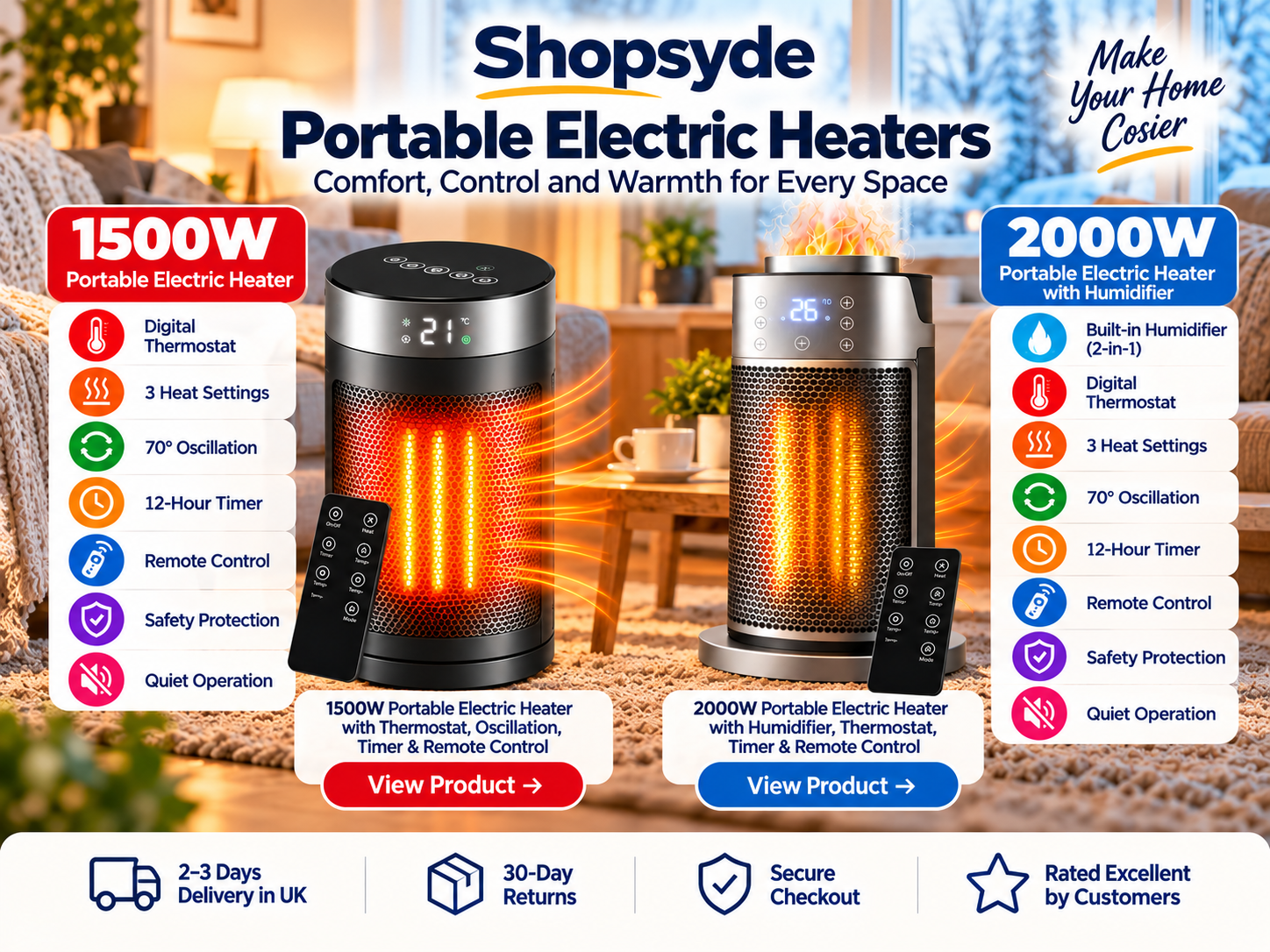
Don't make the decision based only on running cost.
Choose according to the job the heater needs to perform.
A 1500W model provides:
lower maximum power draw + lower maximum heating output
A 2000W model provides:
higher maximum power draw + higher maximum heating output
Consider:
Room requirement → insulation → controls → desired heating output → operating cost
rather than simply:
cheapest hourly figure → buy
Portable Electric Heater Buying Checklist
Before purchasing, check:
| Feature | What to verify |
|---|---|
| Wattage | Maximum rated power |
| Heating technology | Ceramic, fan, convector, etc. |
| Thermostat | Manual or digital |
| Heat settings | Available modes |
| Timer | Supported operating duration |
| Oscillation | Available or not |
| Remote | Included or not |
| Safety features | Exact manufacturer specifications |
| Dimensions | Fits intended location safely |
| Noise | Verified dB specification if important |
| Plug | Suitable UK plug |
| Running cost | Based on your electricity tariff |
| Returns | Retailer's actual return terms |
| Delivery | Availability to your location |
Don't rely solely on marketing phrases such as “energy saving”.
Compare actual specifications.
The Bottom Line
When choosing a portable electric heater UK shoppers should look beyond wattage alone.
Consider:
room requirements
1500W vs 2000W
ceramic heating
thermostat
heat settings
timer
oscillation
running costs
and safety features.
A good buying decision comes from matching the heater's verified specifications to the way you actually intend to use it.
Explore the complete range:
Shopsyde Portable Electric Heaters →