

If you're wondering how to use an electric heater efficiently, the key is not simply choosing the lowest wattage or turning the thermostat down as far as possible.
Efficient use means providing the supplementary warmth you need while avoiding unnecessary heating time and excessive heat loss.
The heater's wattage, thermostat setting, operating time, room insulation, windows, draughts and your electricity tariff can all affect how much electricity you ultimately use.
Portable electric heaters can be useful when you want additional heat in a particular occupied room for a limited period. The goal is to use that heat deliberately rather than leaving the appliance operating unnecessarily.
What Does Efficient Electric Heater Use Actually Mean?
For a portable electric heater, efficiency shouldn't be confused with marketing claims such as:
“Uses almost no electricity”
or:
“Cuts heating costs by 50%.”
For conventional resistance electric heating, electricity consumption is strongly connected to:
Power × operating time
A 2000W heater operating continuously at its full rated heating power uses more electricity per hour than a 1500W heater operating continuously at its full rated power.
However, real-world consumption also depends on how frequently the heating element operates.
A thermostat, lower-power heat mode and sensible operating schedule can affect that operating time.
So practical efficiency is about:
using an appropriate heater, for an appropriate space, for an appropriate amount of time.
Choose the Right Heater Wattage for the Room
Start by considering how much heating the room actually requires.
Common portable heater ratings include:
1000W = 1kW
1500W = 1.5kW
2000W = 2kW
Higher wattage provides greater maximum heating output, but also creates a higher maximum electrical power draw.
Don't automatically choose:
lowest wattage = most efficient
An undersized heater may struggle to provide the warmth you're trying to achieve.
Likewise:
highest wattage = best heater
isn't necessarily true either.
Consider:
room dimensions
ceiling height
insulation
glazing
draughts
outside temperature
existing heating
desired indoor temperature
For a deeper explanation:
What Size Electric Heater Do I Need for My Room? UK Guide
Use the Thermostat Instead of Constant Maximum Heating
A thermostat is one of the most useful controls on a portable electric heater.
Suppose you select 21°C.
Depending on the heater's design, its temperature sensor and control system can monitor conditions and regulate heating as the selected temperature is approached.
A simplified process is:
Set temperature
↓
Heater monitors temperature
↓
Heating operates
↓
Selected temperature is approached
↓
Heating cycles according to the appliance's controls
↓
Heating resumes when required
The important point is that a thermostat doesn't magically reduce the heater's maximum wattage.
Instead, it can affect how long the heating element operates.
For the complete explanation:
How Does a Thermostat Work on an Electric Heater?
Don't Keep Increasing the Thermostat to Heat Faster
Setting an unusually high target temperature doesn't necessarily make a heater produce more than its maximum rated output.
For example, if a heater is already operating at its full 2000W heating output, changing the thermostat target from 21°C to 28°C doesn't turn it into a 3000W heater.
It may simply cause the appliance to continue heating for longer before the selected temperature is approached.
Use a comfortable target rather than automatically selecting the maximum temperature.
This can help avoid unnecessary heating.
Use Lower Heat Settings When They Meet Your Needs
Some portable electric heaters provide multiple heating modes.
If a lower mode genuinely operates at lower electrical power, it will use less electricity per active hour than the maximum-power setting.
For example, at an electricity rate of 26.11p/kWh:
1000W continuous full output ≈ 26.1p/hour
while:
2000W continuous full output ≈ 52.2p/hour
However, only use wattage figures confirmed for the actual heater.
Don't assume that a button labelled “Low” always means 1000W unless the manufacturer states that specification.
The objective is to choose the lowest heat mode that comfortably meets the current heating requirement.
Use a Timer to Control Heater Running Time
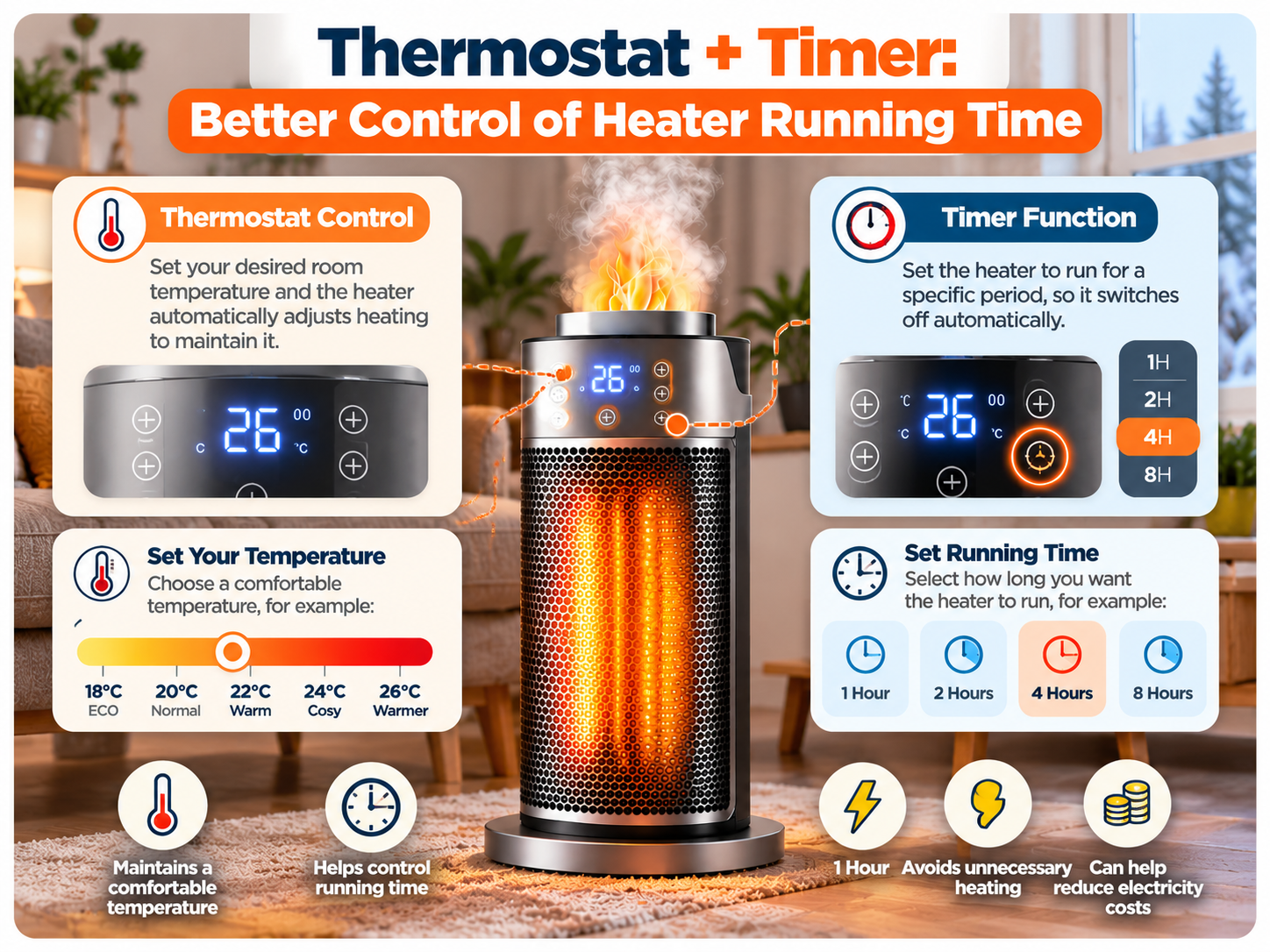
A timer doesn't reduce the price of electricity.
What it can do is help control how long the heater operates.
Imagine you only need supplementary warmth while working at your desk for two hours.
Setting an appropriate operating period can help avoid accidentally leaving the heater running long after you've left the room.
A timer is therefore useful for:
managing heating periods
reducing unnecessary operation
creating more deliberate heating habits
However, a timer is not a replacement for safe supervision.
Portable heaters should still be used according to the manufacturer's safety instructions.
Don't Heat an Empty Room Unnecessarily
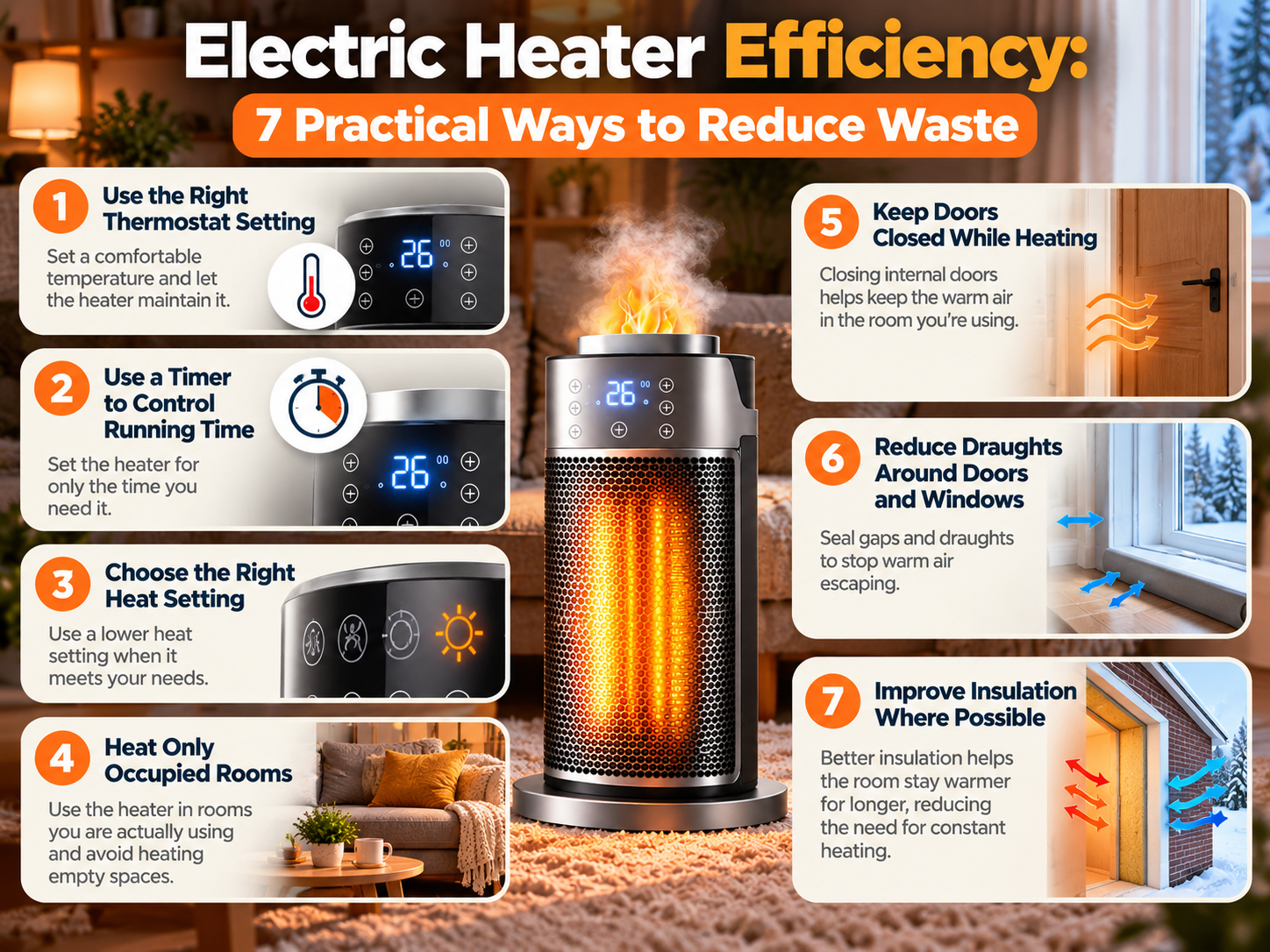
One of the simplest ways to avoid wasted electricity is to avoid supplementary heating where nobody needs it.
If you've finished working in your home office and move to another room, leaving the portable heater running unnecessarily continues to consume electricity.
Use portable heating where it is actually required.
This is one reason portable heaters can be useful as supplementary heating: you can provide additional warmth in a particular occupied area rather than automatically heating every space in the same way.
Close Doors When Heating One Room
If you're intentionally using a portable heater to provide supplementary warmth in one room, allowing that warm air to continuously escape into unused areas can make it harder to maintain the desired temperature.
Where appropriate and safe, closing internal doors can help keep the heated air within the room you're actually using.
However, ventilation requirements still matter.
Don't block required ventilation or ignore building-specific ventilation guidance simply to retain heat.
The objective is to reduce unnecessary heat loss—not to make the room completely airtight.
Reduce Draughts Around Doors and Windows
Draughts allow colder air to enter and warmer air to escape.
Common sources can include:
gaps around doors
poorly sealed windows
unused openings
gaps around frames
Reducing avoidable draughts can help the room retain warmth.
Energy Saving Trust recommends draught-proofing as one way to reduce unwanted heat loss from a home.
This matters because a room losing heat quickly can require more frequent heating to maintain a comfortable temperature.
Improve Insulation Where Practical
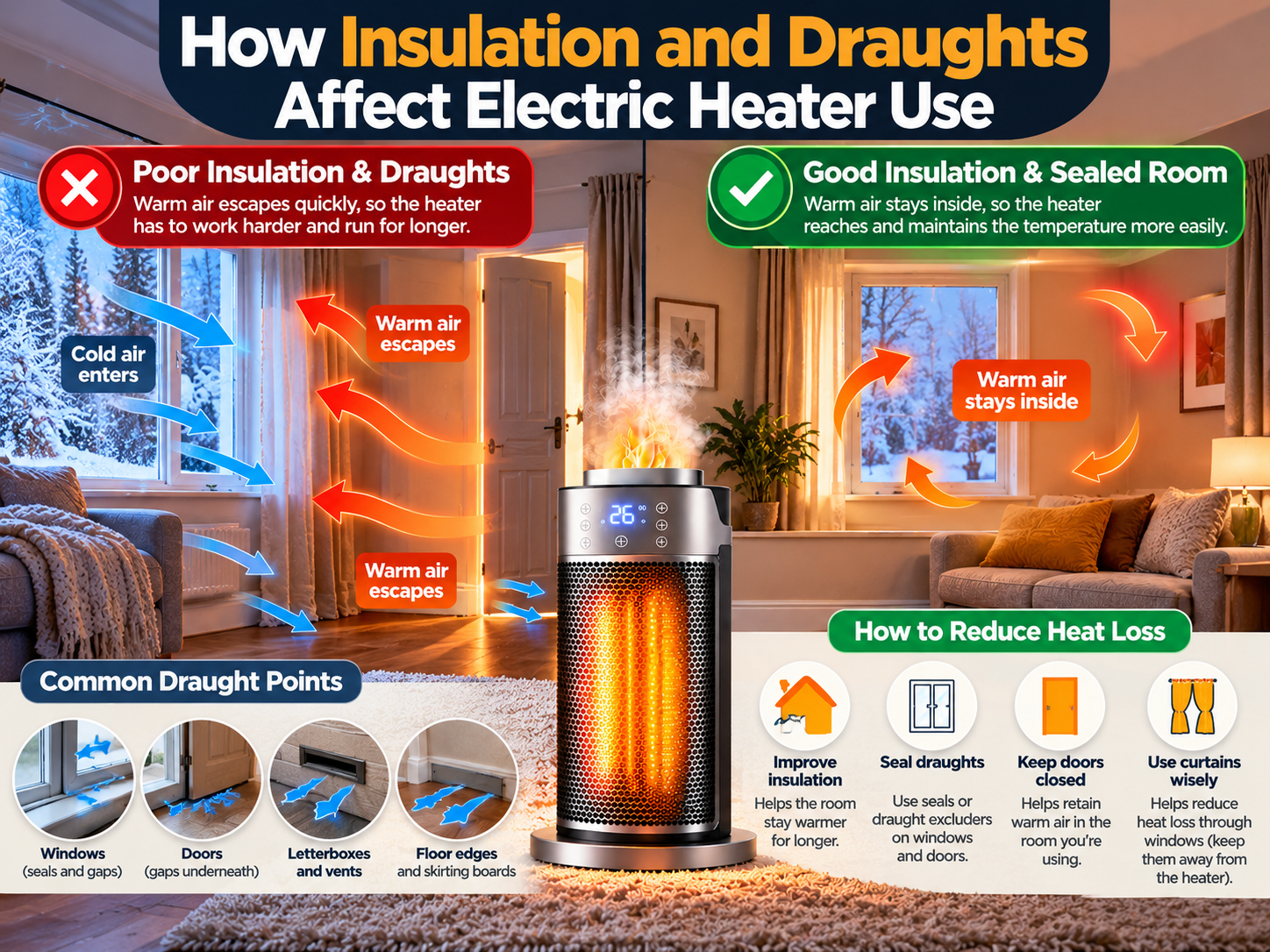
Insulation affects how quickly your home loses heat.
Better heat retention can reduce the amount of replacement heat required.
Relevant areas include:
loft/roof insulation
walls
floors
windows
doors
Energy Saving Trust provides guidance on insulation and reducing heat loss from homes.
A portable heater can't compensate efficiently for unlimited heat loss.
If a room becomes cold again almost immediately after heating stops, improving the building fabric may be more useful than simply running the heater for longer.
Use Curtains Sensibly Without Blocking the Heater
Curtains can help reduce heat loss through windows, particularly during colder periods.
But they must never obstruct or come too close to a portable heater.
Electrical Safety First recommends keeping portable heaters at least one metre away from combustible materials, including curtains, furniture and paper.
So:
Use curtains to help retain room warmth
but:
keep the heater safely away from them.
Never compromise heater clearance for the sake of reducing draughts.
Keep the Heater's Airflow Clear
Fan-assisted and ceramic heaters need unobstructed airflow.
Avoid positioning the heater where vents are blocked by:
furniture
curtains
bedding
clothing
boxes
walls positioned too closely
accumulated dust or fluff
Restricted airflow can interfere with normal heater operation.
Never cover a portable electric heater.
For detailed placement guidance:
Where Should You Place a Portable Electric Heater? UK Safety Guide
Position the Heater Where Warm Air Can Circulate
A heater pushed tightly between furniture may not distribute warm air effectively.
Choose a safe, open position that provides the clearances required by the manufacturer.
If your heater includes oscillation, allowing a clear airflow path can help distribute heated air across the surrounding area rather than continually directing it at one point.
Oscillation itself doesn't make electricity cheaper.
It is primarily an air-distribution and comfort feature.
1500W vs 2000W: Which Uses Less Electricity?
At continuous maximum rated power, a 1500W heater uses less electricity per hour than a 2000W heater.
The calculation is straightforward:
1500W = 1.5kW
2000W = 2kW
Using the Ofgem July–September 2026 average Direct Debit electricity unit rate of 26.11p/kWh:
1500W → approximately 39.2p per continuous full-power hour
2000W → approximately 52.2p per continuous full-power hour
The difference is approximately:
13.1p per continuous full-power hour
But don't conclude that the 1500W model is automatically better.
The 2000W heater provides greater maximum heating output.
For the complete comparison:
1500W vs 2000W Heater: Which Should You Choose?
How Much Does Efficient Electric Heater Use Cost?
There isn't one universal figure because actual usage varies.
Using 26.11p/kWh as an illustrative rate:
| Heater | Full-Power Energy Use | Approx. Cost/Hour |
|---|---|---|
| 500W | 0.5kWh | 13.1p |
| 1000W | 1kWh | 26.1p |
| 1500W | 1.5kWh | 39.2p |
| 2000W | 2kWh | 52.2p |
These figures assume continuous operation at the stated full rated output.
A thermostat may cause the heating element to cycle rather than operate continuously.
Your actual electricity tariff may also differ.
For the complete UK cost breakdown:
Are Electric Heaters Expensive to Run in the UK?
Also link the electricity rate to the official Ofgem electricity unit rates and standing charges page.
Check Your Own Electricity Tariff
Don't assume the Ofgem average rate used in an article is exactly what you pay.
Your actual unit rate can depend on:
tariff
region
payment method
meter
supplier
Check your electricity bill or supplier account for your actual pence-per-kWh rate.
Then calculate:
Heater power in kW × hours of full-power operation × your unit rate
For example, if your actual tariff were 25p/kWh:
1.5kW × £0.25 = £0.375/hour
for continuous full 1500W output.
Using your actual tariff gives you a more meaningful estimate than relying solely on national averages.
Does Ceramic Heating Automatically Use Less Electricity?
No.
This is an important distinction.
If a ceramic heater and another resistance electric heater both continuously draw 1500W for one hour, both consume:
1.5kWh
The ceramic heating element doesn't make electrical energy consumption disappear.
What can differ is:
heating-element design
airflow
thermostat controls
heat settings
fan behaviour
user experience
Real-world consumption can therefore differ between appliances because of controls and usage, not simply because one contains a ceramic element.
Ceramic Heater vs Fan Heater: Which Should You Choose?
Does Oscillation Reduce Electricity Use?
Not inherently.
Oscillation changes the direction of airflow.
Its purpose is to help distribute warm air across a wider surrounding area rather than continually heating toward one fixed direction.
It can improve how warmth is distributed, but it shouldn't be marketed as automatically reducing electricity consumption.
The heater's wattage, operating time and control behaviour remain more important to electricity usage.
Is It More Efficient to Heat One Room?
It depends on what you're comparing.
If you only need supplementary warmth in one occupied room for a short period, using a portable heater there may avoid providing the same additional heat to other unused spaces.
However, this doesn't mean portable electric heating is automatically cheaper than every whole-home heating system.
Electricity can be relatively expensive per unit of heat compared with some other heating methods.
The right comparison depends on:
your main heating system
tariffs
property
room requirements
operating time
temperature settings
Avoid simplistic claims such as:
“A portable heater is always cheaper than central heating.”
That isn't universally true.
Should You Turn an Electric Heater Off When Leaving the Room?
For portable heaters, don't leave them operating unattended.
Electrical Safety First advises never leaving portable heaters unattended and recommends not using them overnight.
So when you no longer require the supplementary heat or leave the area, follow the manufacturer's instructions for switching the heater off.
This is both a safety consideration and a way to avoid unnecessary electricity use.
Can You Leave a Portable Heater Running Overnight?
Portable heaters shouldn't be left operating while you're asleep.
Electrical Safety First advises against overnight portable-heater use and unattended operation.
A:
thermostat
timer
tip-over switch
overheat protection system
doesn't replace safe-use guidance.
Can You Leave an Electric Heater On Overnight?
Don't Use an Extension Lead With a Portable Heater
Electrical Safety First advises against powering portable heaters through extension leads because they can be overloaded.
High-powered appliances such as:
1500W heaters
and
2000W heaters
can draw substantial electrical power.
Follow the electrical instructions supplied with your heater and use an appropriate wall socket.
Trying to position a heater more conveniently isn't worth creating an electrical hazard.
Don't Use an Electric Heater to Dry Clothes
Never place clothing over a portable heater.
Electrical Safety First specifically advises against using portable heaters to dry clothes.
Covering or surrounding the heater with fabric can:
obstruct airflow
contribute to overheating
place combustible material too close to heat
Use appropriate clothes-drying methods instead.
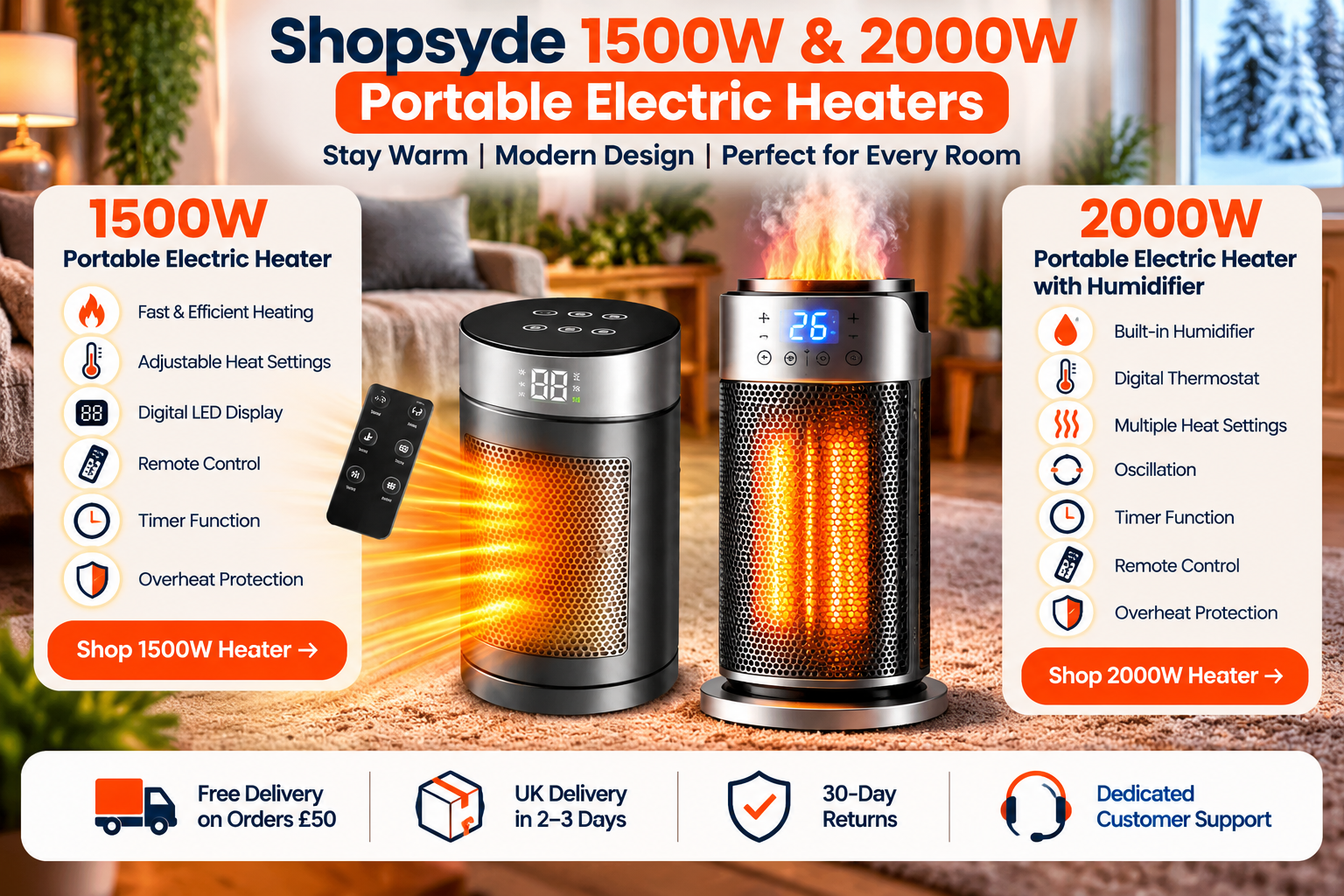
Shopsyde 1500W Portable Electric Heater
For customers looking for supplementary portable heating with a lower maximum power draw than a 2000W model, Shopsyde offers the:
1500W Portable Electric Heater With Thermostat, Oscillation, Timer & Remote Control
Confirmed features include:
up to 1500W heating
ceramic heating
digital thermostat
multiple heat settings
oscillation
timer
remote control
portable freestanding design
At continuous maximum 1500W output and an illustrative 26.11p/kWh electricity rate:
1.5kW × £0.2611 ≈ £0.392/hour
or approximately 39.2p per hour.
View the Shopsyde 1500W Portable Electric Heater
Shopsyde 2000W Portable Electric Heater
For customers wanting greater maximum heating output, Shopsyde offers the:
2000W Portable Electric Heater With Humidifier, Thermostat, Timer & Remote Control
Confirmed features include:
up to 2000W heating
thermostat control
timer
remote operation
humidifier functionality
portable design
At continuous maximum 2000W output using the same illustrative rate:
2kW × £0.2611 ≈ £0.522/hour
or approximately 52.2p per hour.
View the Shopsyde 2000W Portable Electric Heater
You can also:
Browse Shopsyde Portable Electric Heaters
Practical Electric Heater Efficiency Checklist
Before and during use, check:
| Action | Why it matters |
|---|---|
| Choose suitable wattage | Match output to heating requirement |
| Use thermostat | Helps regulate heating according to temperature |
| Use appropriate heat mode | Avoid unnecessary maximum output |
| Use timer where useful | Helps control operating duration |
| Reduce draughts | Helps retain warm air |
| Improve insulation | Reduces heat loss |
| Close appropriate internal doors | Helps retain heat in occupied space |
| Keep airflow clear | Supports normal heater operation |
| Use safe placement | Keeps heater away from combustible materials |
| Check electricity tariff | Gives more accurate running-cost calculations |
| Turn off when not needed | Avoids unnecessary operation |
| Follow manufacturer instructions | Product-specific guidance takes priority |
The Bottom Line
Understanding how to use an electric heater efficiently is mostly about controlling how much heat you request, how long the heater operates and how quickly the room loses that heat.
Focus on:
appropriate heater wattage
sensible thermostat settings
useful heat modes
controlled operating time
reduced draughts
better insulation
safe heater placement
and switching the heater off when it isn't required.
Don't rely on claims that ceramic technology, a timer or thermostat automatically produces huge electricity savings.
Instead, make deliberate choices based on your room and actual heating needs.
For supplementary portable heating: