Compare 1500W vs 2000W heaters to understand their running costs, electricity usage and key differences. See how much each heater costs to run in the UK and what to consider when choosing the right electric heater for your home.
Choosing between a 1500W vs 2000W heater isn't simply a question of which one produces more heat. Electricity consumption, room conditions, thermostat settings and how long you actually use the heater can all affect the final running cost.
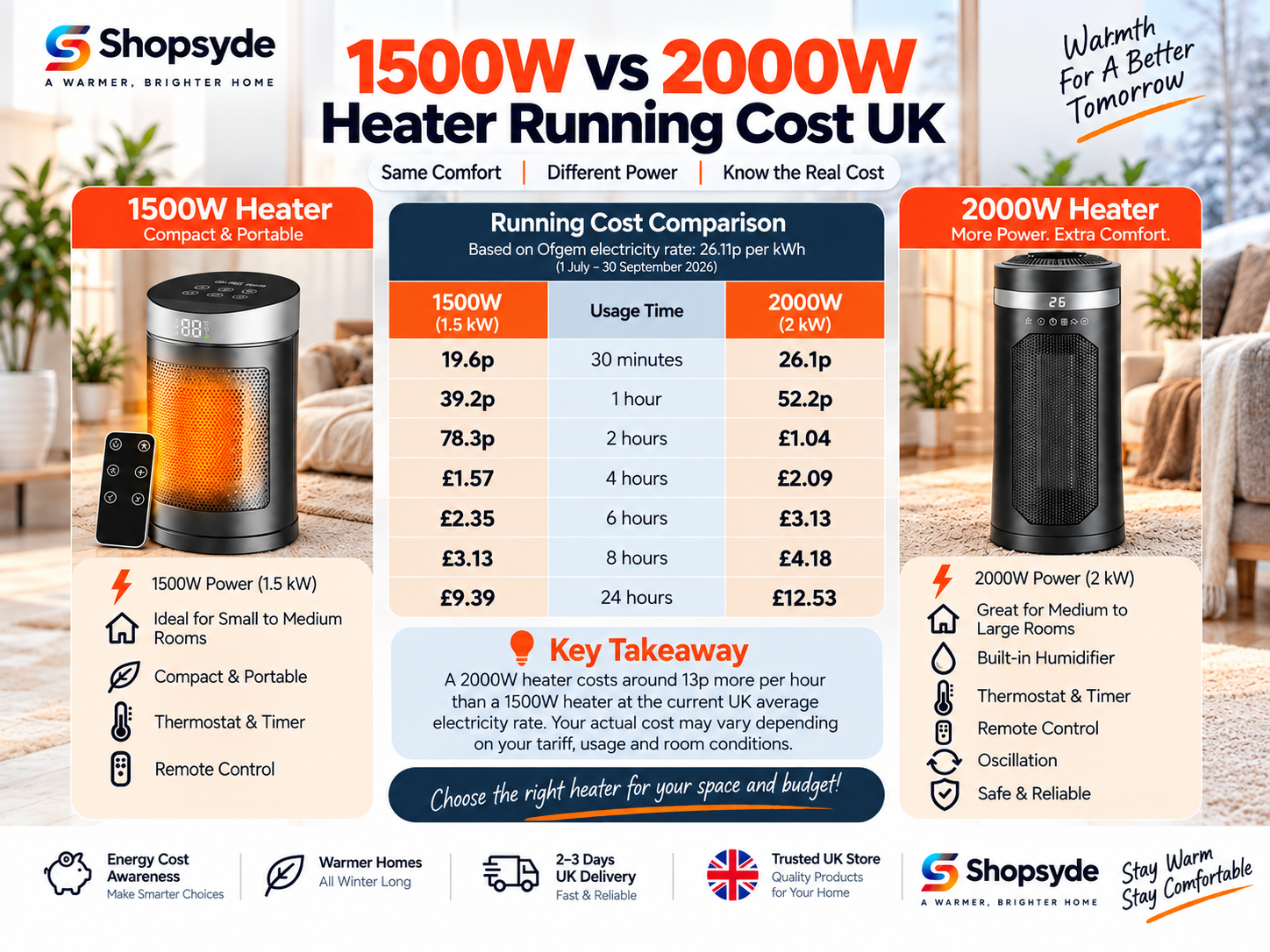
Using Ofgem's average electricity unit rate of 26.11p per kWh for Direct Debit customers on default tariffs from 1 July to 30 September 2026, a 1500W heater costs approximately 39.2p per continuous hour at full power, while a 2000W heater costs approximately 52.2p per hour.
That makes the 2000W model approximately 13p more per continuous full-power hour under this example.
But that doesn't automatically mean a 1500W heater is the right choice for everyone.
1500W vs 2000W Heater Running Cost at a Glance
A heater's wattage tells us its rated electrical power.
These figures assume continuous operation at the heater's full rated output.
Real-world electricity consumption may differ when thermostatic controls cycle the heating element on and off.
How Much Does a 1500W Heater Cost to Run?
At full output, a 1500W heater consumes:
1.5kWh for every continuous hour of full-power operation
Using 26.11p/kWh:
1.5 × £0.2611 = £0.39165
That's approximately:
39.2p per hour
Four continuous hours would therefore cost approximately £1.57.
For a deeper breakdown covering hourly, daily and monthly costs, read our guide to how much a 1500W electric heater costs to run in the UK.
How Much Does a 2000W Heater Cost to Run in the UK?
A 2000W heater has a rated power of 2kW.
At the same 26.11p/kWh electricity rate:
2 × £0.2611 = £0.5222
That's approximately:
52.2p per continuous hour at full 2000W output
Two hours would cost approximately £1.04, while four continuous hours at maximum rated output would cost approximately £2.09.
Your actual electricity rate may differ depending on region, tariff, meter and payment method. Ofgem specifically notes that actual rates vary according to these factors.
Is a 1500W Heater Cheaper to Run Than a 2000W Heater?
At continuous maximum output and for the same length of time, yes.
At 26.11p/kWh:
1500W → approximately 39.2p/hour
2000W → approximately 52.2p/hour
Difference:
approximately 13.1p/hour
But this needs context.
A heater's rated wattage tells you its maximum electrical power draw. It doesn't tell you exactly how long the heating element will operate during every real-world session.
A thermostatically controlled heater may cycle its heating element after reaching the selected temperature.
Room size, insulation, heat loss, outside temperature, thermostat setting and heater design can therefore influence actual electricity consumption.
Does a 2000W Heater Heat a Room Faster?
A 2000W heater has a higher rated heating output than a 1500W heater, so it can deliver more heat while operating at maximum power.
However, you shouldn't assume that it will always warm every room a particular percentage faster.
Real-world heating performance depends on factors such as:
room dimensions
insulation
ceiling height
windows and glazing
outside temperature
starting room temperature
air circulation
heater placement
This is why choosing purely on running cost can be misleading.
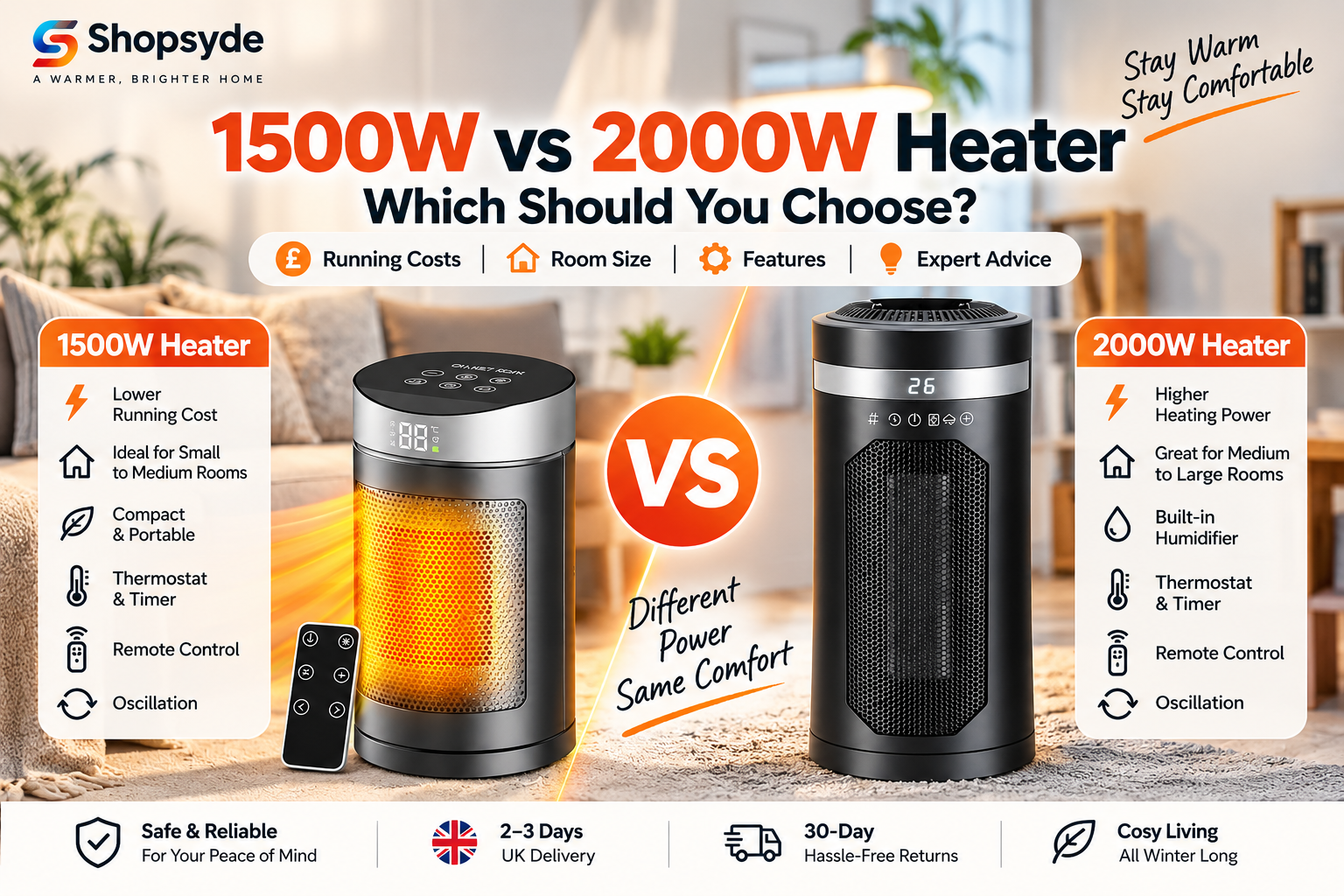
1500W or 2000W Heater: Which Should You Choose?
There's no universal winner.
A 1500W portable heater may suit someone who wants a compact supplementary heater with lower maximum electricity consumption.
A 2000W heater provides a higher maximum heating output and may be preferable where greater heat output is required.
Rather than simply choosing the lowest wattage, consider how and where you intend to use the heater.
Consider a 1500W heater if:
You want a lower maximum power draw, portable supplementary heating and convenient controls such as a thermostat, timer, oscillation and remote control.
Consider a 2000W heater if:
You want higher maximum heating output and features available on the particular model suit your needs.
Your Shopsyde 2000W model also combines ceramic heating with a humidifier function, giving it a different use case from a standard portable heater.
What Is a Ceramic Heater?
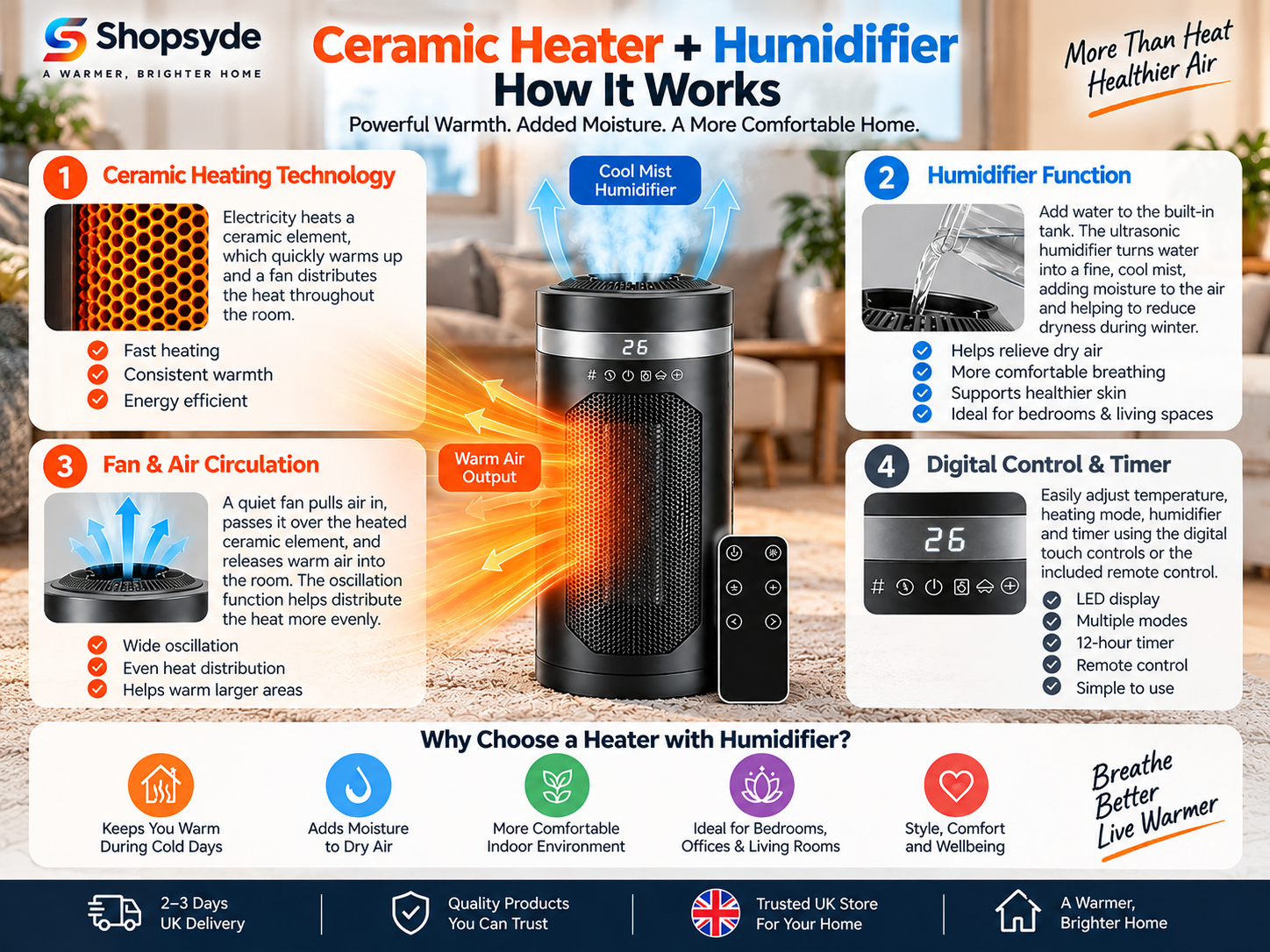
Ceramic heaters use a ceramic heating element together with airflow to distribute heated air.
Your Shopsyde 2000W Ceramic Tower Heater with Humidifier combines heating with oscillation, timer, remote control and humidification.
The important point is that ceramic doesn't make electricity magically cheaper.
Running cost is primarily determined by electricity consumption, your electricity tariff and how long the heating element operates.
A 2000W heater continuously drawing its full 2000W still consumes approximately 2kWh per hour, regardless of marketing terminology around efficiency.
What Does the Humidifier Function Do?
Indoor air can feel dry during colder periods, particularly when heating is being used.
A heater with an integrated humidifier combines two functions in one appliance: heating and adding moisture to the surrounding air according to the appliance's humidification design.
That can be convenient for customers who would otherwise use separate heating and humidification appliances.
However, the humidifier shouldn't be presented as reducing the heater's electricity consumption unless there is reliable product-specific evidence demonstrating that.
This distinction is important for both customers and accurate SEO content.
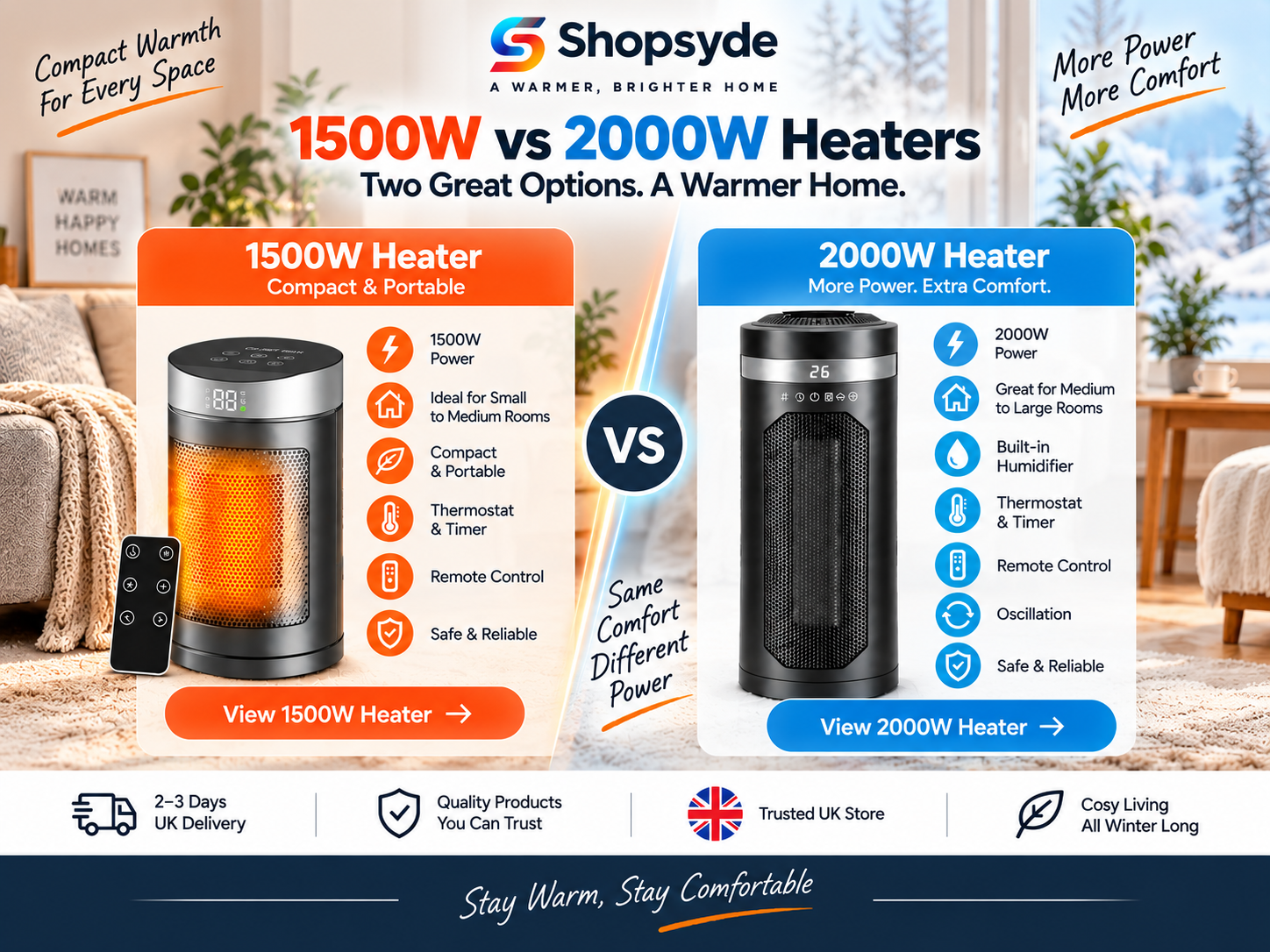
Compare Shopsyde's 1500W and 2000W Heaters
Feature
1500W Portable Heater
2000W Ceramic Tower Heater
Maximum heating power
1500W
2000W
Approx. full-power hourly cost*
39.2p
52.2p
Thermostat
Yes
Use actual product data
Oscillation
Yes
Yes
Timer
Yes
Yes
Remote control
Yes
Yes
Ceramic heating
Yes
Yes
Humidifier
No
Yes
Portable design
Yes
Yes
*Based on 26.11p/kWh and continuous operation at full rated output. Actual costs vary.
Before publishing, replace “Use actual product data” with the confirmed thermostat specification from your 2000W product record.
Shopsyde 1500W Portable Electric Heater
If you want a compact portable option with a lower maximum power draw, consider the Shopsyde 1500W Portable Electric Heater with Thermostat & Remote Control.
It includes:
1500W heating Digital thermostat Oscillation Timer Remote control Ceramic heating
Ofgem has already published the electricity rate for the next price-cap period.
From 1 October to 31 December 2026, the average electricity unit rate for Direct Debit customers on default tariffs will be 26.32p/kWh, compared with 26.11p/kWh for July–September.
At 26.32p/kWh:
1500W heater
1.5 × £0.2632 = 39.5p/hour
2000W heater
2 × £0.2632 = 52.6p/hour
So the comparison remains broadly similar, but this article should be updated whenever the applicable Ofgem rate changes.
Portable Heater Safety
Whichever wattage you choose, safe use matters more than saving a few pence.
Electrical Safety First advises placing portable heaters on a level surface, keeping them at least one metre from combustible materials, avoiding extension leads, and not leaving heaters unattended or operating while you're asleep.
Always follow the instructions supplied with your particular heater.
1500W vs 2000W Heater: The Bottom Line
For continuous operation at maximum rated output using the current 26.11p/kWh Ofgem example rate:
1500W heater ≈ 39.2p/hour
2000W heater ≈ 52.2p/hour
So the 1500W heater uses less electricity during the same period of full-power operation.
But lower wattage doesn't automatically mean better.
The 2000W option provides higher maximum heating output, while your Shopsyde model also offers an integrated humidifier. The right choice depends on the space, heating requirement, desired features and how you plan to use the appliance.
Ofgem reviews the energy price cap every three months, and actual household unit rates vary by region, payment method, tariff and meter type.
FAQS
Frequently Asked Questions
1Is a 1500W heater cheaper to run than a 2000W heater?
At the same electricity tariff and with both heaters operating continuously at maximum rated power, yes. Using 26.11p/kWh, a 1500W heater costs approximately 39.2p/hour, compared with approximately 52.2p/hour for a 2000W heater.
2How much electricity does a 2000W heater use per hour?
A 2000W heater operating continuously at its full rated output uses 2kWh during one hour.
3How much electricity does a 1500W heater use per hour?
At continuous full output, a 1500W heater uses 1.5kWh per hour.
4Is 2000W better than 1500W?
Neither wattage is universally better. A 2000W heater provides a higher maximum heating output, while a 1500W heater has a lower maximum electricity draw. The better choice depends on your heating requirements, room conditions and desired features.
5Does a thermostat make an electric heater cheaper to run?
A thermostat controls heating according to the selected temperature. If the heating element cycles rather than operating continuously, actual electricity consumption can be lower than a calculation that assumes maximum power for the entire period. The exact consumption depends on the heater and conditions.
6Is a ceramic heater cheaper to run than another 2000W electric heater?
Not simply because it uses ceramic heating. Two heaters continuously drawing 2000W consume the same 2kWh per hour at full rated power. Real-world consumption can differ because of controls, thermostatic cycling and usage.
7Can I leave a portable heater running overnight?
Electrical Safety First recommends not using a portable heater overnight and says portable heaters shouldn't be left unattended while operating.