

Are electric heaters expensive to run? The answer depends mainly on the heater's wattage, your electricity unit rate, how long the heating element operates and how you're using the heater.
Portable electric heaters can be relatively expensive if they're operated at high power for long periods. Energy Saving Trust notes that secondary electric heaters can be expensive to run because standard-rate electricity costs more per unit of heat than several common main-heating alternatives. However, portable heaters can still be useful when you only want to warm one room for a short period or need extra heat during a cold spell. (Energy Saving Trust)
For UK households, the simplest way to understand the cost is to calculate it from the heater's kilowatt (kW) rating × hours used × your electricity price per kWh.
Let's work through the numbers.
How Much Does Electricity Cost in the UK in 2026?
For 1 July to 30 September 2026, Ofgem lists an average electricity unit rate of 26.11p per kWh for Direct Debit customers on default tariffs, averaged across England, Scotland and Wales. The actual rate you pay varies according to factors including your region, tariff, meter and payment method. (Ofgem)
From 1 October to 31 December 2026, Ofgem's corresponding average electricity rate will be 26.32p per kWh. (Ofgem)
Because this article is being published in September 2026, we'll use the current 26.11p/kWh rate for the main examples.
Important: Check your own electricity bill or tariff for your actual unit rate. The Ofgem figure is an average, not a universal price.
How Do You Calculate Electric Heater Running Cost?
The calculation is straightforward:
Heater wattage ÷ 1,000 = heater power in kW
Then:
Power in kW × hours used × electricity unit rate = estimated electricity cost
For example, a 1500W heater is:
1500 ÷ 1000 = 1.5kW
At 26.11p/kWh:
1.5 × £0.2611 = £0.39165
So a 1500W heater continuously drawing its full rated 1500W for one hour would cost approximately:
39.2p per hour
This is a full-power calculation. A thermostatically controlled heater may not continuously draw its maximum heating power throughout the entire period.
Electric Heater Running Cost Per Hour UK
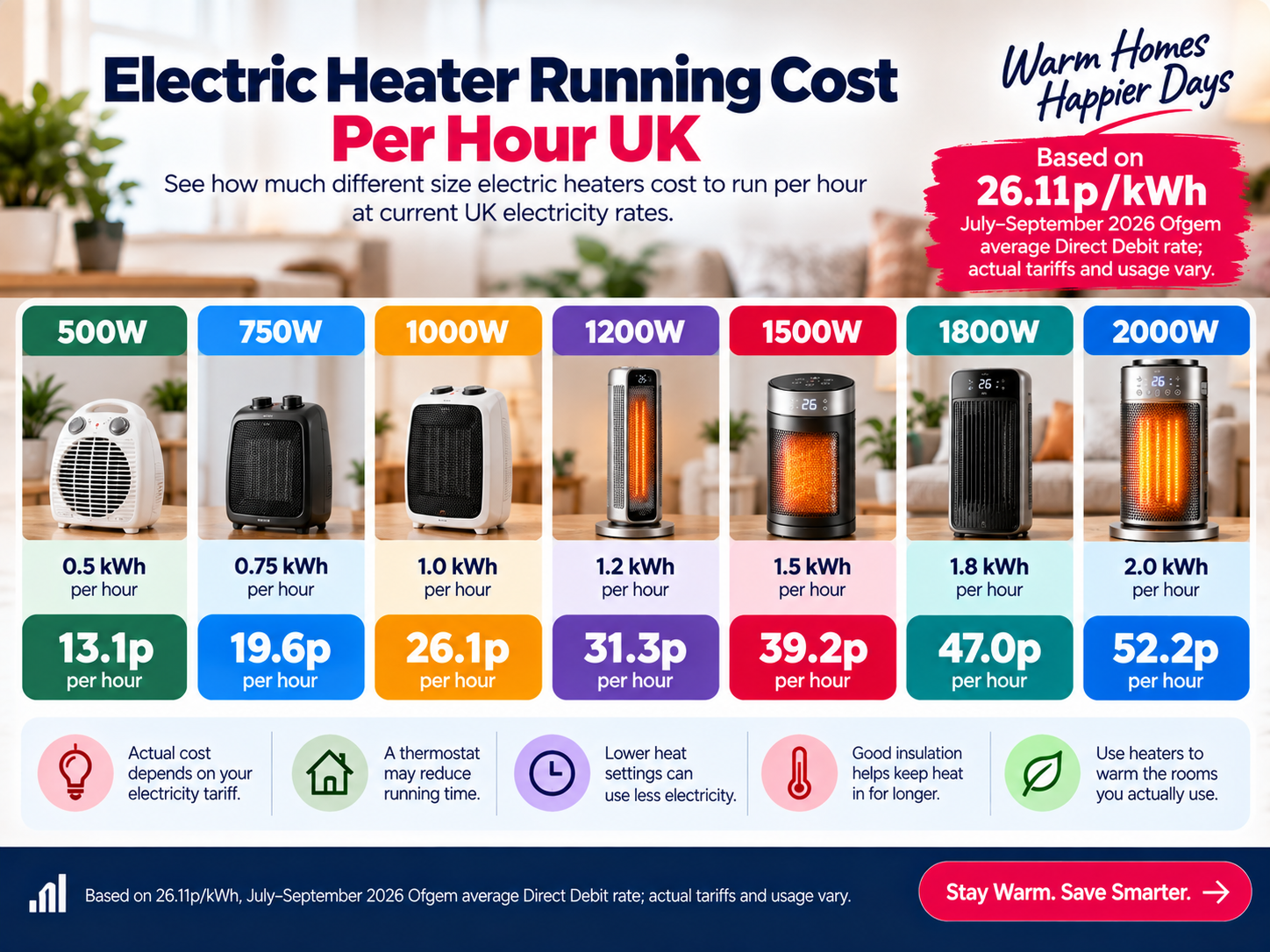
Using Ofgem's current July–September 2026 average Direct Debit electricity rate of 26.11p/kWh, the approximate full-power costs are:
| Heater Power | Electricity Used Per Hour | Approx. Cost Per Hour |
|---|---|---|
| 500W | 0.5kWh | 13.1p |
| 750W | 0.75kWh | 19.6p |
| 1000W | 1kWh | 26.1p |
| 1200W | 1.2kWh | 31.3p |
| 1500W | 1.5kWh | 39.2p |
| 1800W | 1.8kWh | 47.0p |
| 2000W | 2kWh | 52.2p |
These calculations assume the heating element continuously operates at the stated rated power for the full hour.
Actual consumption may differ.
How Much Does a 1500W Electric Heater Cost to Run?
At the current illustrative rate of 26.11p/kWh, a 1500W heater operating continuously at its full rated output uses 1.5kWh per hour.
That works out at approximately:
| Usage | Approx. Cost |
|---|---|
| 30 minutes | 19.6p |
| 1 hour | 39.2p |
| 2 hours | 78.3p |
| 4 hours | £1.57 |
| 8 hours | £3.13ds |
How Much Does a 1500W Electric Heater Cost to Run in the UK?
1500W Portable Electric Heater With Thermostat & Remote Control
How Much Does a 2000W Electric Heater Cost to Run?
A 2000W heater has a maximum rated power of:
2000W = 2kW
At 26.11p/kWh:
2 × £0.2611 = £0.5222
So continuous operation at full 2000W output would cost approximately:
52.2p per hour
Approximate examples:
| Usage | Approx. Cost |
|---|---|
| 30 minutes | 26.1p |
| 1 hour | 52.2p |
| 2 hours | £1.04 |
| 4 hours | £2.09 |
| 8 hours | £4.18 |
This section is particularly important because Google has already begun showing Shopsyde for searches related to 2000W heater cost per hour.
How Much Does an Electric Heater Cost Per Day?
There isn't one universal daily cost because it depends on wattage and operating time.
For example, using a heater continuously at maximum rated power for 4 hours per day at 26.11p/kWh would give approximately:
| Heater | 4 Hours Per Day | 7 Days |
|---|---|---|
| 500W | £0.52 | £3.66 |
| 1000W | £1.04 | £7.31 |
| 1500W | £1.57 | £10.97 |
| 2000W | £2.09 | £14.62 |
Again, these calculations assume continuous full-power operation.
A thermostatically controlled heater may cycle its heating element rather than remaining at maximum output continuously.
Are Electric Heaters Expensive to Run Compared With Other Heating?
Electric resistance heating can be relatively expensive for sustained heating because standard-rate electricity is costly compared with several common alternatives.
Energy Saving Trust currently states that electricity is around four times more expensive than gas per unit and notes that direct electric heating typically has high running costs, despite being relatively straightforward and inexpensive to install. (Energy Saving Trust)
However, the comparison needs context.
A portable electric heater can allow you to heat one occupied room rather than necessarily heating an entire property.
Energy Saving Trust specifically notes that secondary electric heating can be useful when you want to warm one room for a little while or need additional heat during a cold spell. (Energy Saving Trust)
So the relevant question isn't always:
“Is electricity cheaper than gas?”
It can also be:
“What space am I actually trying to heat, and for how long?”
Does a 2000W Heater Always Cost 52p Per Hour?
No.
52.2p/hour is the theoretical cost if the heater continuously draws its full 2000W heating power for the entire hour at an electricity rate of 26.11p/kWh.
Real-world consumption can differ because of:
thermostat cycling
lower heat settings
room temperature
insulation
heat loss
selected temperature
heater control behaviour
how long the heating element actually operates
That's why you shouldn't simply multiply the maximum wattage by every hour the appliance is switched on and assume that is always the exact electricity consumed.
Does a Thermostat Make an Electric Heater Cheaper to Run?
A thermostat doesn't change the maximum rated power of the heater.
A 2000W heater remains a 2000W heater when its heating element is operating at full rated output.
What a thermostat can do is regulate heating according to the selected temperature and the way the particular appliance operates.
Once the room reaches or approaches the selected temperature, a thermostatically controlled heater may cycle the heating element rather than running continuously.
That can reduce actual energy consumption compared with a scenario where the heating element runs continuously at full output.
However, don't claim a fixed percentage saving such as:
“A thermostat saves 30% electricity.”
Actual consumption depends heavily on the room and usage conditions.
Do Lower Heat Settings Cost Less?
If a heater genuinely draws less electrical power on a lower heat setting, then operating at that lower power uses less electricity per hour while the heating element is active.
For example:
1000W = 1kW
At 26.11p/kWh:
1 × 26.11p = 26.11p/hour
Compared with:
2000W = 2kW
2 × 26.11p = 52.22p/hour
But always check the actual specifications of the heater.
Don't assume the wattage of individual heat modes unless the manufacturer confirms them.
Does a Timer Reduce Electric Heater Running Costs?
A timer doesn't make electricity itself cheaper.
What it can do is help control how long the heater operates.
For example, avoiding an unnecessary extra hour at continuous full 2000W output could theoretically avoid approximately 52.2p of electricity use at the current illustrative rate.
A timer is therefore primarily a usage-control feature, rather than an energy-efficiency technology by itself.
Does Insulation Affect Electric Heater Running Costs?
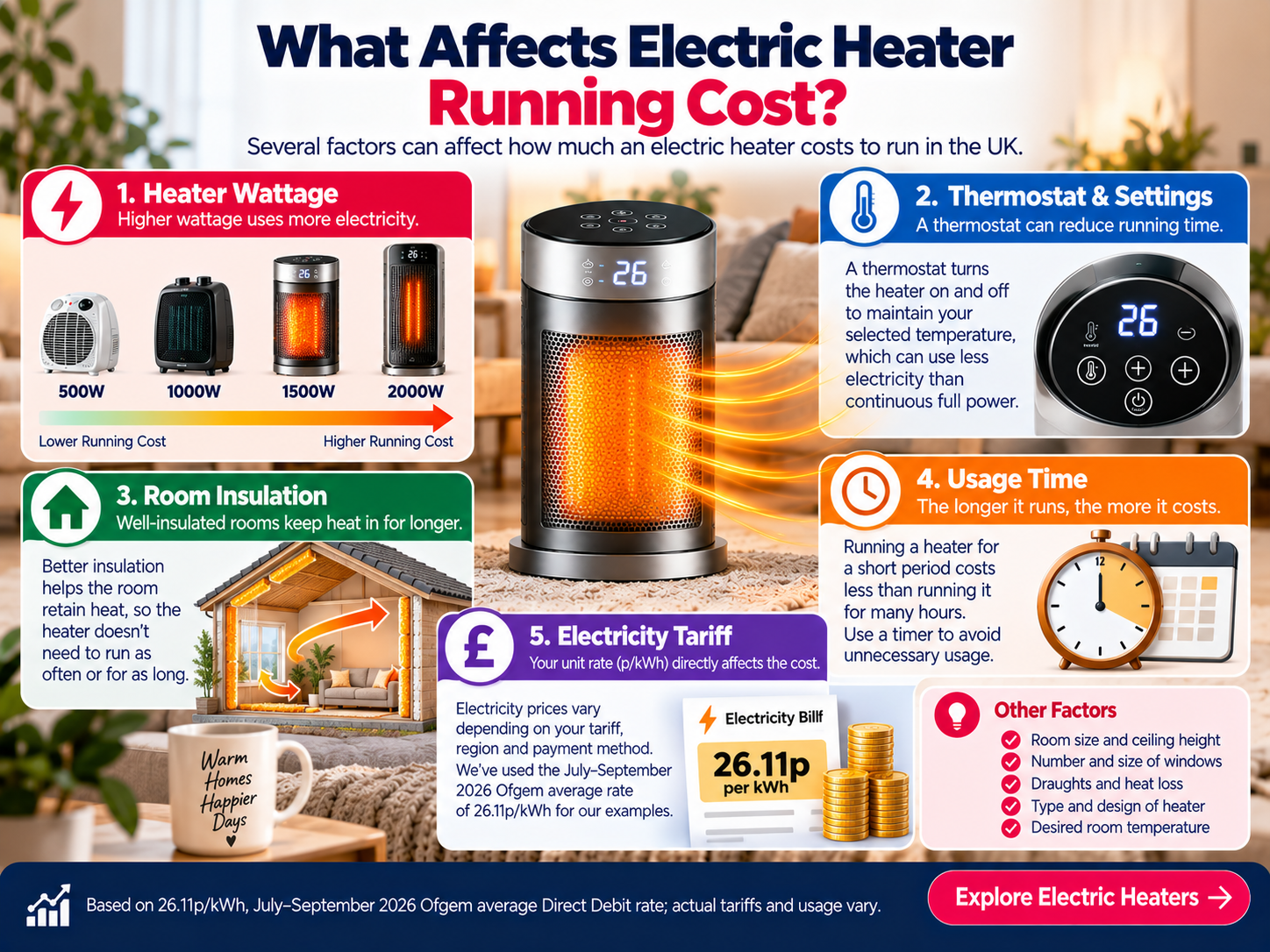
Yes, indirectly.
A poorly insulated room loses heat faster than a well-insulated room.
That can mean a heater needs to operate for longer or cycle more frequently to maintain the desired temperature.
Energy Saving Trust notes that an insulated home with well-controlled heating can help reduce heating bills regardless of the heating system used. (Energy Saving Trust)
Important factors include:
wall insulation
loft/roof insulation
glazing
draughts
doors
ceiling height
room volume
What Size Electric Heater Do I Need for My Room? UK Guide
Is a 1500W Heater Cheaper to Run Than a 2000W Heater?
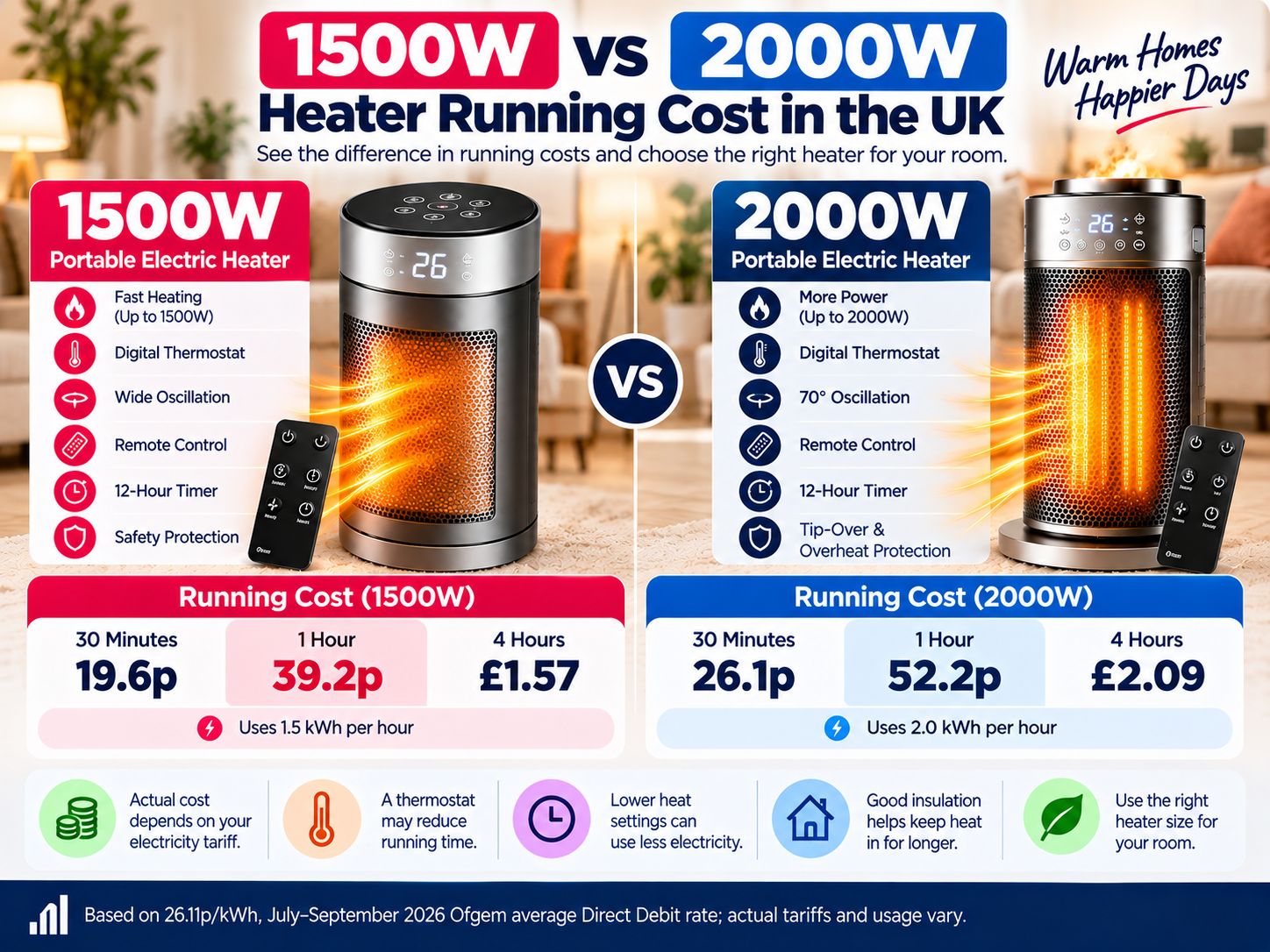
At continuous maximum rated power, yes.
Using 26.11p/kWh:
1500W → approximately 39.2p/hour
2000W → approximately 52.2p/hour
Difference:
approximately 13.1p per continuous full-power hour
However, that doesn't automatically make the 1500W heater the better choice.
A 2000W heater provides greater maximum heating output.
The appropriate choice depends on:
room conditions
heating requirement
insulation
usage duration
desired temperature
heater controls
Is a Smaller Electric Heater Always Cheaper?
Per hour at maximum output, a lower-wattage heater generally draws less electricity.
But choosing an undersized heater simply to reduce wattage isn't necessarily the best strategy.
If a lower-powered heater needs to operate for considerably longer to provide the warmth you want, comparing only the hourly maximum cost doesn't give the full picture.
Choose a heater according to the actual heating requirement, not simply the smallest wattage available.
How Can You Reduce Electric Heater Running Costs?
There isn't a magic setting that makes resistance heating free or dramatically changes the cost of electricity.
But you can avoid unnecessary consumption.
Heat the Space You Actually Use
Portable heaters can make sense as supplementary heating when you only need additional warmth in one occupied room for a limited period. Energy Saving Trust specifically identifies this as a potential use for secondary electric heating. (Energy Saving Trust)
Use the Thermostat Appropriately
Choose a comfortable temperature rather than automatically selecting the highest setting.
Use Lower Heat Settings Where Appropriate
If the heater supports genuinely lower-power modes and those modes provide enough warmth, they can reduce active power consumption.
Reduce Draughts and Heat Loss
Improving insulation and draught-proofing can help the room retain heat.
Don't Heat an Empty Room Unnecessarily
Switch the heater off when supplementary heating isn't required.
Compare Your Electricity Tariff
Your actual electricity rate may differ substantially from the Ofgem average used in this guide.
Should You Buy an Electric Heater Just Because It Says “Energy Efficient”?
Be careful with broad marketing claims.
For conventional resistance electric heaters, wattage and actual operating time are important when calculating electricity consumption.
Claims such as:
“50% cheaper to run”
“uses almost no electricity”
or
“cuts heating bills in half”
should not be accepted without reliable evidence and a clear basis for comparison.
Instead, look at:
rated wattage
heat settings
thermostat
timer
room conditions
actual electricity tariff
how long you intend to operate it
Those factors provide a much more useful picture.
Shopsyde 1500W Portable Electric Heater
For supplementary heating, Shopsyde offers a 1500W Portable Electric Heater With Thermostat & Remote Control.
Confirmed features include:
up to 1500W heating
digital thermostat
ceramic heating
multiple heat settings
oscillation
timer
remote control
portable design
At continuous maximum output and the current illustrative electricity rate, 1500W corresponds to approximately 39.2p/hour.
View the Shopsyde 1500W Portable Electric Heater →
Shopsyde 2000W Portable Electric Heaters
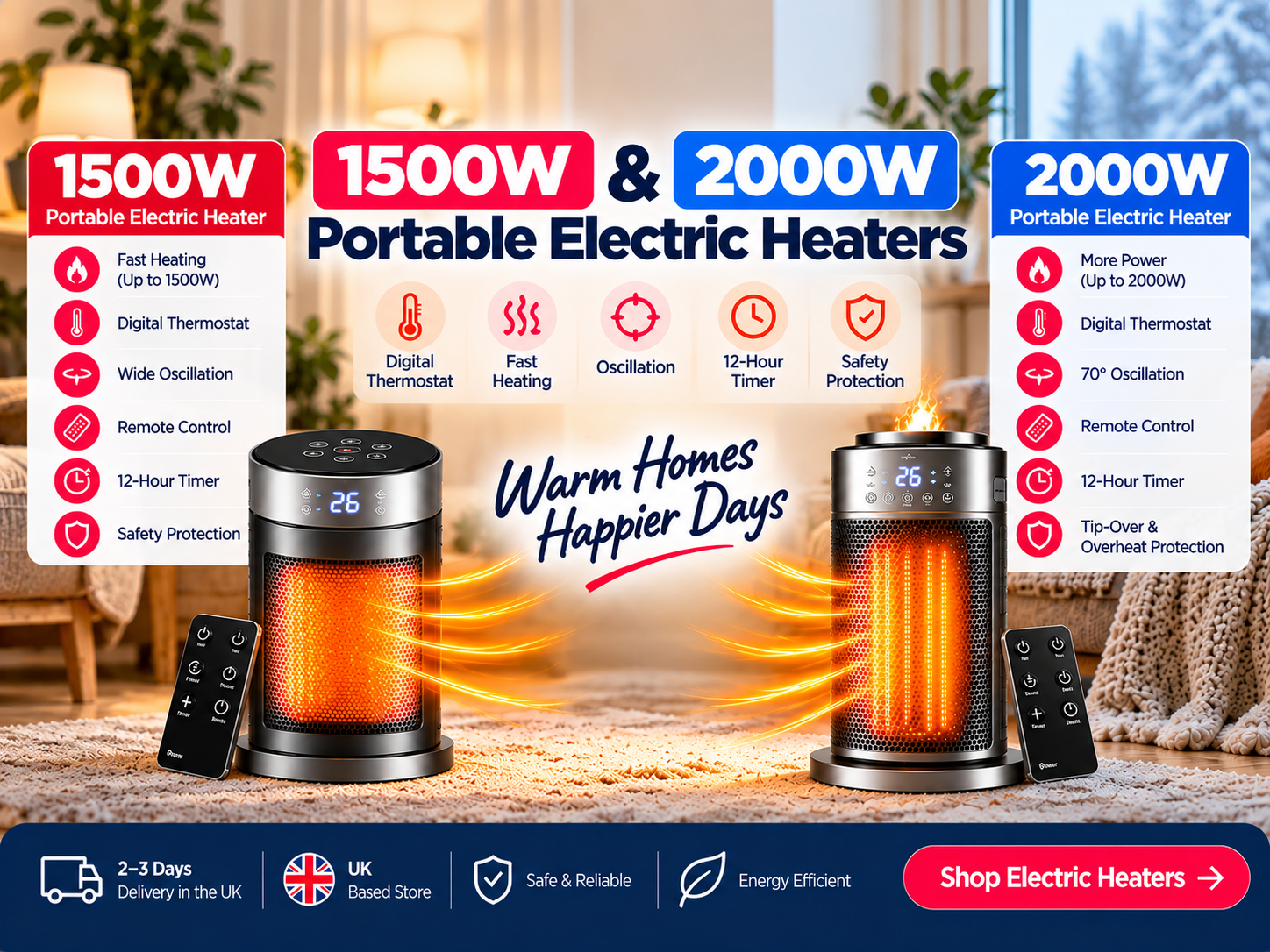
For customers wanting greater maximum heating output, Shopsyde also offers 2000W portable electric heaters.
Your range includes models with features such as:
up to 2000W heating
thermostat controls
timers
oscillation
remote operation
humidification on selected models
At continuous full 2000W output and 26.11p/kWh, the theoretical cost is approximately 52.2p/hour.
One relevant product is:
2000W Portable Electric Heater With Humidifier, Thermostat, Timer & Remote Control
Browse Shopsyde Portable Electric Heaters →
Electric Heater Safety Still Matters
Trying to reduce heating costs should never involve unsafe use.
Electrical Safety First recommends keeping portable heaters on a level surface and at least one metre away from combustible materials such as furniture, curtains and paper. It also advises against powering portable heaters through extension leads and recommends never leaving them unattended or operating while you're asleep. (Electrical Safety First)
Don't:
cover a heater
dry clothing directly on it
position it against curtains
plug it into an extension lead
leave it unattended
operate it while asleep
Always follow the instructions supplied with your particular appliance.
The Bottom Line
So, are electric heaters expensive to run?
They can be relatively expensive when used continuously at high power because standard-rate electricity is comparatively costly. But portable heaters can still be practical when used for supplementary heating in one occupied room for a limited period. (Energy Saving Trust)
At the current Ofgem July–September 2026 average Direct Debit electricity rate of 26.11p/kWh, continuous maximum-output operation works out at approximately:
500W → 13.1p/hour
1000W → 26.1p/hour
1500W → 39.2p/hour
2000W → 52.2p/hour
Your actual cost depends on your tariff and how the heater operates.
Rather than choosing solely based on the lowest wattage, consider your room size, insulation, heat loss, thermostat controls and actual heating requirement.