

If you're wondering how many watts does an electric heater use, the answer depends on the type and model. Portable electric heaters are available at different power ratings, with 1000W, 1500W and 2000W being common examples.
Understanding wattage is useful because it tells you the heater's rated electrical power. From this, you can estimate how much electricity the heater could consume at full output and approximately how much it could cost to operate.
For example, a 1500W heater running continuously at its full rated output for one hour would use approximately 1.5kWh of electricity, while a 2000W heater at continuous full output would use approximately 2kWh.
However, actual energy consumption can differ because of heat settings, thermostat cycling, operating time and how you use the heater.
What Does Wattage Mean on an Electric Heater?
Watts measure electrical power.
When you see a portable heater advertised as 1500W or 2000W, that figure indicates its rated electrical power at the relevant maximum heating mode.
The basic conversions are:
500W = 0.5kW
1000W = 1kW
1500W = 1.5kW
2000W = 2kW
This matters because electricity bills are generally based on energy consumption measured in kilowatt-hours (kWh).
You can estimate electricity use with:
Power in kW × operating time in hours = energy use in kWh
For example:
1.5kW × 1 hour = 1.5kWh
or:
2kW × 1 hour = 2kWh
How Many Watts Does an Electric Heater Use at Different Power Levels?
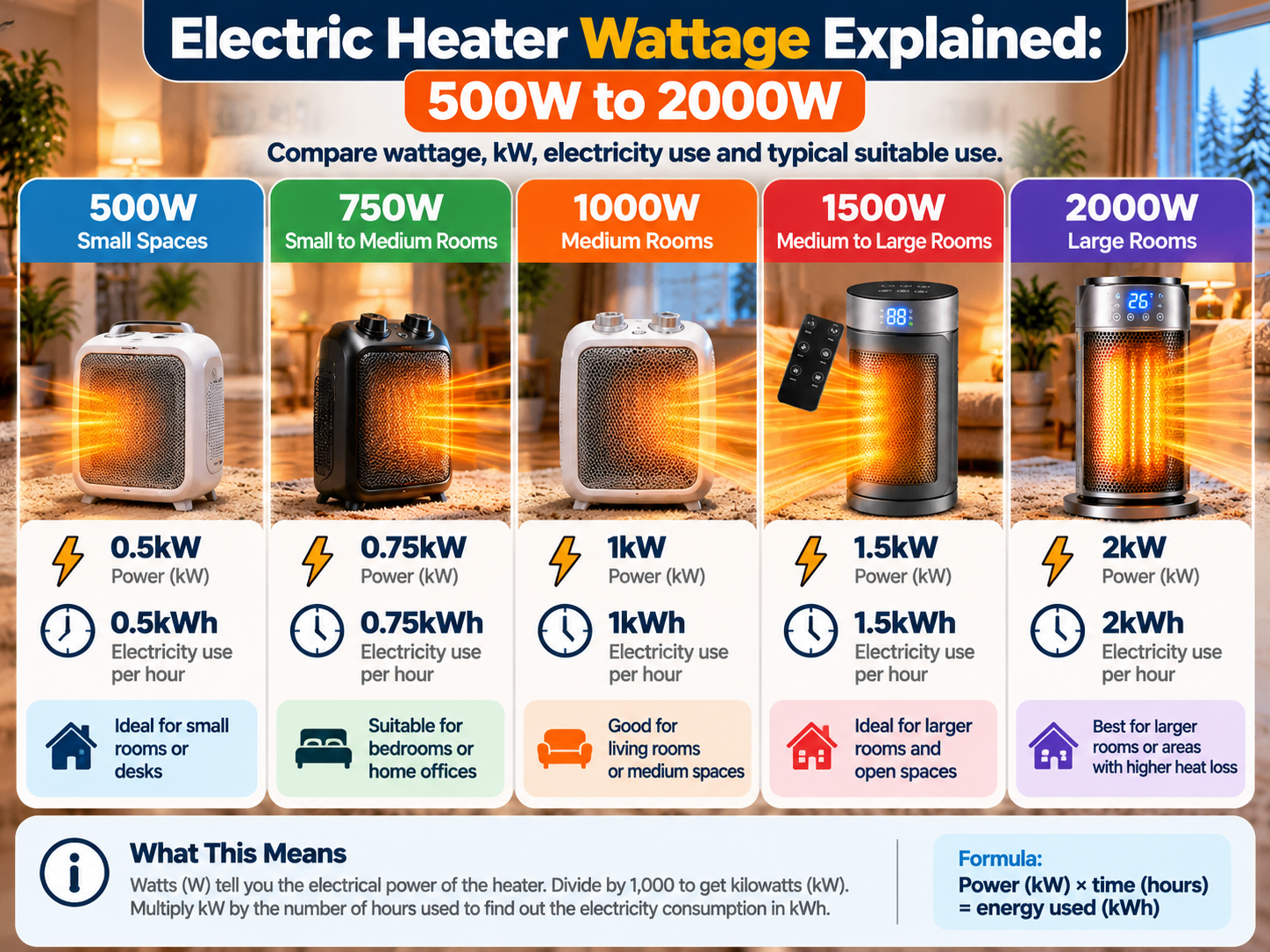
Portable electric heaters come in various power ratings.
Here's a simple comparison:
| Heater Wattage | Power in kW | Maximum Energy Use for 1 Continuous Full-Power Hour |
|---|---|---|
| 500W | 0.5kW | 0.5kWh |
| 750W | 0.75kW | 0.75kWh |
| 1000W | 1kW | 1kWh |
| 1200W | 1.2kW | 1.2kWh |
| 1500W | 1.5kW | 1.5kWh |
| 2000W | 2kW | 2kWh |
These figures assume the heater operates continuously at the stated electrical power for the entire hour.
Real-world consumption can be lower when the heating element isn't operating continuously because of thermostat cycling or lower-power modes.
How Much Electricity Does a 1500W Heater Use?
A 1500W electric heater has a rated power equivalent to:
1500W ÷ 1000 = 1.5kW
If it operates continuously at 1500W for one hour:
1.5kW × 1 hour = 1.5kWh
Therefore:
1 hour = 1.5kWh
2 hours = 3kWh
4 hours = 6kWh
8 hours = 12kWh
These are maximum theoretical examples assuming continuous operation at the full 1500W output.
If the thermostat switches the heating element on and off, actual electricity consumption over the same period can be lower.
For a complete cost calculation:
1500W Electric Heater Running Cost UK
How Much Electricity Does a 2000W Heater Use?
A 2000W electric heater is equivalent to:
2000W ÷ 1000 = 2kW
At continuous maximum output:
2kW × 1 hour = 2kWh
That means:
1 hour = 2kWh
2 hours = 4kWh
4 hours = 8kWh
8 hours = 16kWh
Again, these calculations assume continuous full-power operation.
A heater with thermostat control may cycle the heating element as the selected temperature is approached, so the actual electricity consumed during several clock hours of use may be different.
Does a 2000W Heater Use a Lot of Electricity?
A 2000W heater uses up to 2kWh of electricity for every continuous hour it operates at its full 2000W output.
Whether that counts as “a lot” depends on:
- how long you use it
- your electricity tariff
- selected heat mode
- thermostat behaviour
- room temperature
- insulation and heat loss
- your heating requirements
For example, operating at maximum output continuously for four hours would theoretically consume:
2kW × 4 hours = 8kWh
But being switched on for four hours doesn't necessarily mean the heating element operates at 2000W continuously for every minute.
A thermostat can cause the heating element to cycle according to temperature.
1500W vs 2000W Heater: What's the Difference?
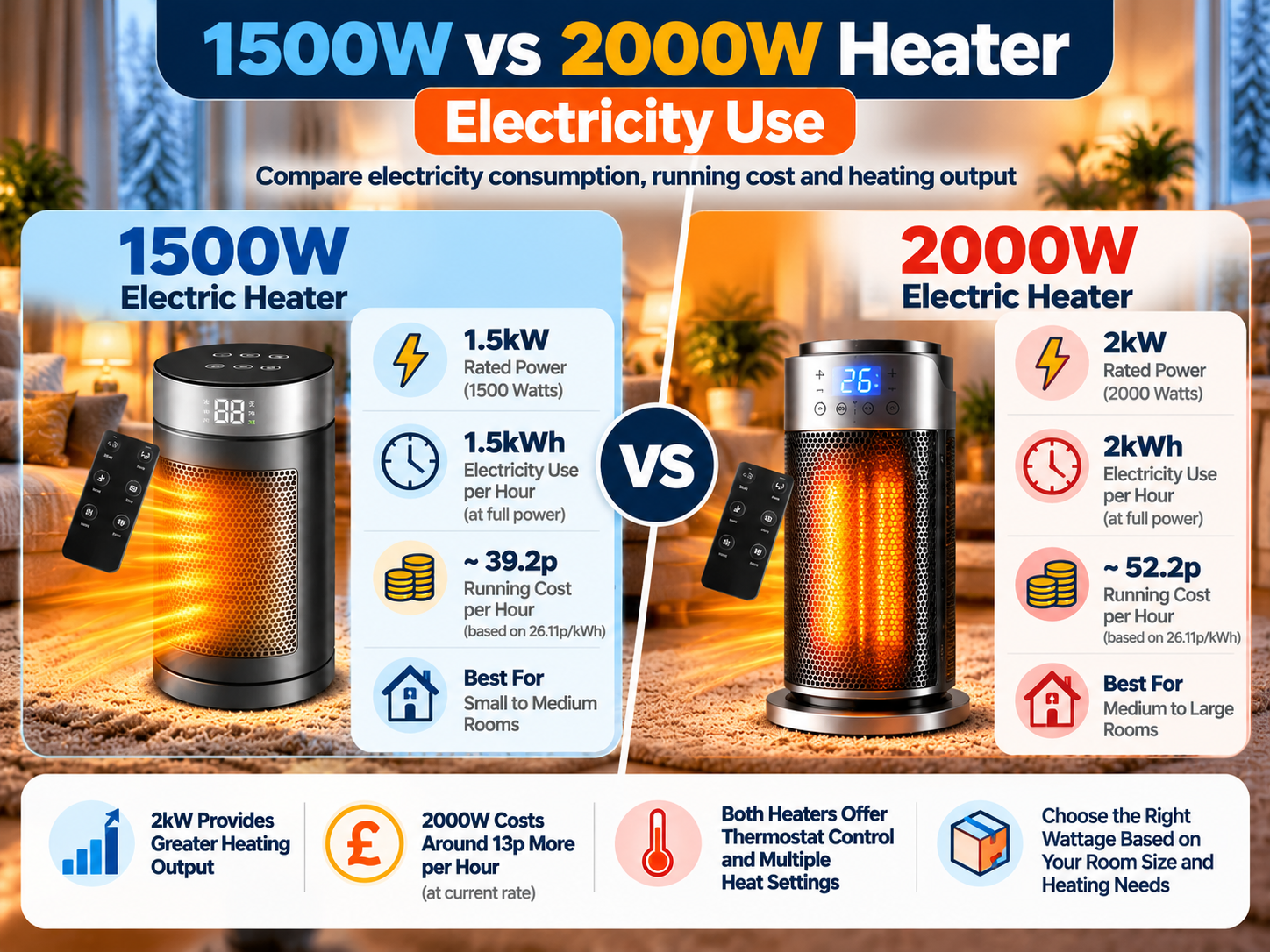
The main difference is maximum rated electrical power and corresponding maximum heating output.
| Feature | 1500W Heater | 2000W Heater |
|---|---|---|
| Rated maximum power | 1.5kW | 2kW |
| Full-power energy use/hour | 1.5kWh | 2kWh |
| Maximum heating output | Lower | Higher |
| Electricity use at continuous maximum output | Lower | Higher |
| Thermostat availability | Depends on model | Depends on model |
| Heat settings | Depends on model | Depends on model |
A 2000W heater can provide greater maximum heating output.
A 1500W heater has a lower maximum power draw.
That doesn't mean one is universally better than the other.
The appropriate choice depends on your heating requirements and room conditions.
Read our:
1500W vs 2000W Heater: Which Should You Choose?
for the full comparison.
Does a Heater Always Use Its Maximum Wattage?
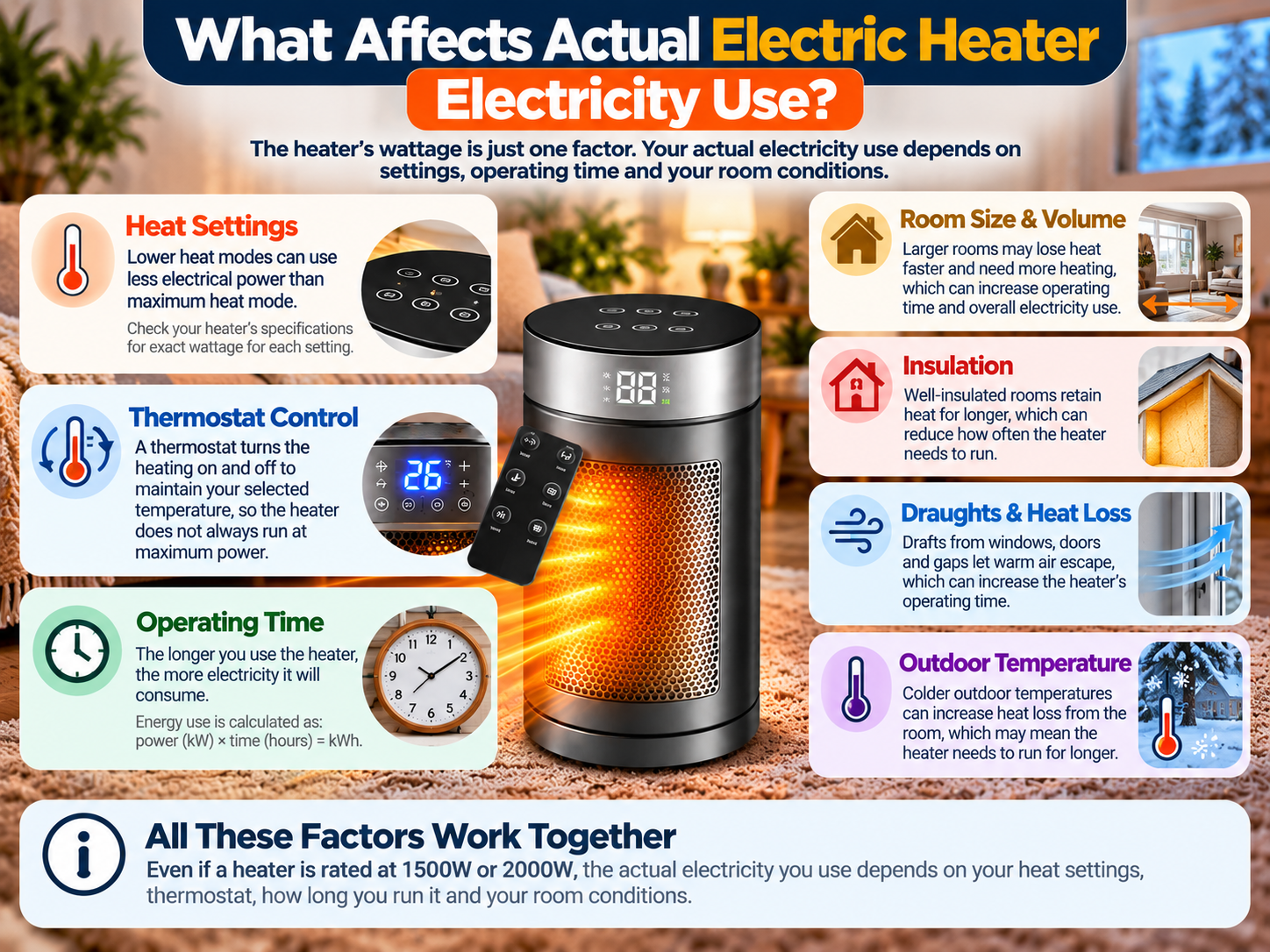
Not necessarily.
A heater labelled 2000W may have 2000W as its maximum rated heating power, but actual electricity consumption can vary depending on its controls.
Two particularly important factors are:
Heat Settings
Some heaters offer multiple heating modes.
If a lower mode genuinely uses lower electrical power, the heater consumes less electricity while operating in that mode than at maximum output.
Check the manufacturer's specifications rather than assuming the wattage associated with each setting.
Thermostat Cycling
A thermostat monitors temperature conditions and controls heating according to the appliance's design.
As the selected temperature is approached, the heating element may cycle rather than continuously drawing maximum heating power.
For more information:
How Does a Thermostat Work on an Electric Heater?
Does Turning the Thermostat Down Reduce Electricity Use?
Potentially.
The thermostat doesn't magically change a 2000W heater into a 500W appliance while its heating element is operating at the maximum mode.
Instead, the thermostat can affect how long heating is required.
For example, maintaining a very high room-temperature target may require the heater to operate for longer than maintaining a more moderate target under otherwise identical conditions.
Actual consumption depends on:
- selected temperature
- room temperature
- insulation
- outdoor conditions
- room size
- heat loss
- heater design
This is why both wattage and operating time matter.
Do Lower Heat Settings Use Fewer Watts?
They can, provided the heater genuinely changes electrical power between modes.
For example, a particular heater might have different power levels for low and high heat.
However, don't assume the exact wattage.
The words:
Low
Medium
and
High
don't automatically tell you the electrical power of each mode.
Check the product manual or manufacturer's specifications.
If the lower mode uses fewer watts, then it consumes fewer kWh per active hour than the higher-power mode.
How Do You Calculate Electric Heater Electricity Use?
The formula is:
Heater wattage ÷ 1000 × hours used = kWh
For example, for a 1500W heater:
1500 ÷ 1000 = 1.5kW
If it operates at that power continuously for three hours:
1.5 × 3 = 4.5kWh
For a 2000W heater:
2000 ÷ 1000 = 2kW
Three continuous full-power hours:
2 × 3 = 6kWh
Once you know the kWh figure, you can estimate cost.
How Do You Calculate Electric Heater Running Cost?
Use:
Power in kW × operating time × electricity price per kWh
For example, if your electricity costs X pence per kWh, a 2000W heater operating continuously at full power for one hour would cost:
2 × X pence
A 1500W heater would cost:
1.5 × X pence
This makes it easy to update your calculations whenever electricity prices change.
Because UK electricity rates change over time, use the current tariff from your own electricity bill for the most accurate estimate.
For national price-cap information, link to:
Ofgem — Energy Price Cap Unit Rates and Standing Charges
Ofgem electricity unit rates and standing charges
How Much Does a 1500W Heater Cost to Run?
The exact cost depends on your electricity unit rate.
For example, using a hypothetical electricity rate of 25p/kWh:
1.5kW × £0.25 = £0.375
So continuous full-power operation would cost approximately:
37.5p per hour
Two continuous hours:
75p
Four continuous hours:
£1.50
Use your actual tariff for an accurate calculation.
How Much Does a 2000W Heater Cost to Run?
Using the same hypothetical 25p/kWh rate:
2kW × £0.25 = £0.50
Continuous full-power operation would therefore cost:
50p per hour
Two continuous hours:
£1.00
Four continuous hours:
£2.00
These are theoretical maximum-output examples.
Your actual consumption may differ because of thermostat cycling and selected heat modes.
For a deeper explanation:
Are Electric Heaters Expensive to Run in the UK?
Is a 2000W Heater More Expensive to Run Than a 1500W Heater?
If both operate continuously at their respective maximum rated outputs for the same period, yes.
At maximum output:
1500W = 1.5kWh/hour
2000W = 2kWh/hour
Therefore, the 2000W heater consumes:
0.5kWh more per continuous full-power hour.
At a hypothetical 25p/kWh:
1500W → 37.5p/hour
2000W → 50p/hour
Difference:
12.5p/hour
However, the 2000W heater also provides greater maximum heating output.
So running cost shouldn't be considered in isolation from the heating requirement.
How Many Watts Do You Need for Your Room?
There isn't a universal wattage that's correct for every room.
Heating requirements depend on more than floor area.
Consider:
- room length
- room width
- ceiling height
- insulation
- glazing
- external walls
- draughts
- outdoor temperature
- desired indoor temperature
- existing heating
A poorly insulated room may lose heat much faster than a well-insulated room of similar dimensions.
For a complete explanation:
What Size Electric Heater Do I Need for My Room? UK Guide
Does Higher Wattage Mean Better Heating?
Higher wattage generally means greater maximum electrical input and, for resistance heating, greater maximum heating output.
But more powerful doesn't automatically mean more appropriate.
For example, you shouldn't choose a heater purely because it has the highest wattage.
Consider:
How much heat does the space require?
How long will you use the heater?
Does it have suitable controls?
Can it be positioned safely?
What is the maximum running cost?
Matching the appliance to the intended use is more useful than simply choosing the largest number.
Does a Ceramic Heater Use Fewer Watts?
Not automatically.
“Ceramic” describes the heating technology, not necessarily the electrical power consumption.
A 1500W ceramic heater operating continuously at 1500W still consumes:
1.5kWh per hour
A 1500W conventional resistance heater operating continuously at 1500W also consumes:
1.5kWh per hour
The appliances may differ in:
- airflow
- heat distribution
- thermostat controls
- heat settings
- physical design
- comfort
But ceramic technology doesn't make the rated electrical power disappear.
Read:
Ceramic Heater vs Fan Heater: Which Should You Choose?
for the full explanation.
Does Oscillation Change Heater Wattage?
Oscillation primarily changes the direction of airflow.
It can help distribute warm air across a wider surrounding area rather than continuously directing it toward one point.
It doesn't inherently change a 1500W heating element into a lower-wattage element.
The heater's total electrical consumption can include the small amount of power used by controls, fans and oscillation motors, but the heating element is normally responsible for most of the appliance's power draw.
How Does Insulation Affect Electricity Use?
Wattage tells you the heater's electrical power, but your room determines how much heating may be required over time.
A poorly insulated room can lose heat through:
- windows
- walls
- doors
- floors
- roofs
- draughts
If heat escapes quickly, the thermostat may need to call for heating more frequently.
A better-insulated room generally retains heat for longer.
This is why the same heater can behave differently in two different homes.
Can a Timer Reduce Unnecessary Heater Use?
A timer doesn't change the heater's maximum wattage.
Instead, it controls operating duration.
If you only need supplementary heating for a particular period, a timer can help prevent the heater from continuing to operate longer than intended.
For example:
2000W for one continuous full-power hour = 2kWh
while:
2000W for two continuous full-power hours = 4kWh
Operating time matters just as much as wattage when calculating energy use.
How Can You Reduce Unnecessary Electric Heater Use?
Practical steps include:
- choose suitable heater output
- use an appropriate thermostat setting
- use lower heat modes when sufficient
- use a timer where appropriate
- heat occupied rooms rather than empty spaces unnecessarily
- reduce avoidable draughts
- improve insulation where practical
- keep doors closed where appropriate
- keep heater airflow unobstructed
- switch the heater off when supplementary heating is no longer required
For the complete guide:
cha
Portable Heater Safety Still Matters
Electricity consumption isn't the only consideration.
Electrical Safety First advises keeping portable heaters at least one metre away from combustible materials such as furniture, curtains and paper. It also advises against using extension leads with portable heaters and recommends not leaving them unattended.
Use an authoritative external link here:
Electrical Safety First — Portable Heater Safety
For detailed placement guidance:
Where Should You Place a Portable Electric Heater? UK Safety Guide
Shopsyde 1500W Portable Electric Heater
Shopsyde's 1500W Portable Electric Heater with Thermostat, Oscillation, Timer & Remote Control provides supplementary portable heating with a maximum rated output of up to 1500W.
Features include:
- up to 1500W heating
- ceramic heating
- thermostat control
- multiple heat settings
- oscillation
- timer
- remote control
- portable design
At continuous maximum 1500W heating output:
1 hour = approximately 1.5kWh
Actual electricity consumption can vary depending on settings and thermostat operation.
View the Shopsyde 1500W Portable Electric Heater
Shopsyde 2000W Portable Electric Heater
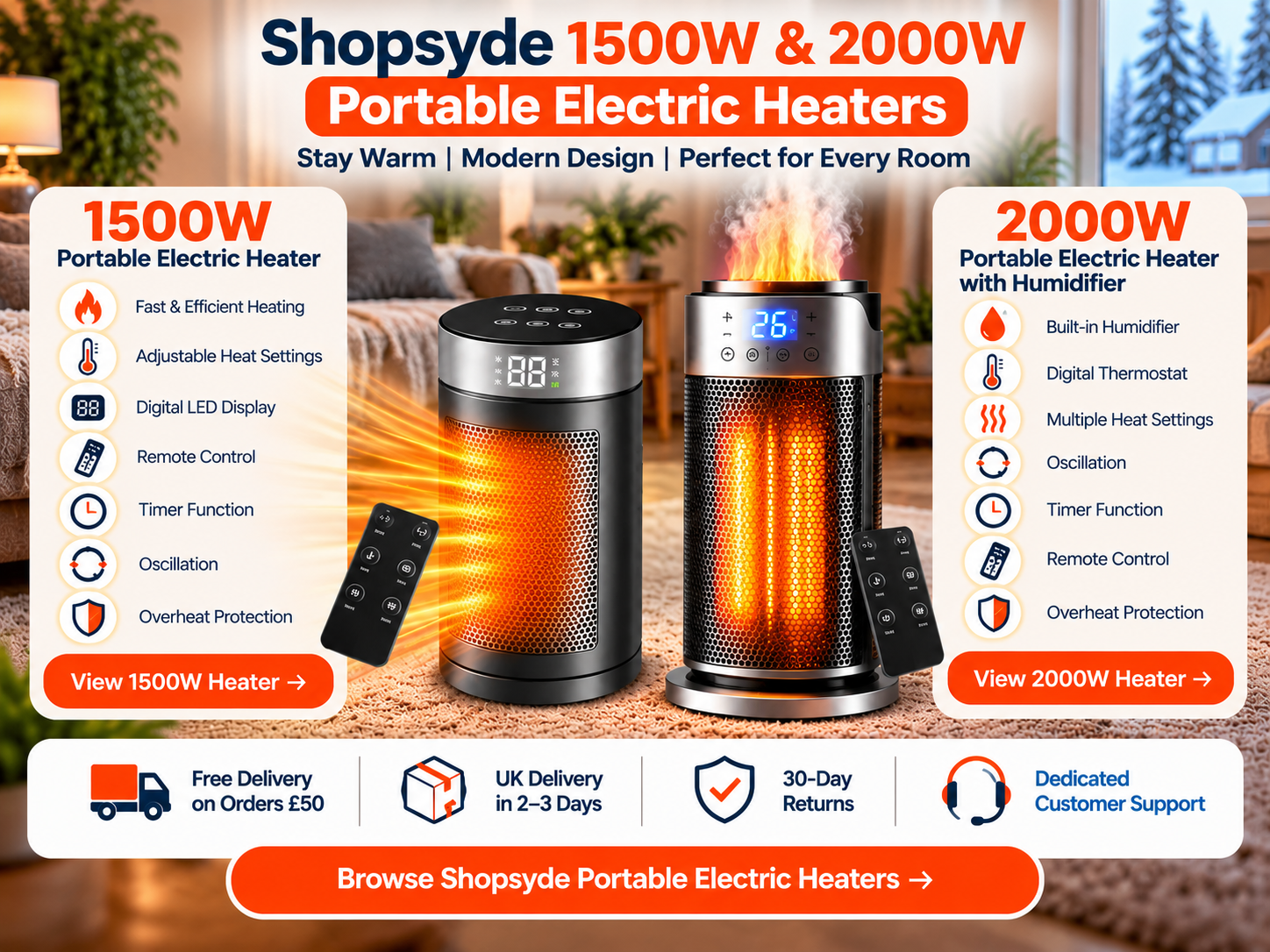
For greater maximum heating output, Shopsyde offers the 2000W Portable Electric Heater with Humidifier, Thermostat, Timer & Remote Control.
Features include:
- up to 2000W heating
- thermostat control
- multiple controls
- timer
- remote operation
- humidifier functionality
- portable design
At continuous maximum 2000W heating output:
1 hour = approximately 2kWh
Actual consumption can vary with operating mode, thermostat cycling and usage.
View the Shopsyde 2000W Portable Electric Heater
You can also:
Browse Shopsyde Portable Electric Heaters
Electric Heater Wattage Quick Reference
| Question | Answer |
|---|---|
| 500W in kW | 0.5kW |
| 1000W in kW | 1kW |
| 1500W in kW | 1.5kW |
| 2000W in kW | 2kW |
| 1500W for 1 full-power hour | 1.5kWh |
| 2000W for 1 full-power hour | 2kWh |
| 1500W for 4 full-power hours | 6kWh |
| 2000W for 4 full-power hours | 8kWh |
| Does thermostat change rated maximum wattage? | No |
| Can thermostat affect actual consumption? | Yes, through operating time/cycling |
| Does ceramic automatically mean fewer watts? | No |
| Does a timer reduce wattage? | No, it controls operating time |
The Bottom Line
So, how many watts does an electric heater use?
It depends on the model, but common portable heater ratings include 1000W, 1500W and 2000W.
The most important conversions are:
1000W = 1kW
1500W = 1.5kW
2000W = 2kW
At continuous maximum output for one hour:
1500W → approximately 1.5kWh
2000W → approximately 2kWh
But wattage alone doesn't tell you your final electricity bill.
Actual energy use depends on:
wattage + heat setting + thermostat cycling + operating time + room conditions
To estimate your own running cost, use your actual electricity tariff rather than relying solely on generic national examples.