

A 2000W electric heater with humidifier combines supplementary electric heating with a humidification function in one appliance. Depending on the model, you may also get thermostat control, oscillation, a timer and remote operation.
That combination can be convenient during colder months, but don't choose a heater simply because it has the longest feature list.
Heating power, controls, room conditions, running costs, safety and how you actually intend to use the appliance matter more.
This guide explains what UK shoppers should check before buying a portable electric heater with humidifier.
1. Understand What 2000W Heating Actually Means
A heater rated at 2000W has a maximum rated power of:
2000W = 2kW
If it continuously draws its full 2000W heating power for one hour, that represents approximately:
2kWh of electricity
Your actual electricity consumption can differ because of heat settings, thermostat cycling and how the appliance operates.
Wattage therefore tells you something important about maximum power, but it doesn't tell you exactly what every heating session will cost.
2. Check the Running Cost Before Buying
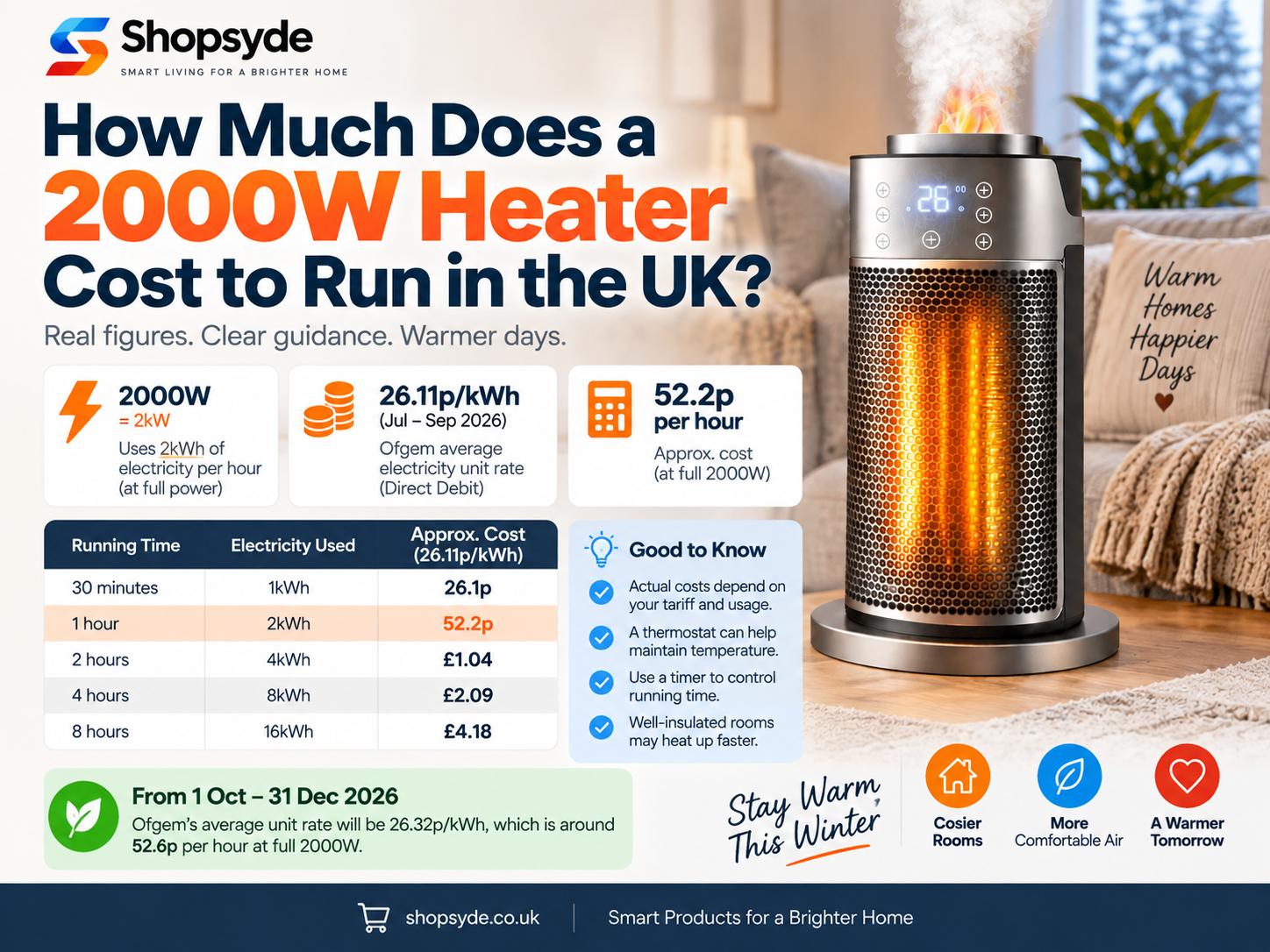
Running cost is especially important when comparing portable electric heaters.
For 1 July to 30 September 2026, Ofgem's average electricity unit rate for Direct Debit customers on default tariffs is 26.11p/kWh, averaged across England, Scotland and Wales.
At that rate:
2kW × £0.2611 = £0.5222
So a 2000W heater operating continuously at its full rated output would cost approximately:
52.2p per hour
Approximate examples:
| Continuous full-power use | Electricity | Approx. cost |
|---|---|---|
| 30 minutes | 1kWh | 26.1p |
| 1 hour | 2kWh | 52.2p |
| 2 hours | 4kWh | £1.04 |
| 4 hours | 8kWh | £2.09 |
| 8 hours | 16kWh | £4.18 |
These are full-power mathematical estimates, not guaranteed household costs.
Actual electricity rates vary by region, tariff, meter and payment method.
3. Electricity Rates Are Changing From October 2026
Because this is a UK buying guide, keeping running-cost information dated is important.
Ofgem has announced an average electricity unit rate of 26.32p/kWh for Direct Debit customers on default tariffs from 1 October to 31 December 2026, averaged across England, Scotland and Wales.
At that rate:
2kW × £0.2632 = £0.5264
or approximately:
52.6p per continuous full-power hour
The difference is small, but this article should be updated whenever the applicable Ofgem rate changes.
4. Look for Thermostat Control
A thermostat is one of the most useful features to consider on an electric heater.
Instead of simply running continuously regardless of room temperature, a thermostatically controlled heater can regulate heating according to the selected temperature and the way the particular model is designed to operate.
That matters for both comfort and electricity consumption.
However, avoid claims such as:
“The thermostat saves 50% electricity.”
unless there is reliable product-specific evidence supporting that figure.
Actual consumption depends on factors including:
- selected temperature
- room size
- insulation
- outside temperature
- heat loss
- starting room temperature
- heater operation
5. What Does the Humidifier Function Do?
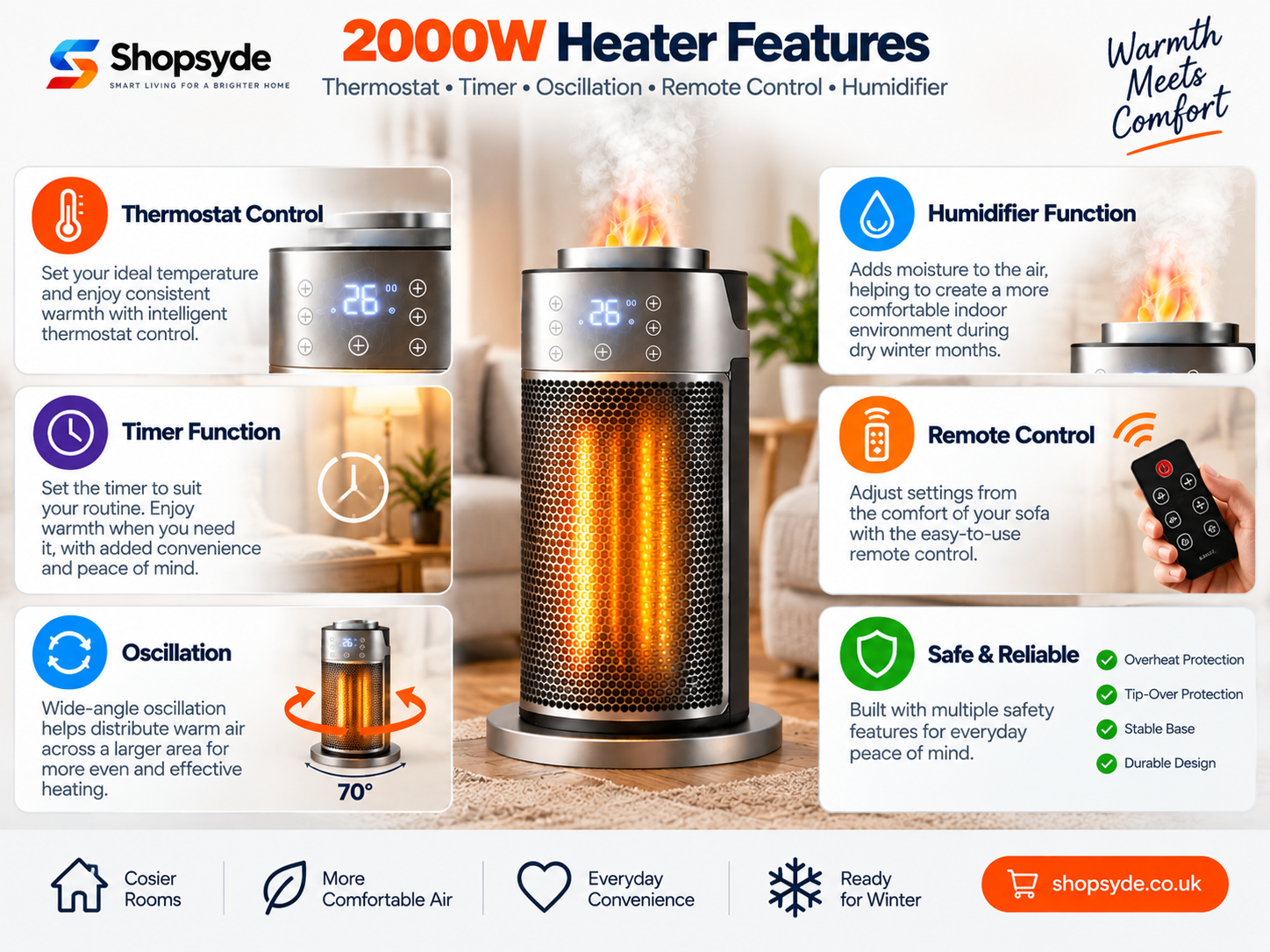
The heater and humidifier perform two different jobs.
Heater: provides warmth.
Humidifier: adds moisture to the surrounding air according to the appliance's humidification design.
This can make a combined appliance convenient if you actually want both functions.
But don't assume the humidifier makes the heating element more energy efficient.
A 2000W heating element drawing its full rated power remains a 2kW electrical load for the heating operation.
For a deeper explanation, link here to your previous article:
Heater With Humidifier: What Does It Do and Is It Useful in Winter?
6. Check Whether the Heater Has Different Heat Settings
Multiple heat settings give you greater control over how the appliance operates.
Instead of always using maximum output, some heaters provide different heating levels.
Before buying, check the actual product specifications for:
number of heat settings
maximum wattage
thermostat range
fan modes
and whether the advertised wattage applies to every mode.
Don't assume every 2000W heater has identical controls.
7. Consider Oscillation
An oscillating heater moves its airflow direction from side to side rather than continuously directing warm air toward one fixed point.
That can help distribute heated air across a wider area around the appliance.
Oscillation doesn't change the heater's maximum wattage.
It's primarily a heat-distribution and comfort feature.
Your Shopsyde model includes an oscillation function, making it useful for customers who want warm airflow distributed more broadly around the surrounding area.
8. Is a Timer Worth Having?
A timer can be useful if you want greater control over when the heater operates.
For example, rather than manually switching the appliance off after a planned period, the timer can be configured according to the settings supported by the particular model.
This is useful for convenience, but don't present a timer as a guaranteed energy-saving technology.
It can help users manage operating time; the resulting electricity consumption depends on how the heater is actually used.
9. Is a Remote Control Useful?
A remote control isn't essential to heating performance, but it can make everyday operation much more convenient.
It allows compatible functions to be adjusted from a distance without repeatedly walking over to the appliance.
For a heater used in a living room, home office or other suitable indoor location, that can be a useful quality-of-life feature.
10. 1500W vs 2000W: Which Should You Choose?
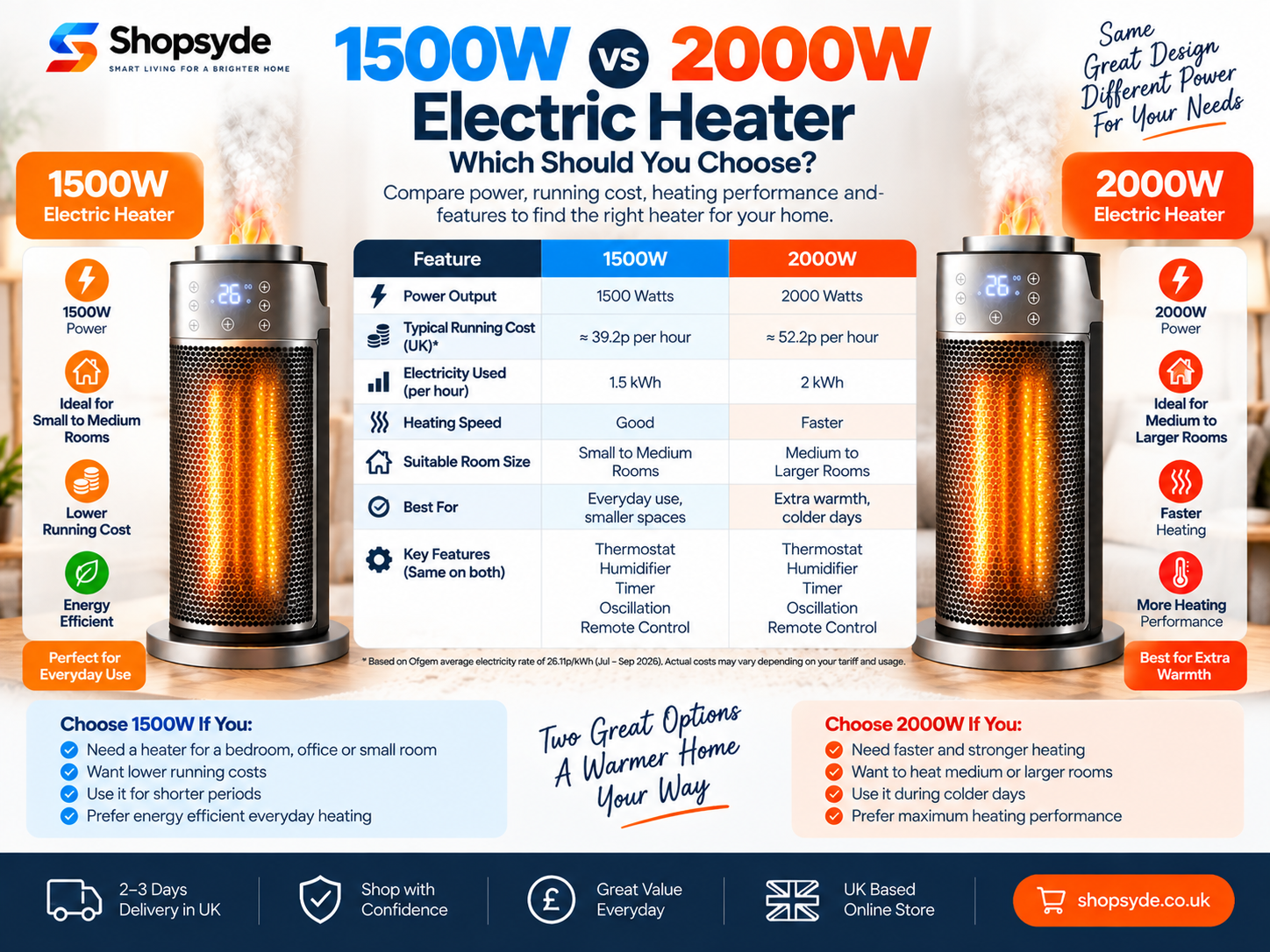
The lower-wattage heater has a lower maximum electrical power draw.
Using the current 26.11p/kWh example:
1500W → approximately 39.2p/hour
2000W → approximately 52.2p/hour
when both operate continuously at their full rated outputs.
But that doesn't make a 1500W heater universally better.
A 2000W heater provides higher maximum heating output.
Your decision should therefore consider:
heating requirement
room conditions
insulation
desired features
usage duration
thermostat controls
budget
For the full comparison, link to your Article #2:
1500W vs 2000W Heater: Which Should You Choose?
That internal link is particularly important for our topical cluster.
11. Don't Choose a Heater Based on Room Size Claims Alone
You'll often see heaters advertised for “small”, “medium” or “large” rooms.
Treat broad claims cautiously.
Actual heating requirements depend on:
- floor area
- ceiling height
- insulation
- glazing
- outside temperature
- heat loss
- desired indoor temperature
Unless the manufacturer provides verified room-coverage specifications for your exact product, don't claim:
“Heats rooms up to 30m²”
just because a competitor makes that claim.
This is one area where Shopsyde can build trust by being more precise.
12. Portable Heater Safety Is Essential
Safety should be part of the buying decision, not something considered after purchase.
Electrical Safety First recommends placing portable heaters on a level surface and keeping them at least one metre away from combustible materials such as furniture, curtains and paper. It also advises against using an extension lead for a portable heater and recommends not leaving heaters unattended or using them while asleep.
Always follow the instructions supplied with the specific appliance.
Shopsyde 2000W Portable Electric Heater With Humidifier
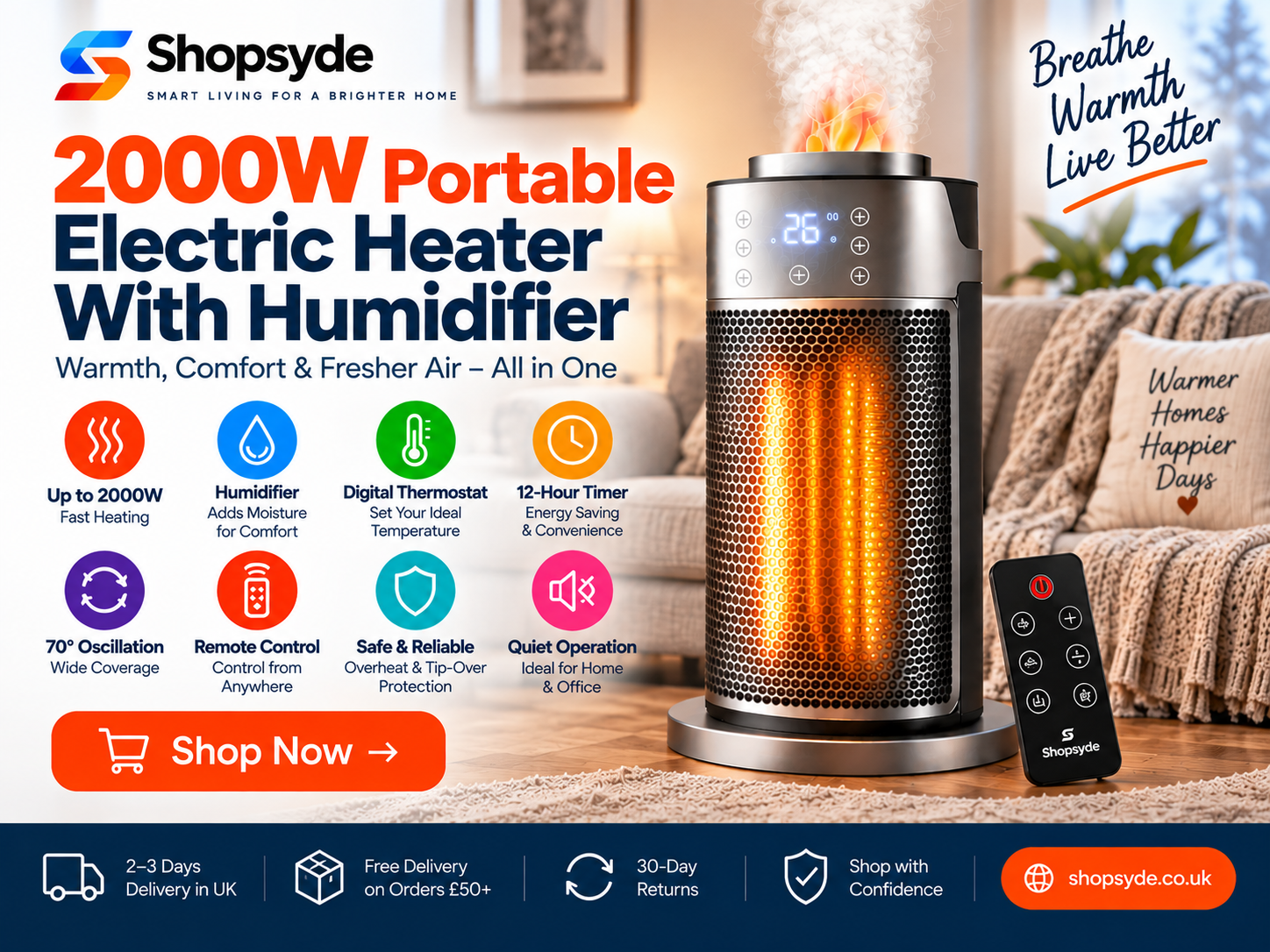
If you're looking for a combined heating and humidification appliance, consider the:
2000W Portable Electric Heater With Humidifier, Thermostat, Timer & Remote Control
Your product combines confirmed features including:
Up to 2000W heating
Humidifier function
Thermostat
Timer
Remote control
Oscillation
Add a prominent CTA:
View the Shopsyde 2000W Electric Heater With Humidifier →
Browse all Shopsyde electric heaters →
What Should You Check Before Buying?
Before purchasing any portable electric heater, check:
| Feature | Why check it? |
|---|---|
| Maximum wattage | Indicates maximum rated power |
| Heat settings | Provides control over heating output |
| Thermostat | Helps regulate selected temperature |
| Timer | Helps manage operating periods |
| Oscillation | Distributes airflow more broadly |
| Remote | Convenient control from a distance |
| Humidifier | Adds humidification when wanted |
| Dimensions | Determines where the appliance can fit |
| Plug | UK electrical compatibility |
| Safety features | Check exact manufacturer specification |
| Warranty | Check actual retailer/manufacturer terms |
| Returns | Understand conditions before purchasing |
This table is useful for both readers and AEO because it gives a concise answer to the article's main buying-guide intent.
The Bottom Line
A 2000W electric heater with humidifier can be worth considering if you're looking for higher maximum heating output together with humidification and convenient controls such as a thermostat, timer, oscillation and remote control.
Don't choose solely because a heater has 2000W printed on the box.
Consider:
how much heating you need
your electricity tariff
thermostat controls
room conditions
how frequently you'll use it
and whether you genuinely want the humidification function.
For customers looking for these features in one appliance:
View the Shopsyde 2000W Portable Electric Heater With Humidifier →