

If you're comparing a ceramic heater vs fan heater, the first thing to understand is that the terms can overlap.
A ceramic heater commonly uses a ceramic heating element together with a fan to move warmed air into the room. A conventional electric fan heater generally heats air using a resistance wire element and then uses a fan to distribute it.
Electrical Safety First describes fan heaters as appliances that use a wire coil to heat surrounding air before forcing that warm air into the room with a fan. It notes that they're generally small, relatively inexpensive and capable of providing heat quickly, although fan noise can be a consideration. (Electrical Safety First)
So the more useful comparison is:
Ceramic fan heater
vs
Conventional wire-element fan heater
Let's look at how they differ and what actually matters when choosing one.
What Is a Ceramic Heater?
A ceramic heater is an electric heater that uses a ceramic-based heating element.
Many portable models use PTC ceramic technology, with a fan moving air across or through the heated element before releasing warm air into the room.
Typical ceramic portable heaters may include features such as:
thermostat control
multiple heat settings
fan-assisted airflow
oscillation
timers
remote controls
digital displays
Features vary significantly between products, so don't assume every ceramic heater includes all of them.
Your Shopsyde 1500W portable heater, for example, uses ceramic heating and combines it with thermostat control, oscillation, a timer and remote operation.
What Is a Fan Heater?
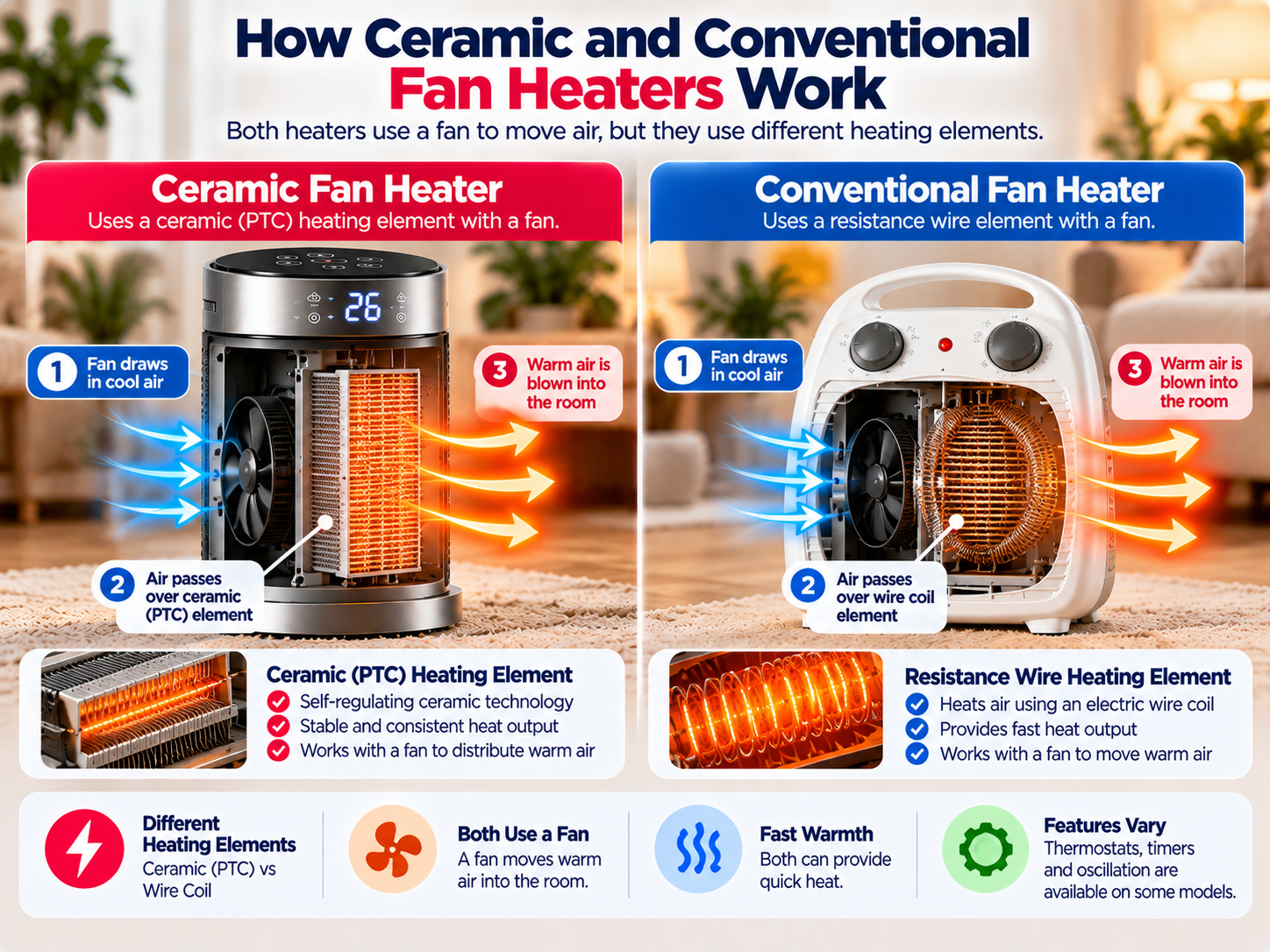
A fan heater uses an electric heating element and a fan.
Electrical Safety First explains that a conventional fan heater typically uses a coil of wire to heat surrounding air before a fan forces the heated air into the room. (Electrical Safety First)
These heaters are often compact and designed to provide heat quickly.
Because airflow is important to their operation, Electrical Safety First advises keeping their vents clear and ensuring airflow isn't restricted by dust or fluff. (Electrical Safety First)
A key point is that “fan heater” doesn't automatically mean “non-ceramic heater.”
A ceramic heater may also contain a fan.
Ceramic Heater vs Fan Heater: Quick Comparison
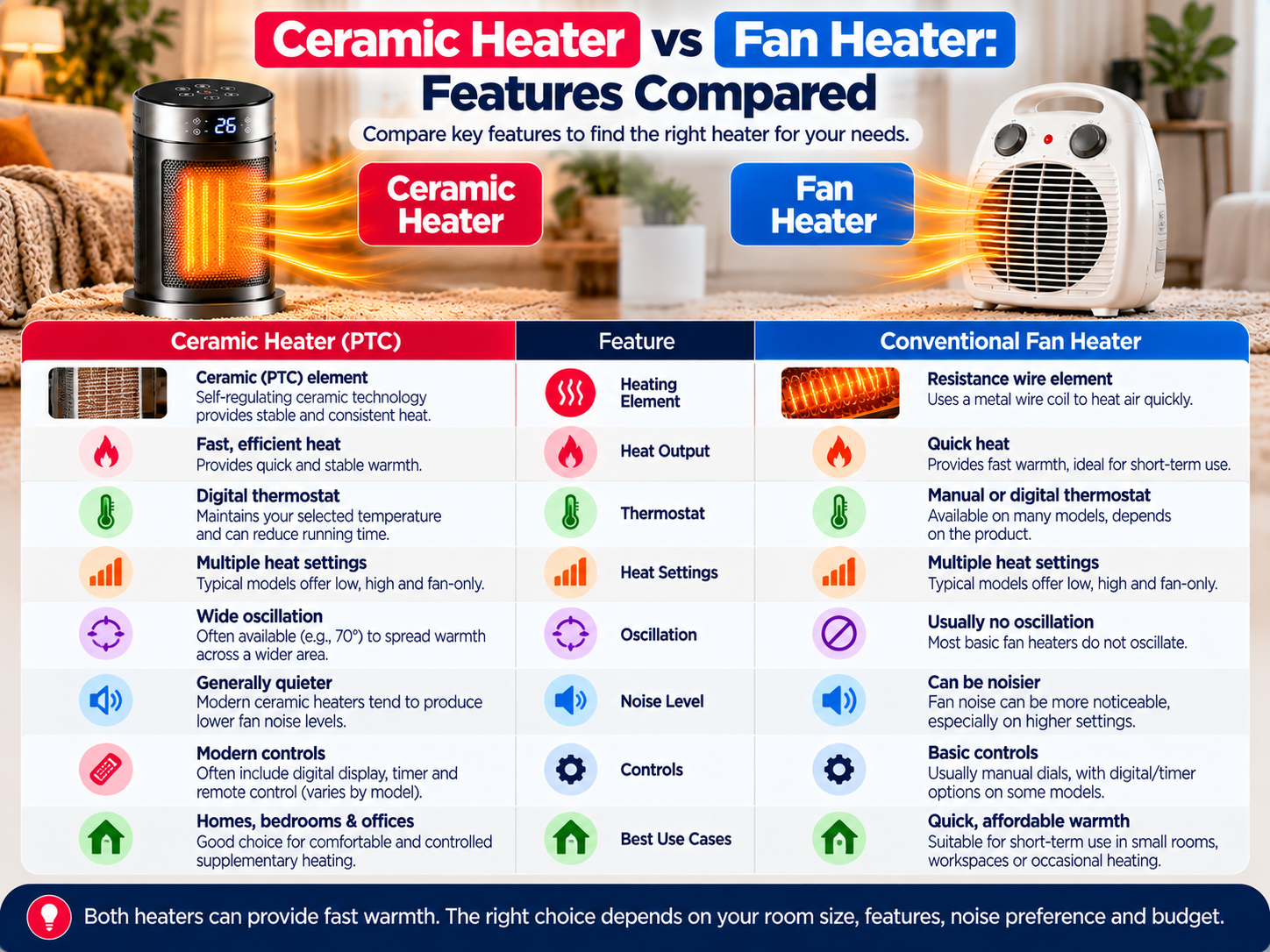
| Feature | Ceramic Fan Heater | Conventional Fan Heater |
|---|---|---|
| Heating element | Ceramic/PTC element | Usually resistance wire coil |
| Uses a fan | Commonly yes | Yes |
| Portable models | Common | Common |
| Fast local warmth | Yes | Yes |
| Thermostat availability | Depends on model | Depends on model |
| Oscillation availability | Common on some models | Depends on model |
| Timer/remote | Available on some models | Available on some models |
| Noise | Fan creates some noise | Fan creates some noise |
| Running cost | Primarily depends on power draw and operating time | Primarily depends on power draw and operating time |
| Best choice | Depends on product and requirements | Depends on product and requirements |
This is why choosing based solely on the words “ceramic” or “fan” can be misleading.
Compare the actual specifications.
Which Heater Warms Up Faster?
Both ceramic and conventional fan heaters are designed to provide relatively quick heat compared with some slower forms of electric heating.
Electrical Safety First specifically notes that fan heaters can provide instant heat. (Electrical Safety First)
However, you shouldn't claim that every ceramic heater is automatically faster than every conventional fan heater.
Real-world warm-up depends on:
rated wattage
heating-element design
airflow
fan speed
room temperature
room volume
insulation
heat loss
selected heat setting
A 2000W conventional fan heater and a 1000W ceramic heater are not directly comparable simply because one uses ceramic technology.
Is a Ceramic Heater More Energy Efficient Than a Fan Heater?
This is one of the most important misconceptions to address.
For direct electric resistance heating, wattage and operating time are central to electricity consumption.
If two heaters both continuously draw 2000W for one hour, each consumes approximately:
2kW × 1 hour = 2kWh
The fact that one uses a ceramic element doesn't by itself make those 2kWh disappear.
What can change real-world consumption is how the appliance is controlled and used, including:
thermostat cycling
heat settings
operating time
selected temperature
room insulation
heat loss
So avoid claims such as:
“Ceramic heaters use 50% less electricity than fan heaters.”
unless there is credible evidence comparing the exact products under equivalent conditions.
Ceramic Heater vs Fan Heater Running Cost
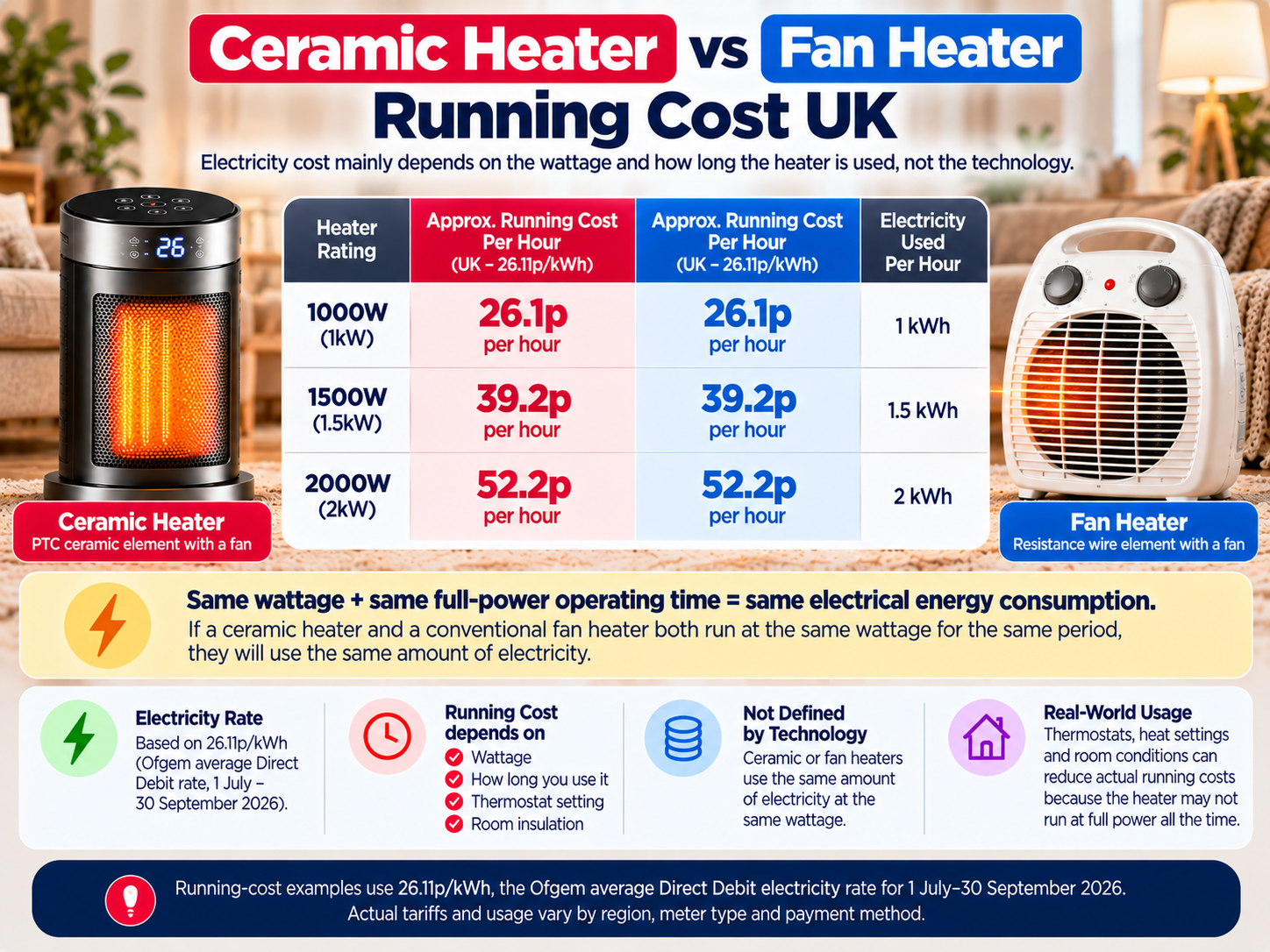
Let's use the current UK electricity rate to demonstrate.
For 1 July to 30 September 2026, Ofgem lists an average electricity unit rate of 26.11p/kWh for Direct Debit customers on default tariffs across England, Scotland and Wales. Your actual rate can vary by tariff, region, meter and payment method. (Ofgem)
At continuous full output:
| Heater Rating | Electricity Used | Approx. Cost/Hour |
|---|---|---|
| 1000W | 1kWh | 26.1p |
| 1500W | 1.5kWh | 39.2p |
| 2000W | 2kWh | 52.2p |
Therefore, if a ceramic heater and conventional fan heater both continuously draw 1500W, their theoretical electricity cost at that rate is the same:
approximately 39.2p per full-power hour.
The technology may affect how heat is delivered and controlled, but electricity billing is based on energy consumed.
For the complete cost breakdown, internally link:
Are Electric Heaters Expensive to Run in the UK?
to Article #6.
Does a Thermostat Matter More Than Heater Type?
For everyday use, thermostat control can be more meaningful than simply choosing something because the label says “ceramic.”
A thermostat allows a heater to regulate operation according to the selected temperature and the way that particular appliance is designed.
Once the desired temperature is approached, the heating element may cycle rather than operating continuously.
This means actual electricity consumption can differ from a calculation that assumes full-power operation for every minute the appliance is switched on.
Don't claim a specific percentage saving unless you have product-specific evidence.
What About Multiple Heat Settings?
Multiple heat settings provide greater control over output.
Suppose a heater supports genuinely different electrical power levels.
Operating on a lower-power mode will consume less electricity per active hour than operating continuously at maximum power.
For example, at 26.11p/kWh:
1000W continuous full output → approximately 26.1p/hour
2000W continuous full output → approximately 52.2p/hour
Check the manufacturer's specifications to confirm the actual wattage associated with each mode.
Which Is Better for a Bedroom?
There isn't one universal answer.
For a bedroom, consider:
room size
insulation
required heating output
noise
thermostat
available heat settings
safe placement
how long you'll use it
Because both ceramic and conventional fan heaters use fans, neither should automatically be described as silent.
If noise matters, look for a verified manufacturer noise specification rather than relying on marketing phrases such as “whisper quiet.”
Also remember that Electrical Safety First advises not using portable heaters overnight and says they should never be left unattended while you're asleep. (Electrical Safety First)
Which Is Better for a Home Office?
A compact ceramic heater can be convenient for supplementary heating in a home office because many modern models combine a small footprint with features such as thermostats, oscillation and timers.
But the same principle applies:
Don't choose based on ceramic technology alone.
Consider whether the heater offers:
appropriate output
thermostat control
suitable dimensions
useful heat settings
manageable fan noise
safe positioning
timer controls
What Size Electric Heater Do I Need for My Room? UK Guide
Does Oscillation Make a Difference?
Oscillation moves the direction of warm airflow from side to side.
This can help distribute heated air across a wider surrounding area instead of continuously directing it toward one fixed point.
Oscillation doesn't reduce a heater's rated wattage by itself.
It's primarily an air-distribution and comfort feature.
Your Shopsyde ceramic heaters include oscillation on selected models.
Are Ceramic Heaters Safer Than Fan Heaters?
Don't assume that one heater type is universally safe simply because of the heating-element material.
Safety depends on:
product design
applicable safety features
product condition
correct placement
unobstructed airflow
electrical condition
correct usage
Electrical Safety First advises keeping portable heaters at least one metre away from combustible materials such as curtains, bedding and furniture. It also warns against using extension leads with portable heaters because they can be overloaded. (Electrical Safety First)
Always check the exact manufacturer's specifications for safety features such as tip-over or overheat protection rather than assuming they're present.
Can You Leave a Ceramic Heater On Overnight?
Portable heaters should not be treated as appliances to leave running unattended while sleeping.
Electrical Safety First advises:
don't use portable heaters overnight
don't leave them unattended
keep them away from combustible materials
don't use them to dry clothes
don't power them through an extension lead (Electrical Safety First)
A timer or thermostat doesn't replace safe-use guidance.
Ceramic Heater vs Fan Heater: Which Is Quieter?
Both types commonly use fans, so both can produce operating noise.
Noise levels depend on:
fan design
fan speed
motor
airflow
housing design
selected mode
A ceramic heater isn't automatically quieter merely because it uses a ceramic element.
If quiet operation is important, compare verified dB specifications for the exact models you're considering.
If no dB figure is supplied, don't invent one.
Ceramic Heater vs Fan Heater: Which Costs Less to Buy?
Basic conventional fan heaters are often available as relatively simple portable appliances. Electrical Safety First describes fan heaters as generally small and cheaper. (Electrical Safety First)
Ceramic heaters can include additional controls such as:
digital displays
thermostats
oscillation
timers
remote controls
Those features may affect purchase price.
However, prices vary substantially between brands and models, so compare actual products rather than assuming every ceramic heater costs more.
Does a More Expensive Heater Cost Less to Run?
Not necessarily.
Purchase price and electricity consumption are different things.
A £70 heater rated at 2000W and a £25 heater rated at 2000W could both theoretically consume 2kWh during one continuous hour at full rated power.
The more expensive model may offer better controls or additional features, but price alone doesn't determine energy consumption.
Compare:
wattage + settings + thermostat + usage time
rather than purchase price alone.
Ceramic Heater vs Fan Heater for Different Room Needs
Room conditions matter regardless of heater technology.
Consider:
Room Size
Larger spaces generally require more heating capacity than smaller spaces under otherwise similar conditions.
Insulation
A well-insulated room retains heat better.
Windows and Draughts
Poor glazing or draughts can increase heat loss.
Ceiling Height
Higher ceilings increase the volume of air in the room.
Existing Heating
A portable heater supplementing central heating has a different job from one expected to provide most of the warmth.
Read our:
What Size Electric Heater Do I Need for My Room? UK Guide
for a deeper explanation.
Shopsyde 1500W Ceramic Portable Electric Heater
Shopsyde offers a 1500W Portable Electric Heater With Thermostat & Remote Control using ceramic heating.
Confirmed features include:
up to 1500W heating
ceramic heating
digital thermostat
multiple heat settings
oscillation
timer
remote control
portable freestanding design
At continuous full 1500W output and the current 26.11p/kWh illustrative electricity rate:
1.5kW × £0.2611 ≈ £0.392/hour
or approximately:
39.2p per hour
Actual consumption varies with settings, thermostat cycling and your electricity tariff.
View the Shopsyde 1500W Portable Electric Heater →
Shopsyde 2000W Ceramic Electric Heaters
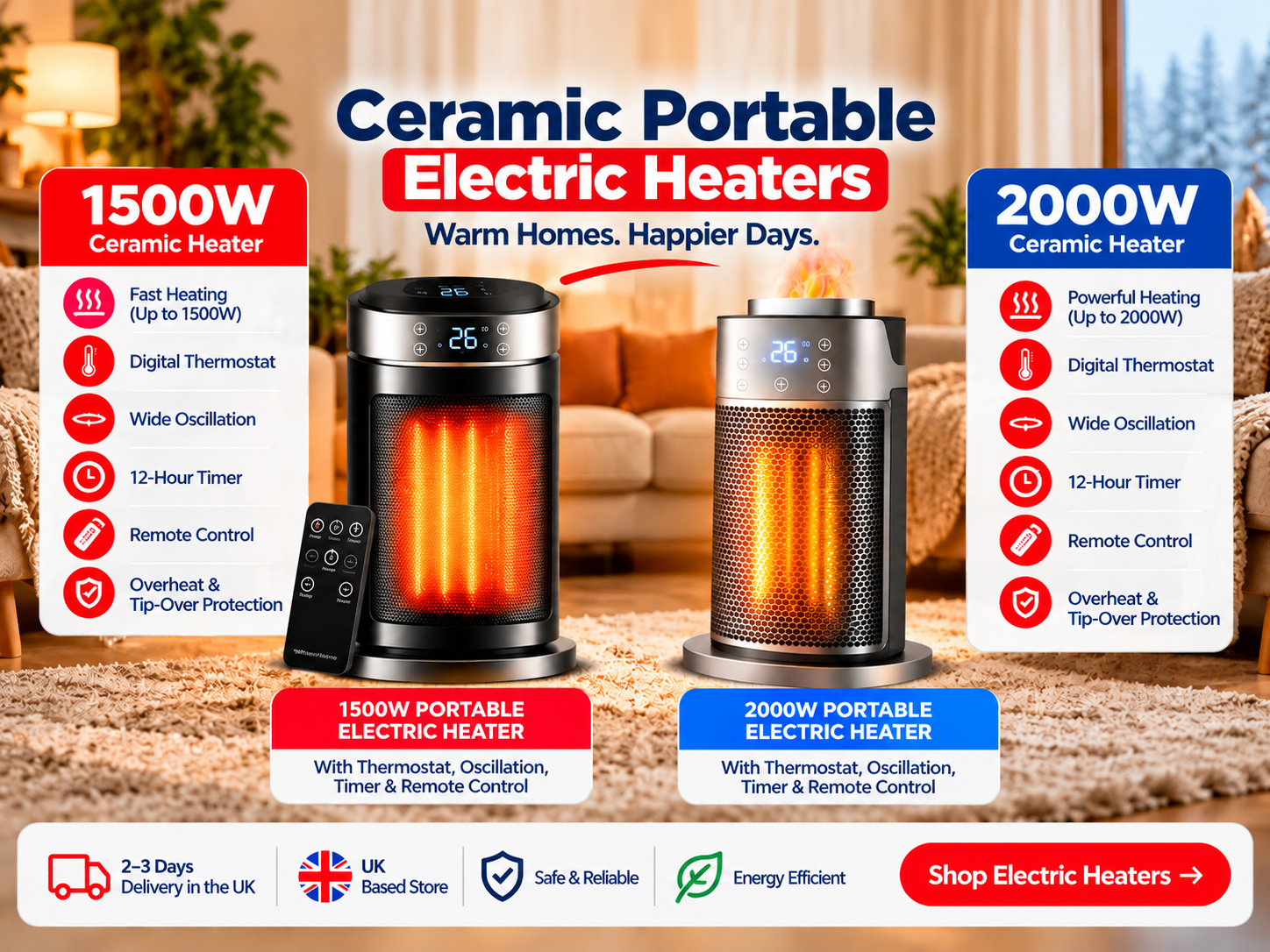
If you need greater maximum heating output, Shopsyde also offers 2000W portable electric heater options.
Depending on the model, confirmed features include combinations of:
up to 2000W heating
ceramic heating
thermostat control
multiple heat settings
oscillation
timers
remote operation
humidification on selected models
At continuous full 2000W output at 26.11p/kWh:
2kW × £0.2611 ≈ £0.522/hour
or approximately:
52.2p per hour
2000W Electric Heater With Humidifier: UK Buying Guide
Browse Shopsyde Portable Electric Heaters →
Ceramic Heater vs Fan Heater: Buying Checklist
Before choosing, compare the actual products:
| Feature | What to Check |
|---|---|
| Heating element | Ceramic/PTC or conventional resistance element |
| Maximum wattage | Maximum rated electrical power |
| Heat settings | Available output levels |
| Thermostat | Temperature-control functionality |
| Fan | Airflow and available modes |
| Oscillation | Whether airflow direction moves |
| Timer | Supported scheduling duration |
| Remote | Whether remote operation is included |
| Noise | Verified dB figure if available |
| Safety | Confirmed tip-over/overheat features |
| Dimensions | Whether it fits safely in your space |
| Warranty | Manufacturer/retailer terms |
| Running cost | Wattage × operating time × electricity rate |
This gives shoppers a more meaningful comparison than simply asking whether the word “ceramic” appears in the product name.
The Bottom Line
When comparing a ceramic heater vs fan heater, remember that these categories can overlap.
Many ceramic portable heaters are ceramic fan heaters.
The practical difference is usually between the type of heating element and the overall appliance design—not simply whether a fan is present.
Rather than choosing based on one marketing term, compare:
wattage
thermostat
heat settings
oscillation
noise
timer
safety features
room requirements
and running cost.
For shoppers who want ceramic heating combined with modern controls, Shopsyde offers 1500W and 2000W portable electric heater options.
Browse Shopsyde Portable Electric Heaters →