

Wondering what size electric heater do I need for a bedroom, living room, home office or another indoor space?
It's tempting to choose a heater based only on wattage or room dimensions, but the answer isn't quite that simple.
A 1500W heater and a 2000W heater have different maximum heating outputs, but the amount of heat your room actually needs also depends on insulation, ceiling height, windows, outside temperature, draughts and how warm you want the room to become.
Portable electric heaters can be useful as supplementary heating when you want to warm one room or provide additional heat during colder periods. Energy Saving Trust describes portable electric heaters as a form of secondary heating that can be useful for warming one room for a short period. (Energy Saving Trust)
This guide explains how to make a more informed choice.
What Does Electric Heater Wattage Mean?
Electric heater wattage tells you the appliance's rated electrical power.
For example:
1000W = 1kW
1500W = 1.5kW
2000W = 2kW
Generally, a 2000W electric resistance heater can produce more heat at maximum output than a 1500W model.
But wattage isn't a direct measurement of:
room size
heating speed in every environment
comfort
electricity used over an entire day
how frequently a thermostat will cycle
That's why simply saying:
“Buy a 2000W heater because your room is large”
isn't enough information.
What Size Electric Heater Do I Need?
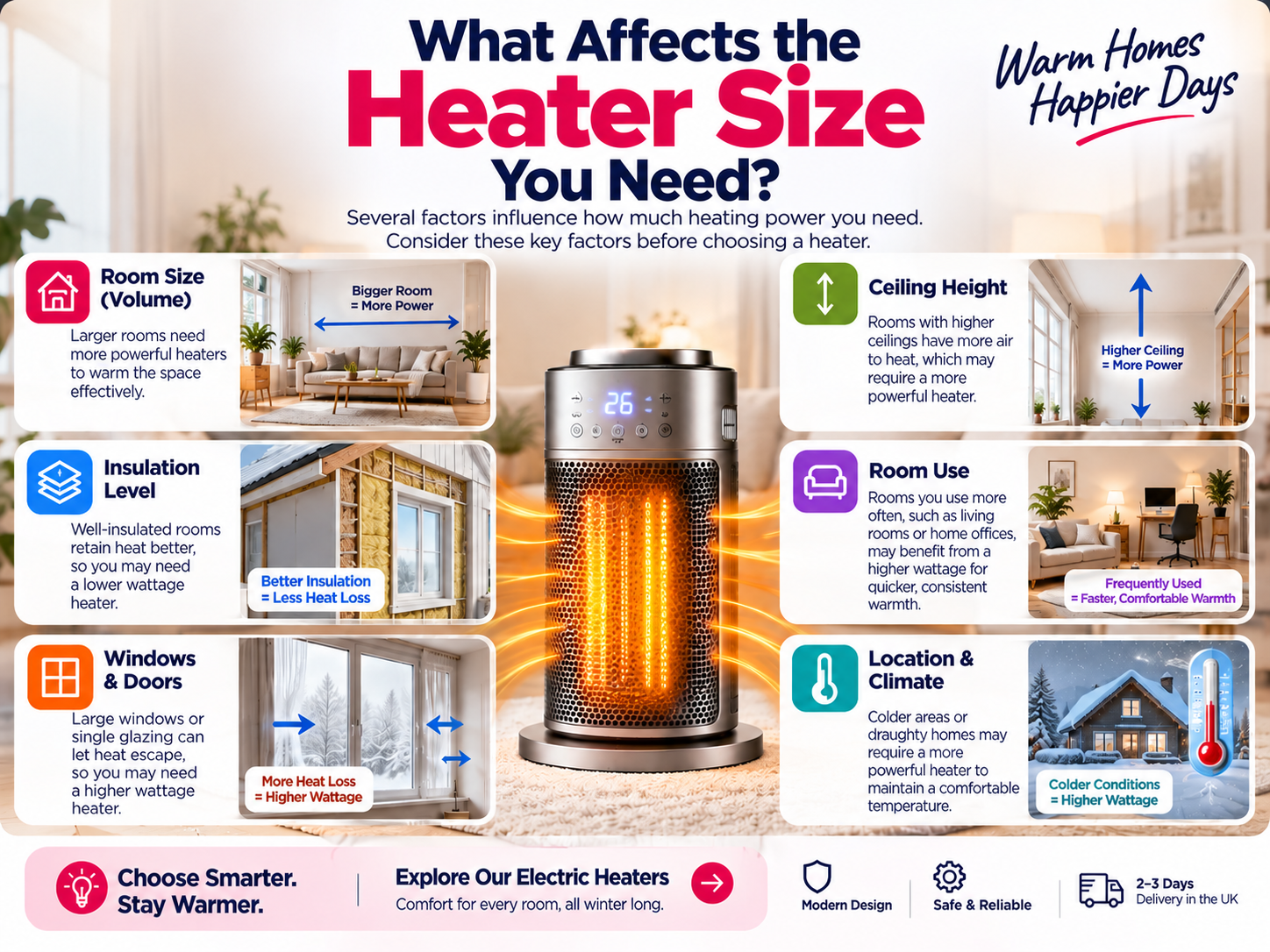
The right heater size depends on how much heat your particular room loses and how much additional heating it needs.
Consider at least these factors:
Room dimensions
A larger volume of space generally requires more heating than a much smaller space under otherwise similar conditions.
Insulation
A well-insulated room generally retains heat better than a poorly insulated one.
Windows
Large windows, older glazing and poorly sealed frames can increase heat loss.
Ceiling height
Two rooms can have the same floor area but very different volumes if one has a much higher ceiling.
Outside temperature
More heat may be required when the temperature outside is substantially lower.
Draughts
Gaps around windows and doors can allow heated air to escape and colder air to enter.
Existing heating
A portable heater being used to supplement central heating has a different job from an appliance being expected to provide most of the room's heat.
So the correct question isn't simply:
How many square metres is my room?
It's:
How much additional heat does this particular room need?
Should You Choose a Heater Based on Room Size Alone?
No.
Room size is useful information, but it should not be the only factor.
Imagine two bedrooms with identical floor dimensions.
Bedroom A has modern glazing, good insulation and little draught.
Bedroom B has older windows, poor insulation and significant heat loss.
Those rooms may have very different heating requirements despite having the same floor area.
This is why Shopsyde should avoid promising that a particular heater will heat a specific number of square metres unless that coverage is actually verified by the manufacturer.
How Do You Measure Your Room?
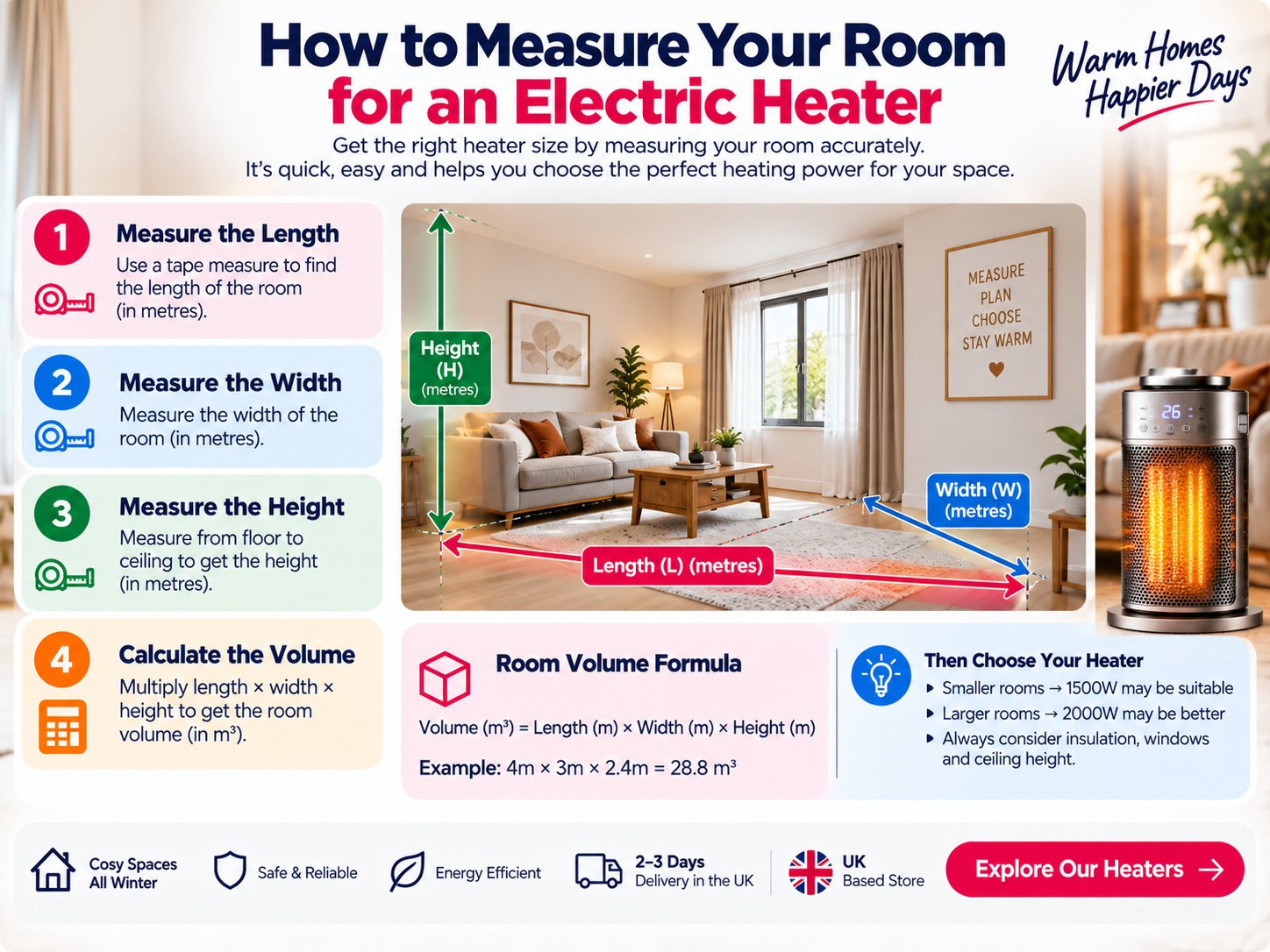
You can start by calculating the floor area.
For a rectangular room:
Length × Width = Floor Area
For example:
4m × 3m = 12m²
You should also consider ceiling height because the heater is ultimately warming a volume of air, not merely a floor.
Room volume can be estimated using:
Length × Width × Height
For example:
4m × 3m × 2.4m = 28.8m³
These measurements give useful context, but they still don't capture insulation and heat loss.
Is a 1500W Heater Enough for a Bedroom?
A 1500W portable electric heater may provide useful supplementary heating in many indoor situations, but wattage alone cannot guarantee that it is appropriate for every bedroom.
Consider:
bedroom dimensions
insulation
glazing
ceiling height
existing heating
outside temperature
desired indoor temperature
For example, someone wanting supplementary warmth while working or relaxing may have different requirements from someone trying to heat a cold room from a much lower starting temperature.
If the manufacturer specifies verified room coverage for the exact heater you're considering, use that information alongside your room conditions.
Otherwise, avoid assuming that every 1500W heater covers the same area.
When Might a 2000W Heater Be Worth Considering?
It may therefore be worth considering when you want more maximum heating capacity.
However, higher wattage also means a higher maximum electrical power draw.
At full rated output:
1500W = 1.5kW
2000W = 2kW
So the decision involves balancing:
Heating requirement ↔ maximum power consumption
rather than simply choosing the largest heater available.
For a detailed comparison, read:
1500W vs 2000W Heater: Which Should You Choose?
1500W vs 2000W Heater: Quick Comparison
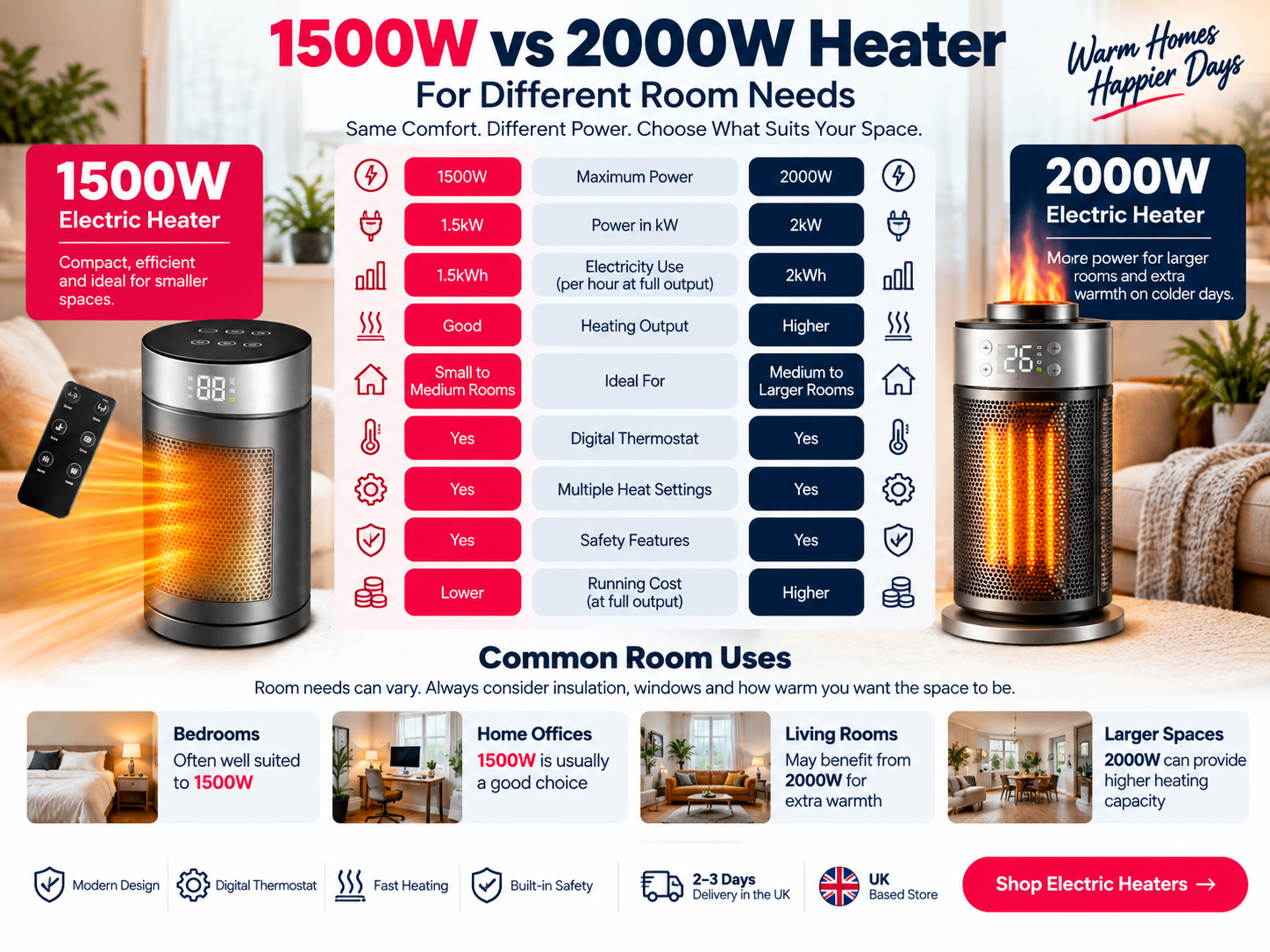
| Feature | 1500W Heater | 2000W Heater |
|---|---|---|
| Maximum rated power | 1500W | 2000W |
| Power in kW | 1.5kW | 2kW |
| Electricity used in 1 hour at continuous full output | 1.5kWh | 2kWh |
| Maximum heating output | Lower | Higher |
| Portable models available | Yes | Yes |
| Thermostat available on Shopsyde models | Yes | Yes |
| Best choice | Depends on room/heating requirement | Depends on room/heating requirement |
The important point is:
2000W isn't automatically better, and 1500W isn't automatically more suitable.
The right choice depends on what you're trying to heat.
Does a Higher-Wattage Heater Heat a Room Faster?
A higher-wattage electric heater can deliver more heat while operating at maximum output.
Therefore, under comparable conditions, a 2000W heater has greater maximum heating capacity than a 1500W heater.
But real-world warm-up time still depends on:
room volume
insulation
heat loss
starting temperature
airflow
heater design
thermostat settings
outside conditions
Avoid interpreting wattage as a guaranteed warm-up time.
Does a Thermostat Matter When Choosing a Heater?
Yes.
A thermostat is particularly useful because it allows the heater to respond to the selected temperature according to the way the particular appliance is designed.
Without thermostatic control, a basic heater may require more manual intervention.
With a thermostat, the heating element may cycle as the selected temperature is approached or maintained.
That means real-world electricity consumption isn't necessarily:
heater wattage × every hour the appliance is switched on
because the heating element may not operate continuously at maximum output.
However, don't assume a particular percentage saving unless there is reliable product-specific evidence.
What About Different Heat Settings?
Multiple heat settings can provide additional flexibility.
For example, some heaters allow you to select different heating outputs rather than always operating at maximum power.
Before purchasing, check:
number of heat settings
wattage associated with each setting
thermostat controls
timer
fan modes
oscillation
Don't assume all 1500W or 2000W heaters operate identically.
Ceramic Heater vs Other Electric Heaters
Ceramic heaters typically use a ceramic heating element combined with airflow.
Electrical Safety First explains that portable heaters come in several forms, including fan heaters, convection heaters, halogen heaters and oil-filled radiators, each with different operating characteristics. (Electrical Safety First)
Your choice should therefore consider heater type as well as wattage.
What Heater Should I Choose for a Small Room?
Don't rely on the label “small room” alone.
Instead, ask:
How large is the room?
How high is the ceiling?
Is the room insulated?
Are the windows modern and well sealed?
Is central heating already operating?
Do you want occasional supplementary warmth or primary heating?
What does the heater manufacturer specify?
A compact portable heater can be useful for supplementary heating, but don't buy solely because an advertisement labels it suitable for “small rooms”.
What Heater Should I Choose for a Larger Room?
The same principle applies.
A larger room may require greater heating capacity, but the appropriate output depends on more than floor area.
A well-insulated larger room may retain heat considerably better than a smaller but poorly insulated room.
If you're unsure about the heating requirement for a particular space, especially where you're considering heating it regularly or replacing an existing heating system, professional heat-loss calculations can provide a more accurate answer than a generic online wattage rule.
Shopsyde 1500W Portable Electric Heater
For customers looking for a compact supplementary heating option, Shopsyde offers a:
1500W Portable Electric Heater With Thermostat & Remote Control
Confirmed features include:
1500W maximum heating
digital thermostat
three heat settings
ceramic heating
oscillation
timer
remote control
portable freestanding design
View the Shopsyde 1500W Portable Electric Heater →
How much does a 1500W heater cost to run?
Shopsyde 2000W Electric Heaters
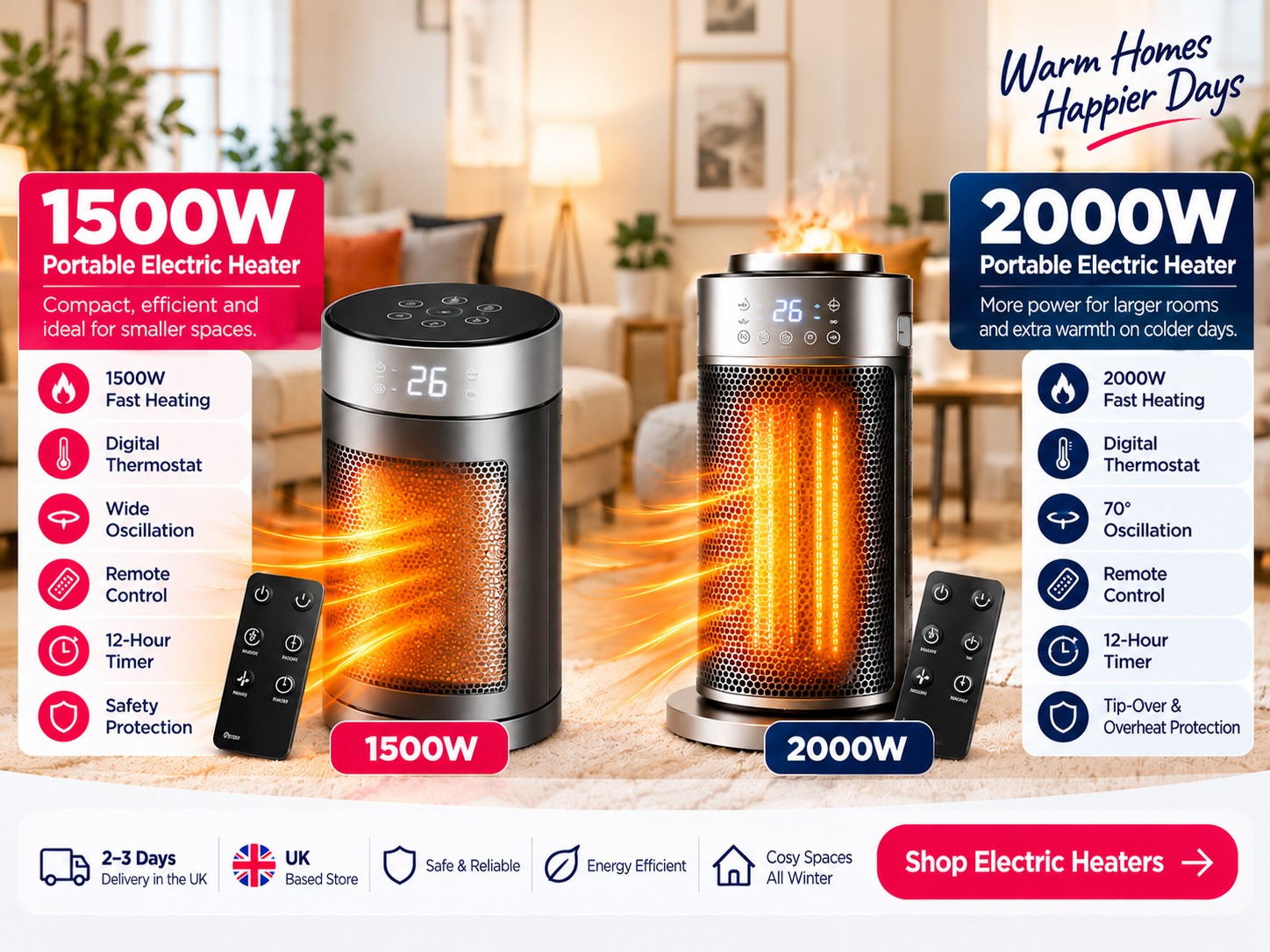
If you're looking for higher maximum heating output, Shopsyde also offers 2000W electric heater options.
Depending on the model, your range includes features such as:
up to 2000W heating
ceramic heating
thermostat controls
oscillation
timers
remote controls
humidifier functionality on selected models
Browse Shopsyde Portable Electric Heaters →
How Much Does Heater Size Affect Running Cost?
Wattage directly affects electricity consumption when comparing continuous operation at maximum power.
A 1500W heater operating continuously at full output uses:
1.5kWh/hour
A 2000W heater operating continuously at full output uses:
2kWh/hour
That means the 2000W heater consumes 0.5kWh more electricity per continuous full-power hour.
However, actual household consumption depends on how long the heating element operates, heat settings, thermostat cycling and room conditions.
1500W vs 2000W Heater Running Costs Compared
Can a Smaller Heater Save Electricity?
At maximum output, a lower-wattage heater consumes less electricity per hour than a higher-wattage heater.
But that doesn't mean choosing the smallest heater is always the most effective approach.
If an undersized heater needs to operate for much longer while struggling to provide the desired warmth, simply comparing maximum wattage doesn't tell the whole story.
Choose based on your actual heating requirement rather than automatically selecting:
lowest wattage = best
or:
highest wattage = best
Where Should You Position a Portable Electric Heater?
Placement affects both comfort and safety.
Electrical Safety First recommends putting a portable heater on a level surface and keeping it at least one metre away from combustible materials such as paper, furniture and curtains. It also advises against powering a portable heater from an extension lead. (Electrical Safety First)
Don't position the heater:
against curtains
beside bedding
where it can easily be knocked over
where airflow is blocked
underneath drying clothes
on an unstable surface
Always follow the manufacturer's placement instructions.
Can You Leave a Portable Heater On Overnight?
Electrical Safety First recommends not using a portable heater overnight and advises never leaving one unattended while operating or while you're asleep. (Electrical Safety First)
GOV.UK winter fire-safety guidance similarly advises unplugging electric heaters when going out or going to bed. (GOV.UK)
A timer should therefore not be treated as permission to ignore safe-use guidance.
Portable Electric Heater Buying Checklist
Before buying, check:
| What to check | Why it matters |
|---|---|
| Maximum wattage | Shows maximum rated electrical power |
| Room dimensions | Provides context for heating requirement |
| Insulation | Influences heat loss |
| Windows/glazing | Can significantly affect heat retention |
| Thermostat | Helps regulate selected temperature |
| Heat settings | Provides greater control |
| Timer | Helps manage operating periods |
| Oscillation | Can distribute airflow more broadly |
| Remote control | Provides convenient operation |
| Plug specification | Ensure suitability for UK use |
| Safety features | Check verified manufacturer specifications |
| Dimensions | Make sure the appliance fits safely |
| Returns/warranty | Check actual retailer/manufacturer terms |
Electrical Safety First also recommends that portable heaters have a UK three-pin plug and advises purchasing from a reputable retailer rather than buying second-hand. (Electrical Safety First)
The Bottom Line
If you're asking what size electric heater do I need, don't choose based on wattage or floor area alone.
Consider:
room dimensions
ceiling height
insulation
windows and draughts
existing heating
outside conditions
thermostat controls
and how much additional heating you actually need.
A 1500W heater offers lower maximum power consumption, while a 2000W heater provides higher maximum heating output. Neither is automatically the correct choice for every room.
For supplementary heating, explore the Shopsyde 1500W and 2000W portable electric heater range and compare the verified specifications of each model before deciding.
Browse Portable Electric Heaters →