

Can you leave an electric heater on overnight?
If you're wondering can you leave an electric heater on overnight, it's important to understand the safety considerations before using a portable heater while sleeping. Portable electric heaters can provide supplementary warmth, but they should not be treated as appliances to leave operating unattended.
For portable electric heaters, the safer approach is not to leave the appliance operating while you're asleep or otherwise unattended.
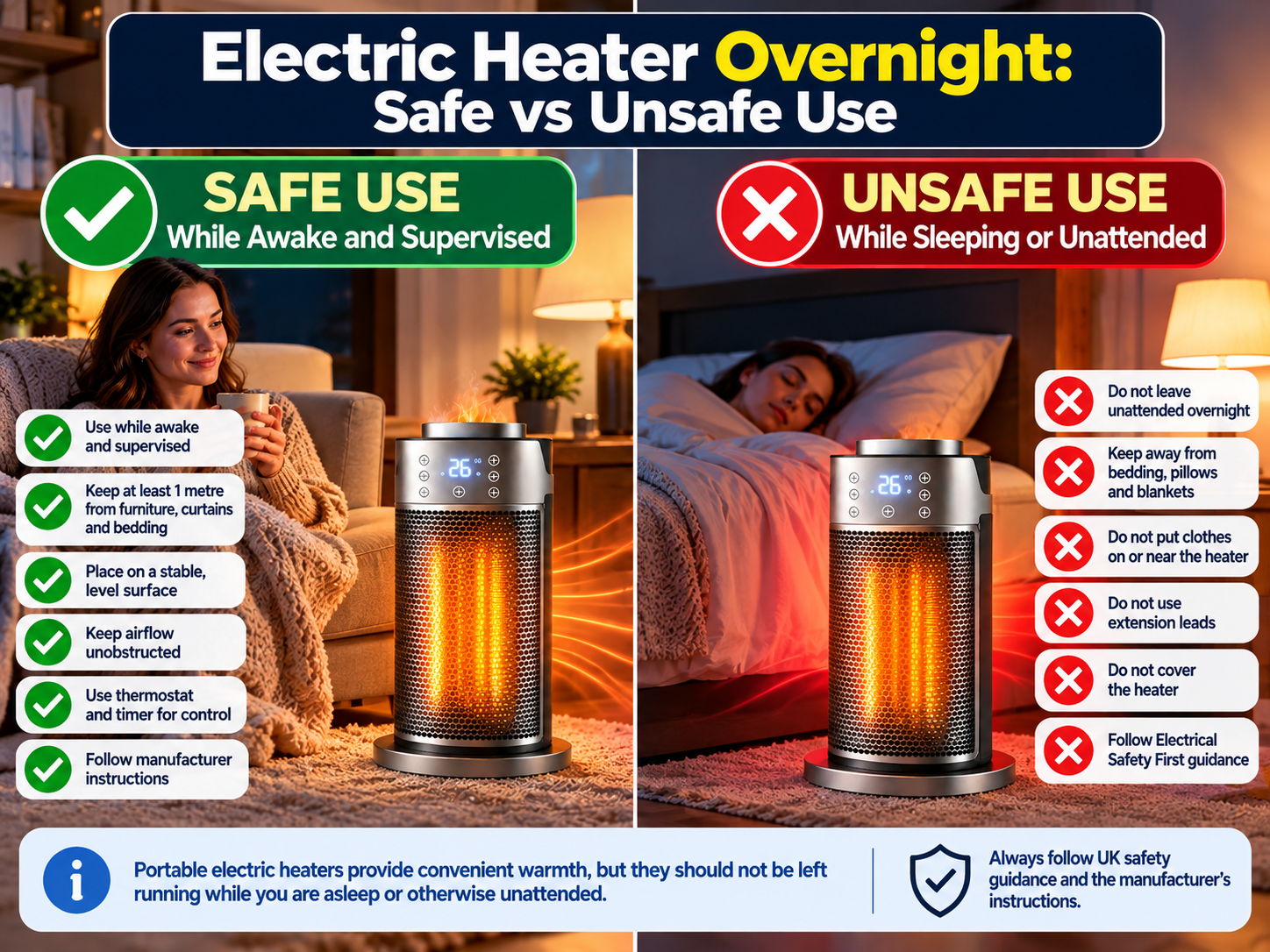
Electrical Safety First advises users not to use portable heaters overnight and says they should never be left unattended. It also recommends keeping portable heaters at least one metre away from combustible materials such as furniture, paper and curtains.
Even if your heater includes a thermostat, timer, tip-over protection or overheat protection, those features don't replace the manufacturer's operating instructions or general portable-heater safety precautions.
Let's look at why.
Can You Leave an Electric Heater On Overnight?
Portable electric heaters are designed to provide convenient supplementary warmth, but that doesn't mean they should be left running unattended for long periods.
Electrical Safety First advises:
don't use portable heaters overnight
don't leave them unattended
keep them away from combustible materials
don't use them to dry clothing
don't power them through extension leads
If you're using a portable heater in a bedroom, use it while you're awake and follow the instructions supplied with the particular appliance.
Why Is Leaving a Portable Heater On Overnight a Concern?
Several things can change while you're asleep.
For example:
Bedding can move.
Curtains can shift.
Clothing or other objects could come into contact with the heater.
Airflow could become obstructed.
An electrical or mechanical problem could develop without being noticed quickly.
When you're awake, you're more likely to notice unusual smells, sounds, overheating or an object getting too close to the appliance.
When you're asleep, your ability to respond is reduced.
Does a Thermostat Change the Safety Advice?
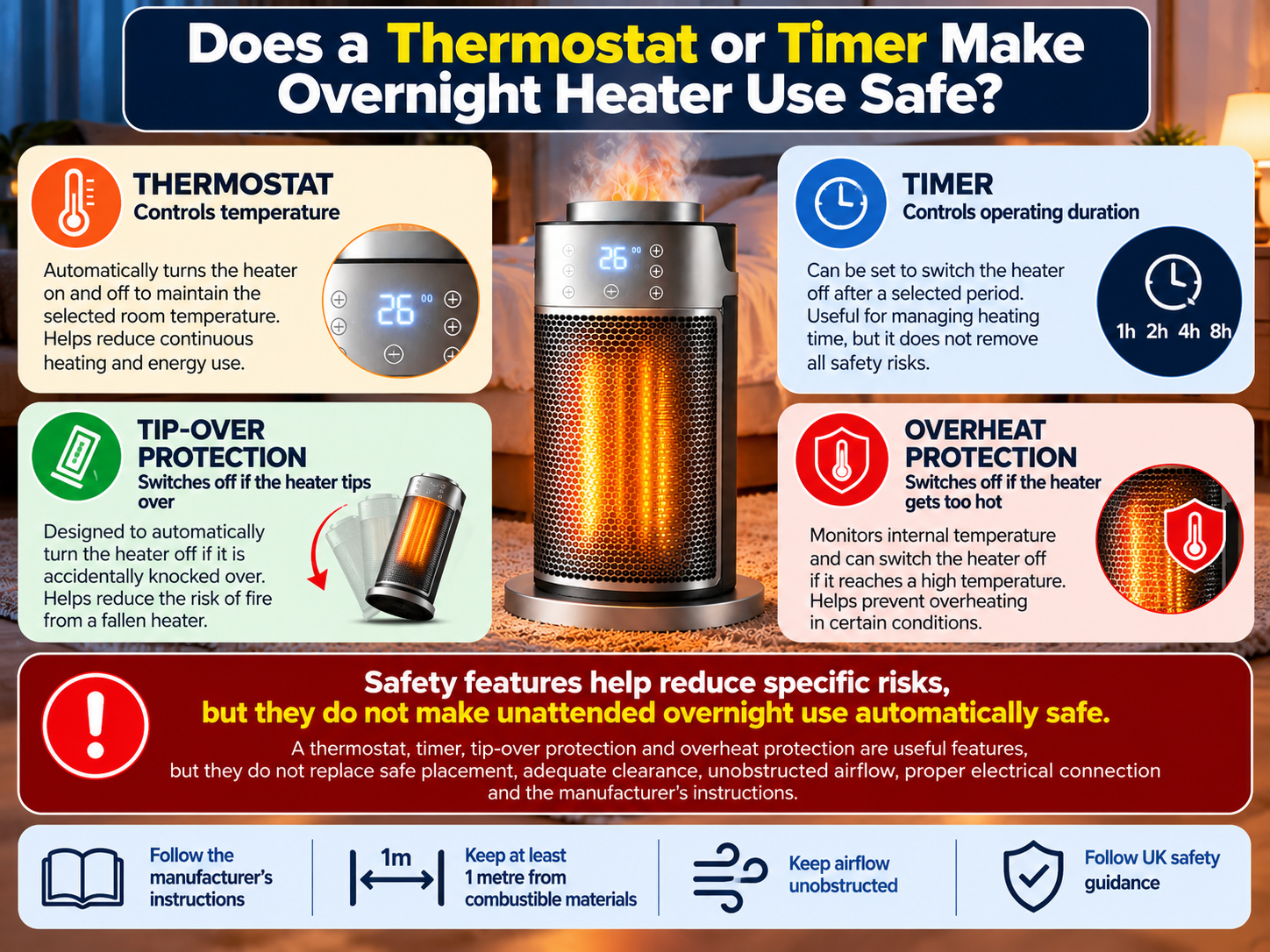
A thermostat is useful, but it shouldn't be confused with permission to leave a portable heater unattended.
A thermostat primarily controls heating according to temperature.
A simplified cycle might be:
Set temperature
→ heater monitors temperature
→ heating operates
→ target temperature approached
→ heating cycles
→ temperature falls
→ heating resumes
This can help regulate room temperature and may reduce continuous heating time.
However:
thermostat ≠ unattended-use guarantee
For a detailed explanation:
How Does a Thermostat Work on an Electric Heater?
What Does a Heater Timer Actually Do?
A timer controls operating duration.
For example, you might configure a heater to switch off after a selected period.
That's useful for managing how long the appliance operates.
But a timer doesn't remove other risks associated with:
combustible materials
blocked airflow
incorrect positioning
electrical problems
damaged cables
improper use
A timer should therefore be considered a control feature, not a substitute for safe-use guidance.
What About Tip-Over Protection?
Some portable heaters include a mechanism designed to switch the heater off if it tips over.
This is a useful safety feature.
But tip-over protection only addresses a particular type of event.
It doesn't necessarily protect against every possible issue, such as:
blocked airflow
combustible materials positioned too closely
damaged wiring
inappropriate extension leads
clothing placed over the heater
Check the exact specifications of your heater rather than assuming a safety feature exists.
What Does Overheat Protection Do?
Overheat protection is designed to respond when the appliance reaches conditions determined by its safety system.
Again, that's valuable.
But:
overheat protection doesn't mean “safe to leave unattended indefinitely.”
Portable heater safety works through multiple layers:
appropriate product design + safety features + correct placement + correct electrical connection + responsible use.
Ceramic Heater Safety During Bedtime Use
A ceramic heating element doesn't change the general guidance about leaving portable heaters operating while you're asleep.
Many ceramic portable heaters include useful features such as:
thermostats
heat settings
oscillation
timers
tip-over protection
overheat protection
depending on the model.
However, Electrical Safety First's guidance about overnight portable-heater use still applies.
For more information about heater technology:
Ceramic Heater vs Fan Heater: Which Should You Choose?
Overnight Safety for a 1500W Electric Heater
The fact that a heater is rated at 1500W doesn't by itself determine whether unattended overnight use is appropriate.
1500W simply describes its maximum rated electrical power.
At full rated output:
1500W = 1.5kW
The safety considerations still include:
placement
clearances
airflow
electrical connection
surrounding materials
manufacturer instructions
supervision
Your existing Article #1 can be internally linked here using:
1500W electric heater running cost
Overnight Safety for a 2000W Electric Heater
The same principle applies to a 2000W portable heater.
2000W represents a maximum rated power of:
2kW
It doesn't mean the appliance should be left unattended while you're asleep.
Higher-power portable heaters also make correct electrical connections especially important.
Electrical Safety First advises against powering portable heaters from extension leads because they can be overloaded.
Should You Use an Extension Lead With an Electric Heater?
Electrical Safety First advises not to power portable heaters from extension leads, because they can be overloaded.
This is particularly relevant to bedroom use because the nearest wall socket may not always be beside the location where someone wants to place the heater.
Don't solve that problem by automatically running an extension lead across the room.
Instead, follow the manufacturer's electrical instructions and choose an appropriate safe location.
Where Should You Place a Heater in a Bedroom?
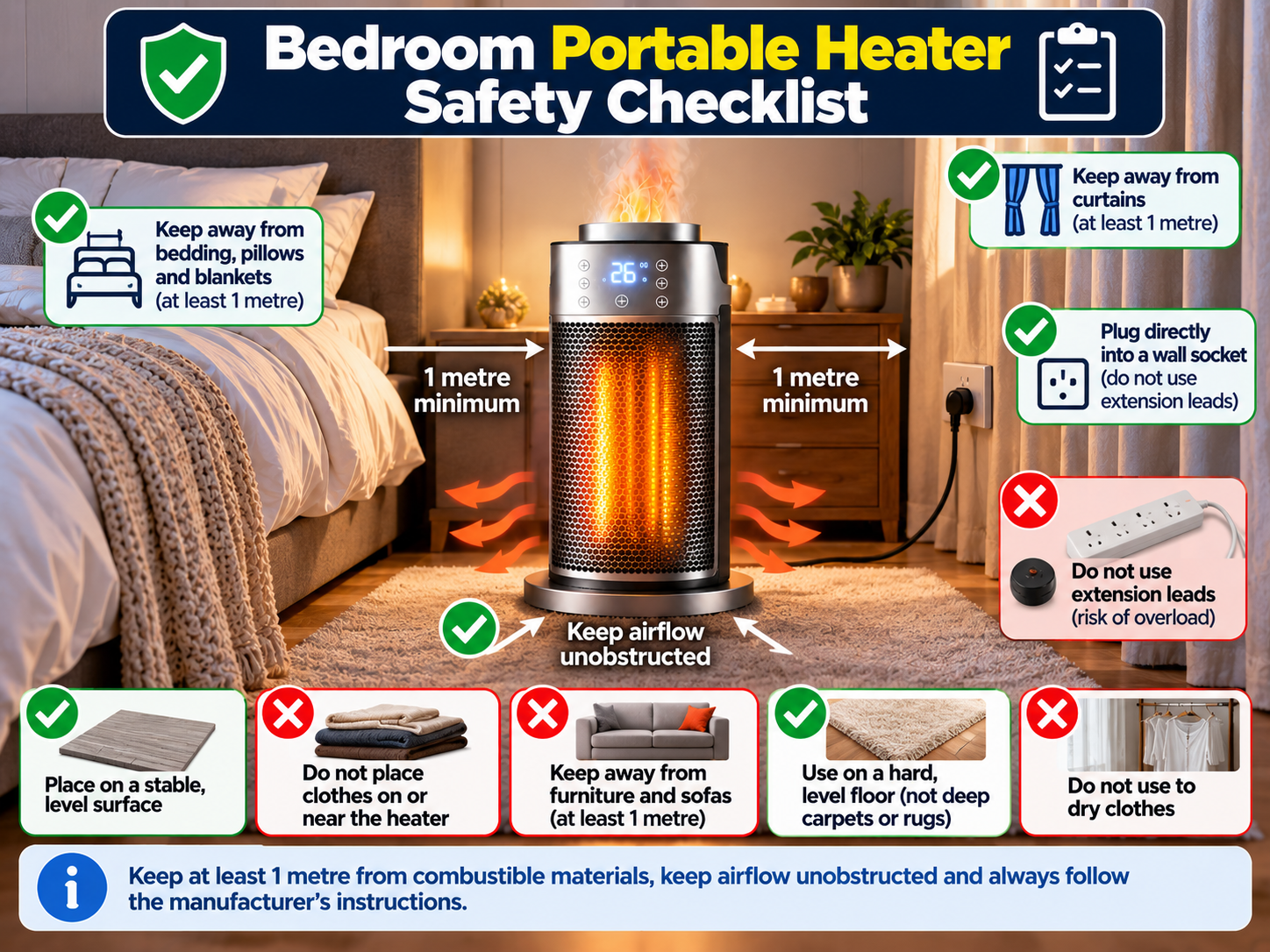
Placement is particularly important around beds.
Keep the heater away from:
bedding
pillows
blankets
clothing
curtains
furniture
paper
other combustible materials
Electrical Safety First recommends at least one metre between a portable heater and combustible materials.
Where Should You Place a Portable Electric Heater? UK Safety Guide
That article provides your complete placement guide.
Should You Put a Heater Next to Your Bed?
Avoid positioning a portable heater immediately beside your bed.
Bedding can move substantially during the night.
A duvet or blanket that was safely away from the heater when you went to bed could potentially move closer later.
The same applies to:
clothing
pillows
throws
curtains
Maintain the manufacturer's required clearance and Electrical Safety First's general one-metre recommendation from combustible materials.
Can You Put an Electric Heater Under the Bed?
No portable heater should be positioned where its airflow is obstructed or where it is surrounded by combustible bedding.
Under-bed placement can also make the heater difficult to monitor.
Use the appliance only in a location permitted by its manufacturer.
Can You Cover an Electric Heater at Night?
No.
Never cover a portable electric heater.
Electrical Safety First advises users not to cover portable heaters and not to use them to dry clothes.
Covering an appliance can restrict airflow and contribute to overheating.
Keep:
blankets
clothes
towels
bedding
and other materials away from the heater.
Can You Use an Electric Heater to Dry Clothes Overnight?
No.
Don't place clothing on or directly around a portable heater for drying.
Electrical Safety First specifically advises against using portable heaters to dry clothes.
This applies whether you're awake or asleep.
Is It Better to Warm the Bedroom Before Sleeping?
If you want supplementary warmth in your bedroom, one approach is to use the portable heater while you're awake, following the manufacturer's instructions, and then switch it off before sleeping.
A thermostat and timer can help manage heating while you're using the appliance.
But your heating strategy should also consider:
insulation
draughts
bedding
room temperature
existing central heating
rather than relying solely on a portable heater.
What Temperature Should a Bedroom Be?
There's no single temperature appropriate for every person.
Age, health, personal comfort and other circumstances matter.
For general household heating, Energy Saving Trust says that 18–21°C should be comfortable for most people, while some people—including older people, babies and those with certain health conditions—may require higher temperatures.
If someone's health means they require a particular indoor temperature, follow appropriate medical or professional guidance rather than relying on a general online figure.
Does Insulation Matter for Overnight Comfort?
Yes.
Better heat retention can reduce how quickly a bedroom loses warmth after heating stops.
Consider:
loft insulation
wall insulation
glazing
draught-proofing
curtains
doors
Improving heat retention can be more useful than simply running a portable heater for longer.
What Size Electric Heater Do I Need for My Room?
How Much Would an Electric Heater Cost to Run Overnight?
Although unattended overnight operation isn't recommended for portable heaters, understanding the theoretical cost helps explain the importance of operating time.
Using 26.11p/kWh as the Ofgem average Direct Debit electricity rate for 1 July–30 September 2026:
1500W at continuous full power for 8 hours
1.5kW × 8 = 12kWh
12 × £0.2611 = approximately £3.13
2000W at continuous full power for 8 hours
2kW × 8 = 16kWh
16 × £0.2611 = approximately £4.18
These are theoretical continuous-full-power calculations, not recommendations to operate a portable heater overnight.
A thermostatically controlled heater may consume less than the maximum theoretical amount because its heating element can cycle.
Are Electric Heaters Expensive to Run in the UK?
Because electricity prices change, update these figures when the Ofgem price-cap period changes.
Electric Heater Overnight Safety Checklist
Before using a portable heater at any time:
| Check | What to do |
|---|---|
| Placement | Stable and level |
| Clearance | At least 1m from combustible materials |
| Curtains | Keep safely away |
| Bedding | Keep safely away |
| Clothing | Never place over heater |
| Airflow | Keep vents unobstructed |
| Power | Follow manufacturer's electrical instructions |
| Extension lead | Avoid |
| Damage | Don't use damaged equipment |
| Unattended use | Avoid |
| Sleeping | Don't leave portable heater running |
| Instructions | Follow the manufacturer |
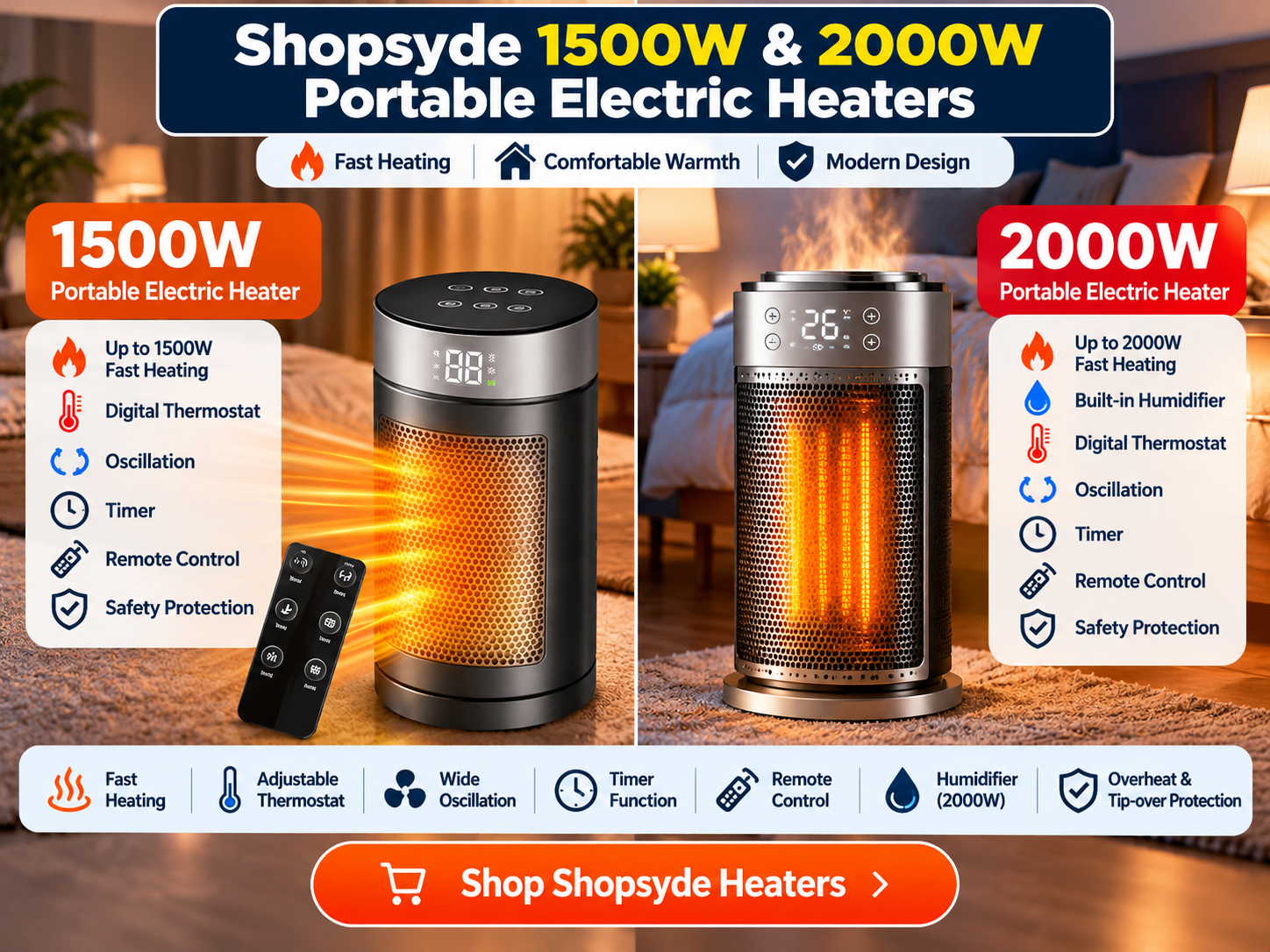
Shopsyde 1500W Portable Electric Heater
The Shopsyde 1500W Portable Electric Heater with Thermostat, Oscillation, Timer & Remote Control provides flexible supplementary heating while you're awake and using the appliance appropriately.
Features include:
up to 1500W heating
ceramic heating
digital thermostat
multiple heat settings
oscillation
timer
remote control
View the Shopsyde 1500W Portable Electric Heater →
Shopsyde 2000W Portable Electric Heater
For greater maximum heating output, Shopsyde also offers a 2000W Portable Electric Heater with Humidifier, Thermostat, Timer & Remote Control.
Features include:
up to 2000W heating
thermostat control
timer
remote operation
humidifier functionality
portable design
View the Shopsyde 2000W Portable Electric Heater →
Browse Shopsyde Portable Electric Heaters →
The Bottom Line
So, can you leave an electric heater on overnight?
For portable electric heaters, the safer answer is don't leave them operating while you're asleep or otherwise unattended. Electrical Safety First specifically advises against overnight portable-heater use.
A thermostat, timer, tip-over switch and overheat protection can all be useful features, but they don't replace:
safe placement
adequate clearance
unobstructed airflow
proper electrical connection
manufacturer instructions
and supervision.
For more guidance, read:
Where Should You Place a Portable Electric Heater? UK Safety Guide
Portable Electric Heater UK: Buying Guide 2026