

Do electric heaters dry out the air? Electric heaters can make indoor air feel drier by increasing room temperature and lowering relative humidity. However, most conventional electric heaters do not directly remove water vapour from the air. Understanding how heating affects humidity can help UK households maintain comfortable indoor conditions during winter.
If you're wondering do electric heaters dry out the air, the answer is that electric heaters can make indoor air feel drier by reducing its relative humidity, even though they generally do not directly remove water vapour from the room.During colder months in the UK, many households use portable electric heaters to provide additional warmth in bedrooms, living rooms and home offices. While these appliances can help maintain a comfortable temperature, you may notice that the air feels less comfortable when the heating is operating.
This happens because temperature and relative humidity are closely connected. When air becomes warmer without additional moisture being introduced, its relative humidity decreases.
Understanding this relationship can help you manage indoor comfort, avoid unnecessary humidification and choose suitable heating equipment.
In this guide, we'll explain how electric heating affects humidity, whether ceramic heaters behave differently and when a humidifier may be useful.
Do Electric Heaters Dry Out the Air When Heating a Room?
Electric heaters can reduce the relative humidity of indoor air as the temperature rises.
However, that doesn't necessarily mean the heater is physically removing water from the room.
Relative humidity describes how much water vapour is present compared with the maximum amount the air could hold at its current temperature.
When temperature increases, the air's capacity to contain water vapour increases.
If the actual amount of water vapour remains unchanged, the relative humidity decreases.
For example, imagine a room at:
18°C and 50% relative humidity
If the air is warmed to approximately 23°C without adding or removing moisture, its relative humidity could fall to around 37%.
These figures are illustrative and assume approximately constant water-vapour content.
The room hasn't necessarily lost water vapour, but the air now has a lower relative humidity.
That change can contribute to the sensation of dry indoor air.
Why Does Indoor Air Feel Drier During Winter?
Winter air can contribute to lower indoor humidity for several reasons.
Cold outdoor air often contains less water vapour than warmer air, even when its relative humidity is high.
When cold outdoor air enters a home and is heated, its relative humidity can fall substantially.
Common contributing factors include:
Cold outdoor temperatures
Ventilation and air exchange
Draughts around windows and doors
Central heating
Portable electric heating
Low indoor moisture generation
For example, outdoor air at a low temperature may feel damp or humid.
However, once that air enters a warm room, its relative humidity can become much lower.
This is one reason some UK homes experience dry indoor conditions during winter.
For additional guidance, read our previous article: Humidifier for Dry Air in Winter — UK Guide.
Does an Electric Heater Remove Moisture From the Air?
Most conventional electric resistance heaters do not directly remove water vapour from the surrounding air.
They generate heat using electricity.
This includes many:
Ceramic heaters
Fan heaters
Oil-filled radiators
Convector heaters
Panel heaters
However, heating can change how humid the air feels.
Absolute humidity vs relative humidity
These two concepts are different.
Absolute humidity describes the mass of water vapour in a given volume of air.
Relative humidity describes the amount of water vapour present relative to saturation at the current temperature.
When air is heated without moisture being added or removed, relative humidity decreases.
In real homes, ventilation, condensation and moisture-producing activities can also change the actual water-vapour content.
Therefore, the final humidity level depends on more than the heater alone.
How Does Heating Affect Relative Humidity?
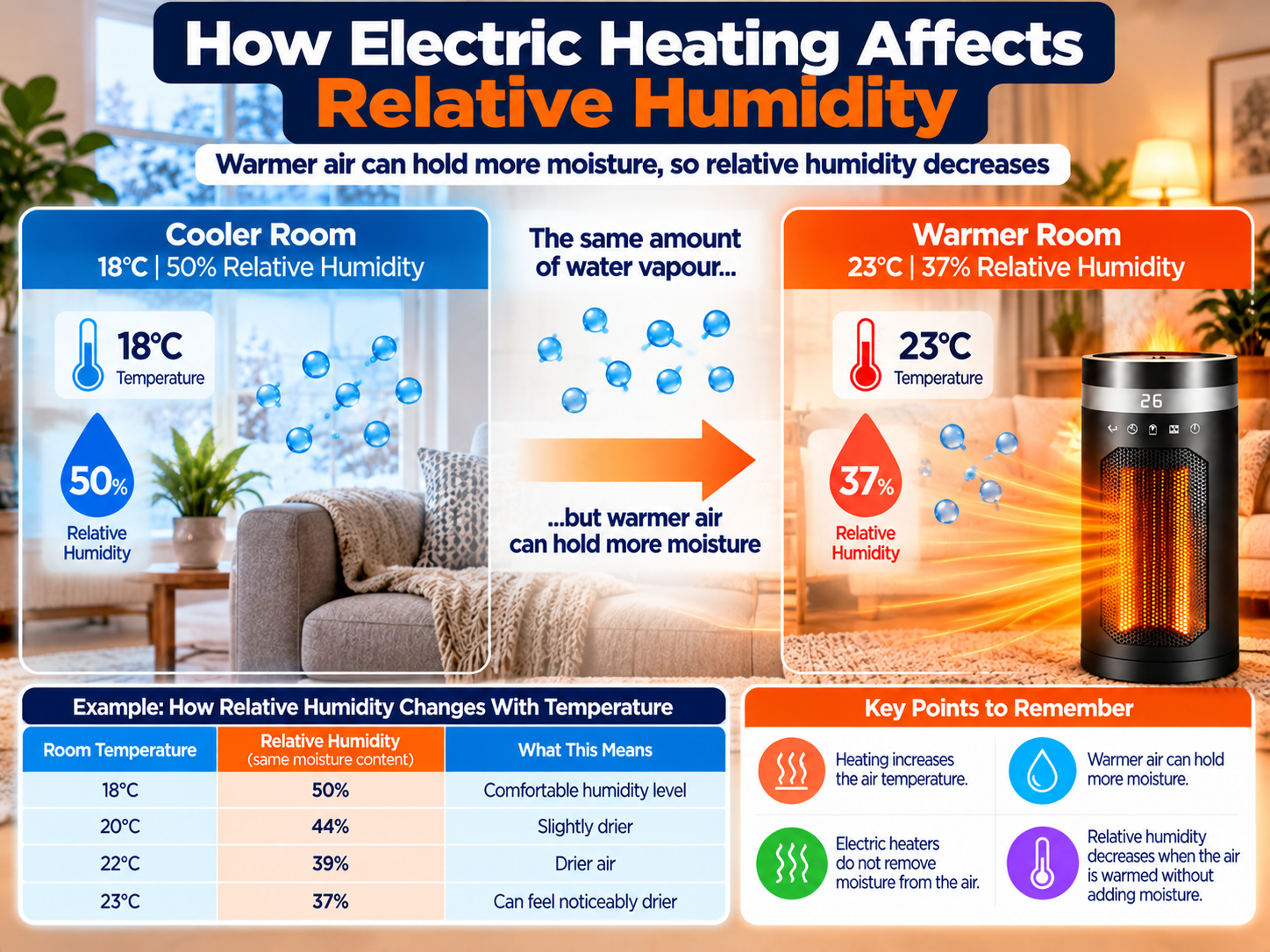
Heating changes the relationship between air temperature and moisture.
Consider this simplified example:
Room temperature | Approximate relative humidity |
|---|---|
18°C | 50% |
20°C | 44% |
22°C | 39% |
23°C | 37% |
These are illustrative values for air warmed from 18°C at 50% relative humidity without changing its water-vapour content.
They are not universal humidity readings for every room.
The important point is that relative humidity can decrease as temperature increases.
This is why turning up the heating may make a room feel drier even though the heater isn't actively extracting moisture.
If you're interested in how heater controls regulate temperature, read our Electric Heater Thermostat Guide.
Can Ceramic Heaters Make a Room Feel Dry?
Yes, ceramic heaters can make indoor air feel drier when they increase the room temperature.
However, this isn't a unique property of ceramic heating technology.
A ceramic heater and another conventional electric resistance heater can both reduce relative humidity by warming the air.
The effect depends mainly on:
Temperature increase
Starting humidity
Ventilation
Room conditions
Moisture entering or leaving the space
Ceramic heaters commonly use a heating element and fan to distribute warmth.
The fan may increase air movement, which can influence how the air feels against your skin.
However, ceramic technology doesn't automatically remove more water vapour than other resistance heating methods.
For a detailed comparison, explore our Ceramic Heater vs Fan Heater UK Guide.
What Are the Signs of Low Indoor Humidity?

Low relative humidity can contribute to several uncomfortable indoor conditions.
Possible signs include:
1. Dry Skin
Some people notice that their skin feels drier during colder months when indoor relative humidity is low.
2. Dry Nose or Throat
Dry indoor air may contribute to irritation or discomfort in the nose and throat.
However, these symptoms can also have other causes.
3. Static Electricity
Static electricity may become more noticeable in low-humidity environments.
4. Dry-Feeling Indoor Air
A room may feel less comfortable even when the temperature is warm enough.
5. Changes in Wooden Furnishings
Very dry indoor conditions can affect some wooden furniture, flooring and musical instruments over time.
These signs don't confirm that humidity is too low.
The most reliable way to assess indoor relative humidity is to measure it.
What Is a Comfortable Indoor Humidity Level?
A commonly used indoor relative humidity range is approximately 30% to 50%, although comfort and building conditions vary.
Many households aim for around 40% to 50% when conditions permit.
However, maintaining higher humidity isn't always beneficial.
Excess moisture can increase the risk of:
Condensation
Damp surfaces
Mould growth
Dust mites
Moisture damage
This is particularly relevant during UK winters when windows and external walls may be cold.
A small digital hygrometer can help you monitor relative humidity.
If condensation regularly appears on windows or walls, adding more moisture may make the problem worse.
The US Environmental Protection Agency's indoor air quality guidance provides useful background information about indoor humidity and moisture control.
For UK-specific damp and mould guidance, see GOV.UK.
Can a Humidifier Help With Winter Dry Air?
A humidifier adds moisture to indoor air.
When relative humidity is genuinely low, appropriate humidifier use may help maintain more comfortable conditions.
However, it is important to measure humidity rather than assuming every heated room requires additional moisture.
For example, a room with 30% relative humidity may benefit from carefully controlled humidification.
A room already at 55% relative humidity may not need additional moisture, particularly if condensation is present.
Important humidifier considerations
Monitor humidity using a hygrometer.
Avoid excessive moisture.
Follow the manufacturer's cleaning instructions.
Replace water regularly.
Keep electrical equipment away from water.
Use the recommended water type.
Stop or reduce humidification if condensation develops.
Poorly maintained humidifiers can disperse contaminants into indoor air.
For more detailed advice, read our Humidifier for Dry Air in Winter — UK Guide.
Electric Heater With Humidifier: How Does It Work?
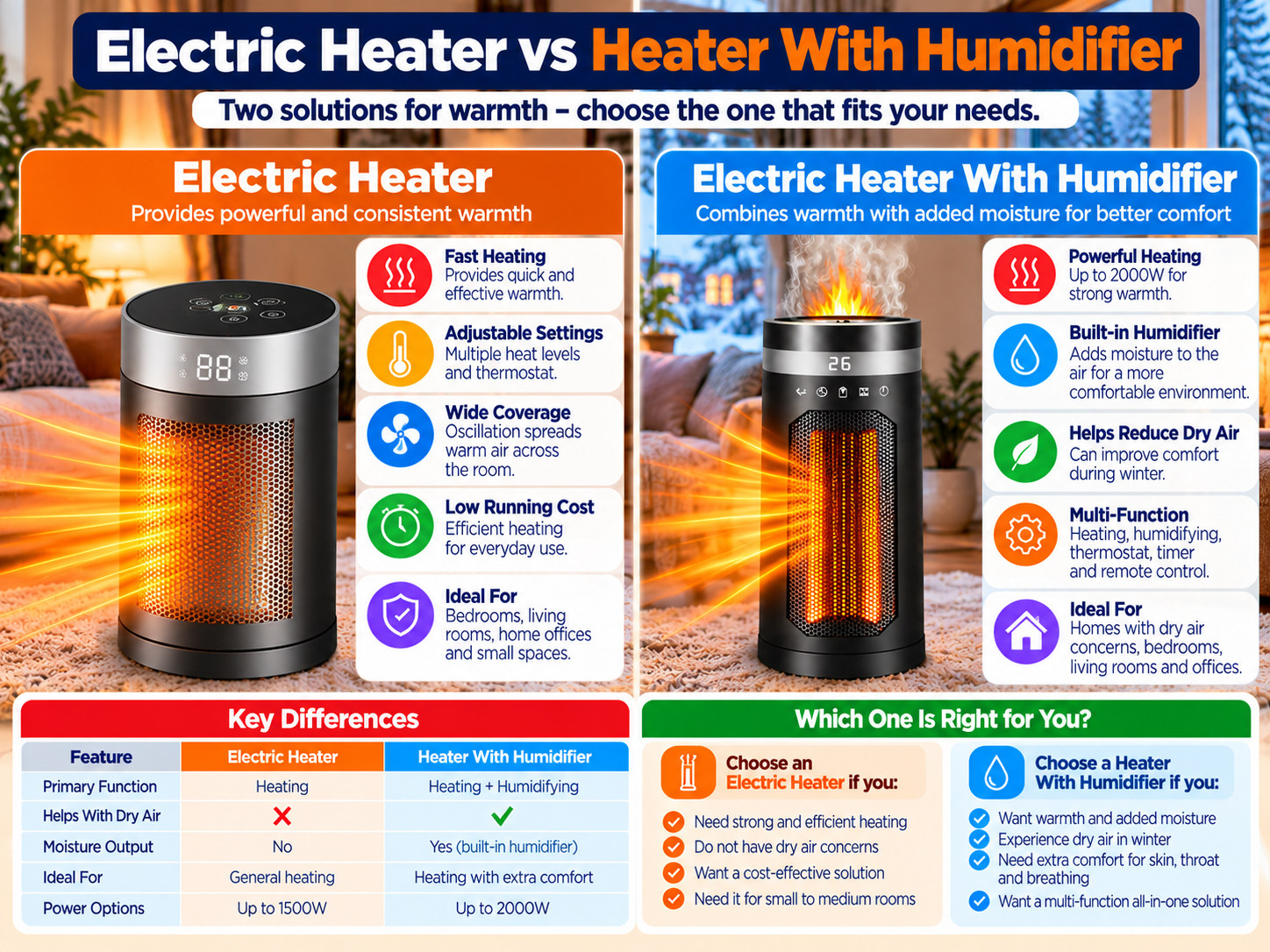
An electric heater with a humidifier combines two functions in one appliance.
The heating component provides warmth, while the humidifier component is designed to introduce moisture into the surrounding air.
The two functions address different aspects of indoor comfort.
Heating function
The heating element increases the temperature of the surrounding air.
This can lower relative humidity if the water-vapour content remains unchanged.
Humidifier function
The humidifier introduces additional moisture.
Depending on the appliance's design and controls, this can help counteract a decrease in relative humidity.
However, humidification must be managed carefully.
A combined heater and humidifier doesn't automatically maintain a particular humidity percentage unless it has appropriate humidity sensing and control.
Always check the manufacturer's specifications.
Does Using a Humidifier Increase Electricity Costs?
A humidifier uses electricity, so operating one can increase total energy consumption.
The amount depends on the humidifier's rated power and operating duration.
For example, consider a hypothetical humidifier drawing 20W.
At continuous operation for five hours:
20W ÷ 1000 × 5 = 0.1kWh
At an illustrative electricity rate of 25p/kWh:
0.1 × £0.25 = £0.025
That equals approximately 2.5p.
This is only a mathematical example, not the confirmed consumption of a Shopsyde humidifier.
The actual electrical power of a heater's integrated humidifier should be checked against its specifications.
If a heater and humidifier operate simultaneously, the total electrical consumption depends on the appliance's design and which functions are active.
How Can You Reduce Dry Air While Heating?
Managing indoor humidity involves more than changing your heater.
Several practical steps can help.
Monitor Relative Humidity
Use a hygrometer to understand whether the air is genuinely dry.
Avoid Unnecessarily High Temperatures
Heating a room more than necessary can lower relative humidity further when the water-vapour content remains unchanged.
Maintain Appropriate Ventilation
Ventilation is important for indoor air quality and moisture control.
However, excessive uncontrolled draughts can also increase heating demand.
Use a Humidifier Only When Needed
Add moisture carefully if measured humidity is low.
Avoid excessive humidification.
Address Condensation and Damp
If your home already experiences condensation or mould, investigate moisture sources and ventilation before adding more humidity.
Maintain Heating Equipment
Follow the manufacturer's instructions for cleaning and maintaining portable heaters.
For more practical heating advice, explore our How to Use an Electric Heater Efficiently in Winter guide.
Where Should You Position a Heater and Humidifier?
Portable heaters and humidifiers should be positioned according to their manufacturers' instructions.
For a separate humidifier, avoid placing it where water or mist could reach a heater, electrical socket, plug or cable.
Portable heater placement
Keep the heater on a stable, suitable surface.
Maintain the manufacturer's required clearances.
Keep it away from curtains, bedding and clothing.
Avoid blocking airflow.
Don't cover the appliance.
Don't leave it operating unattended.
Don't use an extension lead unless the manufacturer explicitly permits a suitable arrangement; direct wall-socket connection is generally recommended.
Electrical Safety First advises keeping portable heaters at least one metre away from combustible materials.
For a detailed explanation, read our Portable Electric Heater Placement and Safety Guide.
You can also consult Electrical Safety First's portable-heater safety guidance.
Shopsyde 2000W Electric Heater With Humidifier
For customers seeking supplementary heating with an integrated humidifier function, Shopsyde offers the 2000W Portable Electric Heater with Humidifier, Thermostat, Timer & Remote Control.
This appliance combines portable electric heating with humidification functionality.
Key features
Up to 2000W heating power
Built-in humidifier
Thermostat control
Timer
Remote control
Portable design
The heating function provides warmth, while the humidifier can add moisture when appropriate.
However, the humidifier should be used according to the manufacturer's instructions and the room's measured humidity.
The 2000W rating indicates the heater's advertised maximum heating power; actual total electrical consumption depends on the operating mode and auxiliary functions.
View the Shopsyde 2000W Electric Heater With Humidifier →
Shopsyde 1500W Portable Electric Heater
Shopsyde also offers the 1500W Portable Electric Heater with Thermostat, Oscillation, Timer & Remote Control.
This model is designed for supplementary portable heating with adjustable controls.
Key features
Up to 1500W heating power
Ceramic heating
Digital thermostat
Multiple heat settings
Oscillation
Timer
Remote control
At continuous full 1500W output, the heater consumes approximately 1.5kWh per hour.
Actual energy consumption can vary with heat settings and thermostat cycling.
If additional humidification is required, a separate humidifier may be considered, provided it is positioned and operated safely.
View the Shopsyde 1500W Portable Electric Heater →
Shopsyde 300ml Flame-Effect Humidifier
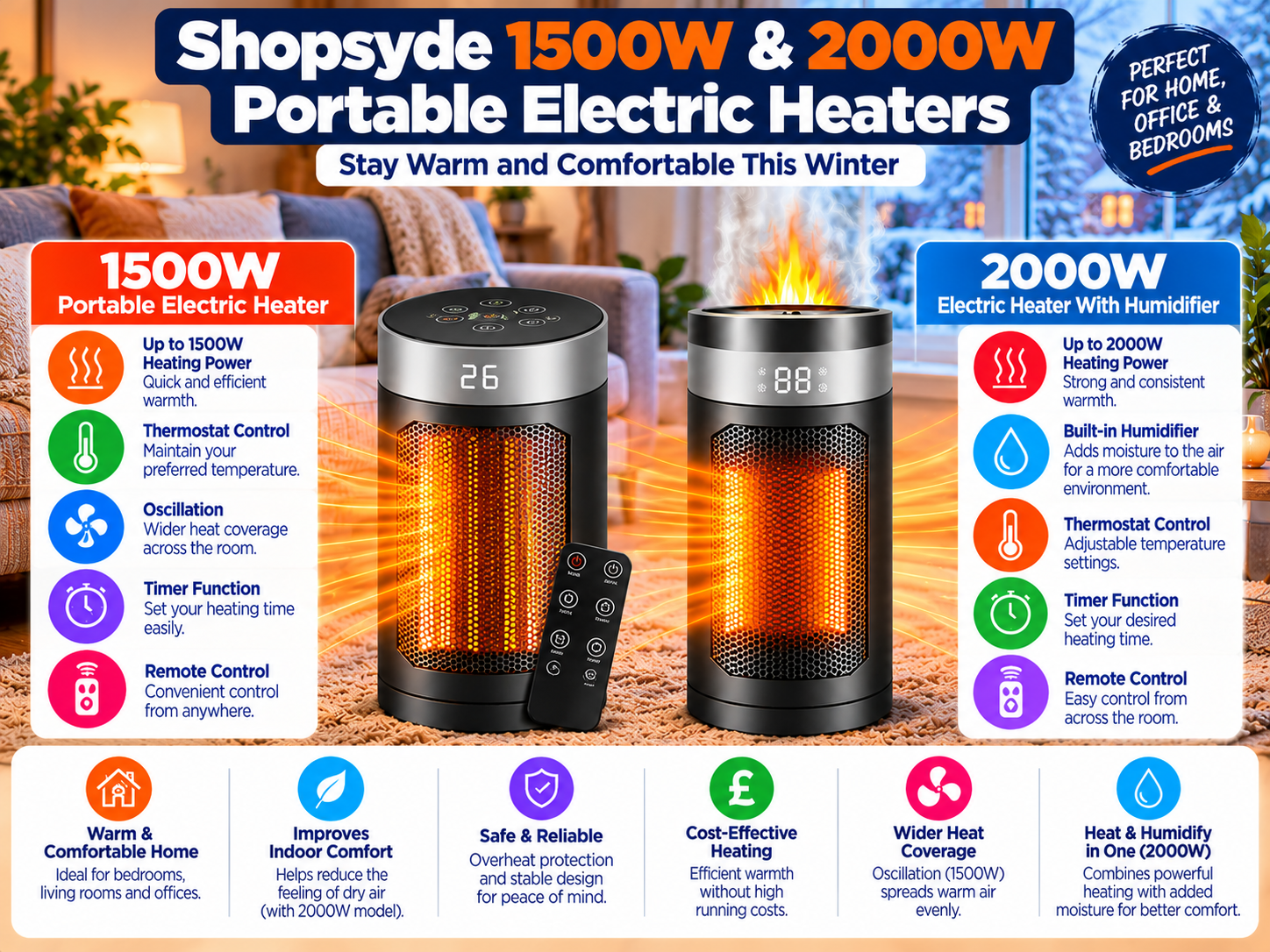
For customers looking for a separate humidifier, Shopsyde offers the 300ml Flame-Effect Humidifier and Aroma Diffuser with LED Lights.
This product combines a compact humidifier design with decorative flame-effect lighting.
It can be considered for adding moisture to indoor air when humidity is low, subject to its rated output and the room's requirements.
Key features
300ml water capacity
Flame-effect lighting
LED illumination
Compact design
Humidification functionality
Always follow the manufacturer's instructions for water, cleaning and operation.
View the Shopsyde 300ml Flame-Effect Humidifier →
You can also browse Shopsyde portable electric heaters.
Electric Heating and Indoor Humidity: Quick Comparison
Factor | What happens |
|---|---|
Electric heating | Increases air temperature |
Relative humidity | Can decrease as temperature rises |
Water vapour | Not necessarily removed by the heater |
Ceramic heating | Does not inherently remove more moisture |
Winter ventilation | Can introduce air with low water-vapour content |
Humidifier | Adds moisture to indoor air |
Hygrometer | Measures relative humidity |
Excess humidity | Can increase condensation and mould risk |
Thermostat | Helps regulate heating temperature |
Good insulation | Helps reduce heat loss |
The Bottom Line
So, do electric heaters dry out the air?
Conventional electric heaters generally do not directly remove moisture from indoor air. Instead, they increase air temperature, which can reduce relative humidity and make the room feel drier.
This effect is not unique to ceramic heaters or portable electric heaters.
The most practical approach is to monitor indoor humidity, use sensible heating temperatures, maintain appropriate ventilation and add moisture only when it is genuinely needed.
For customers seeking portable heating with an integrated humidifier, the Shopsyde 2000W Electric Heater With Humidifier combines both functions in one appliance.
For supplementary heating without integrated humidification, explore the Shopsyde 1500W Portable Electric Heater.