Discover whether running an electric heater on low or high costs less. Compare wattage, electricity consumption, thermostat cycling and practical UK heating costs.
If you're wondering whether to run your electric heater on low or high, the answer depends on the heater's power settings, how long it operates and the amount of warmth your room requires.
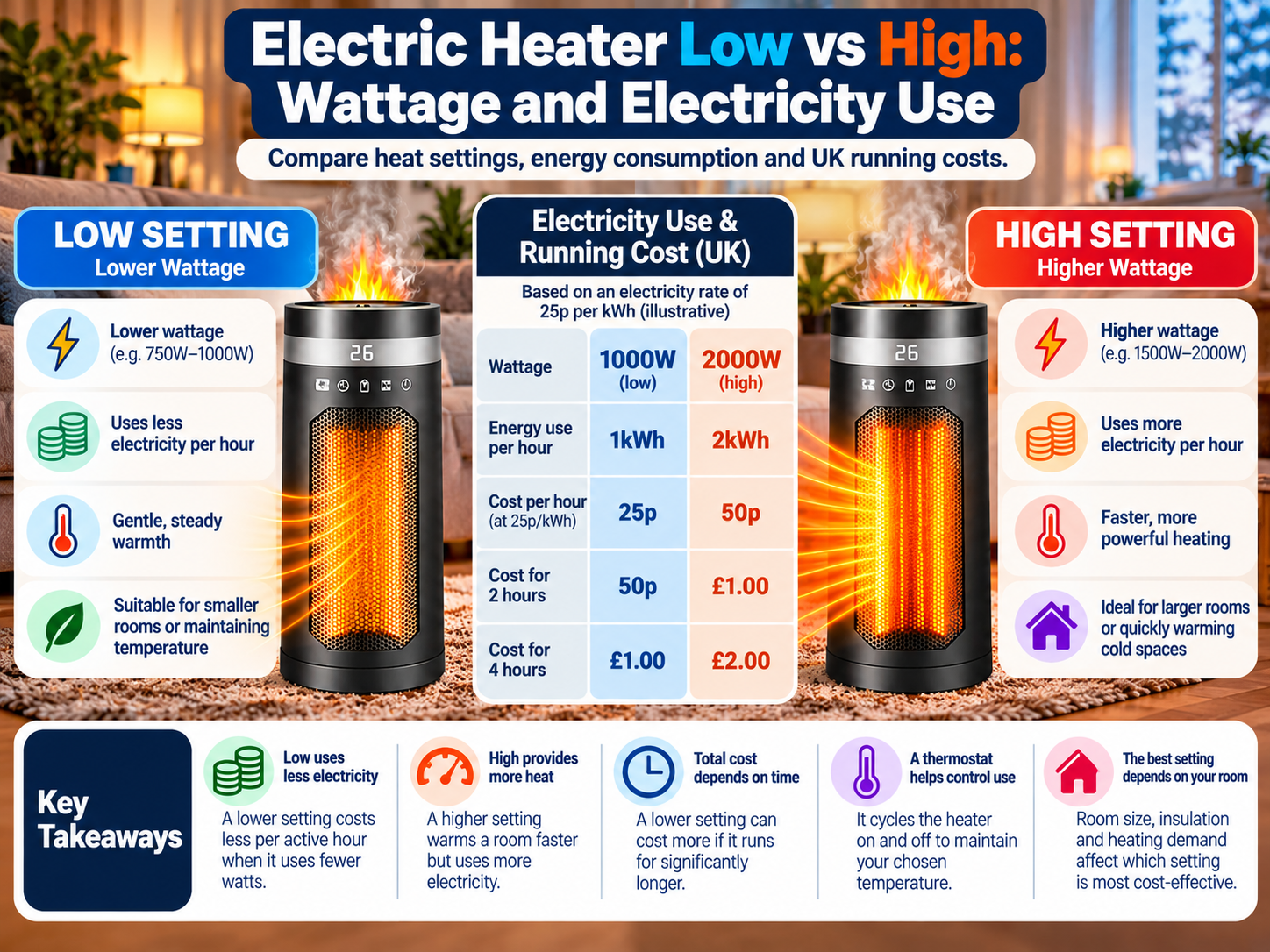
A lower heat setting generally consumes less electricity per active heating hour when it genuinely reduces the heater's electrical wattage. However, that doesn't automatically mean using low mode will always cost less over an entire evening.
For example, a heater operating at 1000W for two hours consumes the same amount of electricity as a 2000W heater operating at full power for one hour: 2kWh.
A thermostat, room insulation, outdoor temperature and heating duration can all affect the final electricity consumption.
This guide explains how low and high heat settings work, compares UK running costs and helps you decide which mode may be more appropriate for your home.
Electric Heater on Low or High: What Changes?
When you select a different heat setting on a portable electric heater, you're usually changing the appliance's heating output.
Many portable heaters offer options such as:
Low heat
High heat
Adjustable temperature
Fan-only mode
Automatic thermostat control
However, the exact behaviour depends on the heater.
Some appliances use separate heating elements or different electrical power levels. Others regulate heating through their thermostat or electronic controls.
For example, a heater might offer:
Low mode — 1000W
High mode — 2000W
These are illustrative figures. Your heater may have different power settings.
If the low mode operates at 1000W and the high mode at 2000W, the high setting consumes twice as much electricity during an equal period of continuous active heating.
But it also provides greater heating output.
Does a Lower Heat Setting Use Less Electricity?
Yes, when the lower setting actually reduces electrical power.
Electricity consumption is calculated using:
Power (kW) × operating time (hours) = electricity used (kWh)
For example:
A 1000W heater operating continuously for one hour consumes:
1kW × 1 hour = 1kWh
A 2000W heater operating continuously for one hour consumes:
2kW × 1 hour = 2kWh
Therefore, the lower-power setting consumes less electricity over the same active heating duration.
However, electricity use over a complete heating session may differ because the heater's thermostat can switch the heating element on and off.
Power (kW) × operating time × electricity unit rate = estimated cost
For this example, we'll use an illustrative electricity price of 25p/kWh.
Heat Setting
Power
1 Hour
2 Hours
4 Hours
Low
1000W
25p
50p
£1.00
High
2000W
50p
£1.00
£2.00
These examples assume continuous operation at the stated power.
Actual consumption may be lower when thermostat cycling reduces the time the heating element is active.
Using UK electricity rates
For a more realistic calculation, replace the illustrative rate with the unit price shown on your electricity bill.
Ofgem publishes average electricity unit rates under the energy price cap, but your actual tariff may differ depending on your supplier, region and payment method.
Comparing 1000W and 2000W helps explain the relationship between electrical power and heating cost.
Feature
1000W
2000W
Electrical power
1kW
2kW
Energy per full-power hour
1kWh
2kWh
Example cost at 25p/kWh
25p
50p
Maximum heating output
Lower
Higher
Heating-element operation
Depends on controls
Depends on controls
A 2000W resistance heater provides approximately twice the heating output of a 1000W resistance heater when both operate continuously at their respective rated heating powers.
However, whether the 2000W setting costs more to maintain a particular room temperature depends on how long it needs to operate.
For instance, a higher-power setting may reach the target temperature sooner and then cycle off.
That is why comparing total kWh used, rather than simply hourly wattage, provides a more meaningful picture of cost.
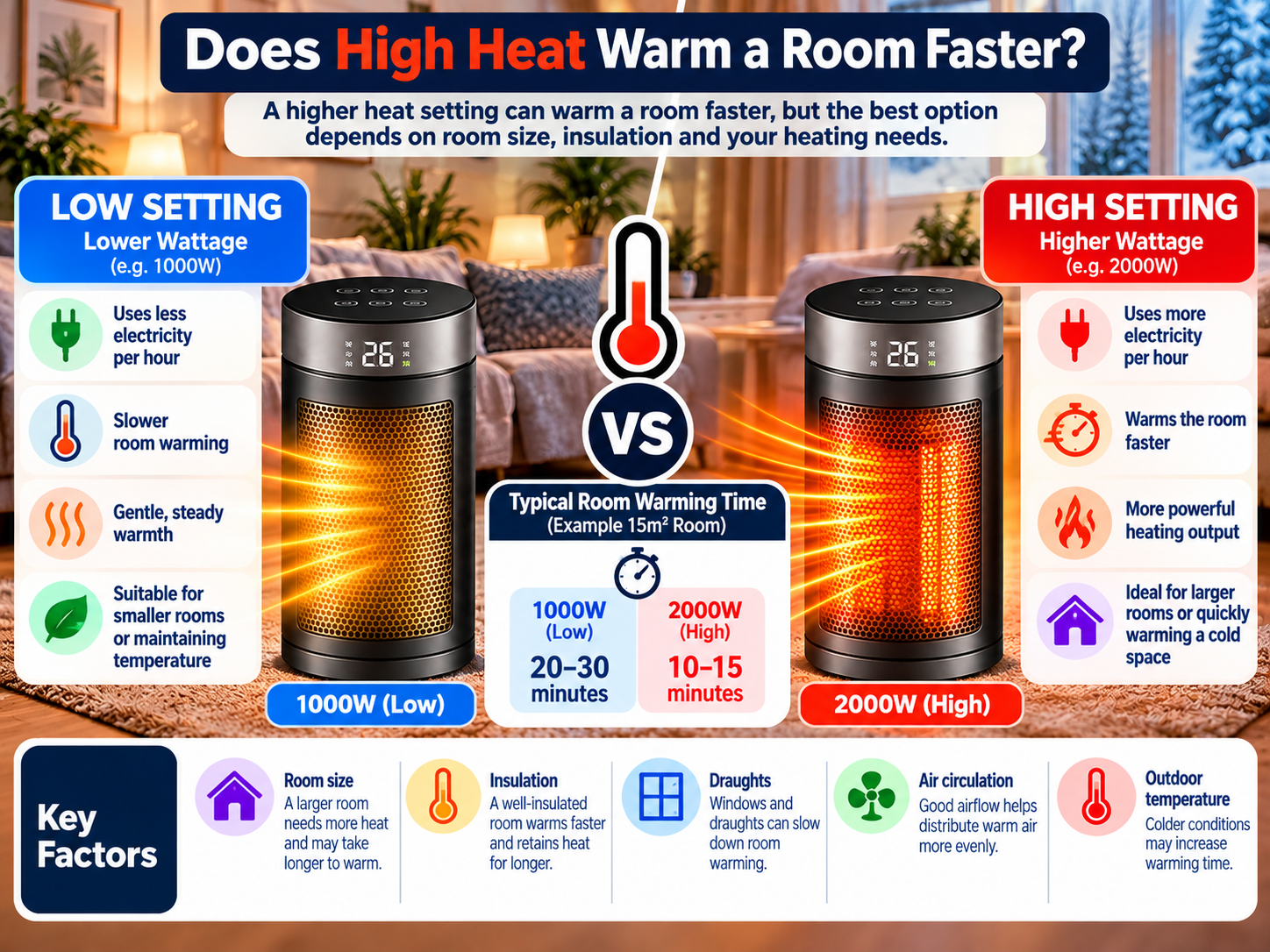
Does High Heat Warm a Room Faster?
Generally, a higher-power heating mode can warm a room faster than a lower-power mode, provided the heater is operating correctly and the room conditions are comparable.
A 2000W heater produces more heat per active hour than a 1000W heater.
However, several factors affect how quickly the room warms:
Room volume
Insulation
Windows and glazing
Draughts
Outdoor temperature
Air circulation
Starting room temperature
Thermostat controls
A poorly insulated room may lose heat quickly, reducing the benefit of additional heating output.
Higher wattage doesn't guarantee that every room will reach a particular temperature within a fixed time.
Can Low Heat Cost More Over a Longer Period?
Yes, a lower-power setting can consume more electricity overall if it operates for sufficiently longer.
Consider two hypothetical heating sessions.
Scenario A: Low heat
A 1000W heater operates continuously for four hours.
1kW × 4 hours = 4kWh
At 25p/kWh:
Total cost = £1.00
Scenario B: High heat
A 2000W heater operates at full power for one hour.
2kW × 1 hour = 2kWh
At 25p/kWh:
Total cost = £0.50
In these examples, the shorter high-power session costs less because it consumes fewer total kWh.
However, these sessions don't necessarily provide the same comfort over the same period. The second scenario may leave the room unheated for the remaining three hours.
To make a fair comparison, consider the total energy needed to maintain a similar comfortable temperature for the same duration.
The key principle is:
Lower wattage doesn't always mean lower total electricity consumption.
How Does a Thermostat Affect Electricity Use?
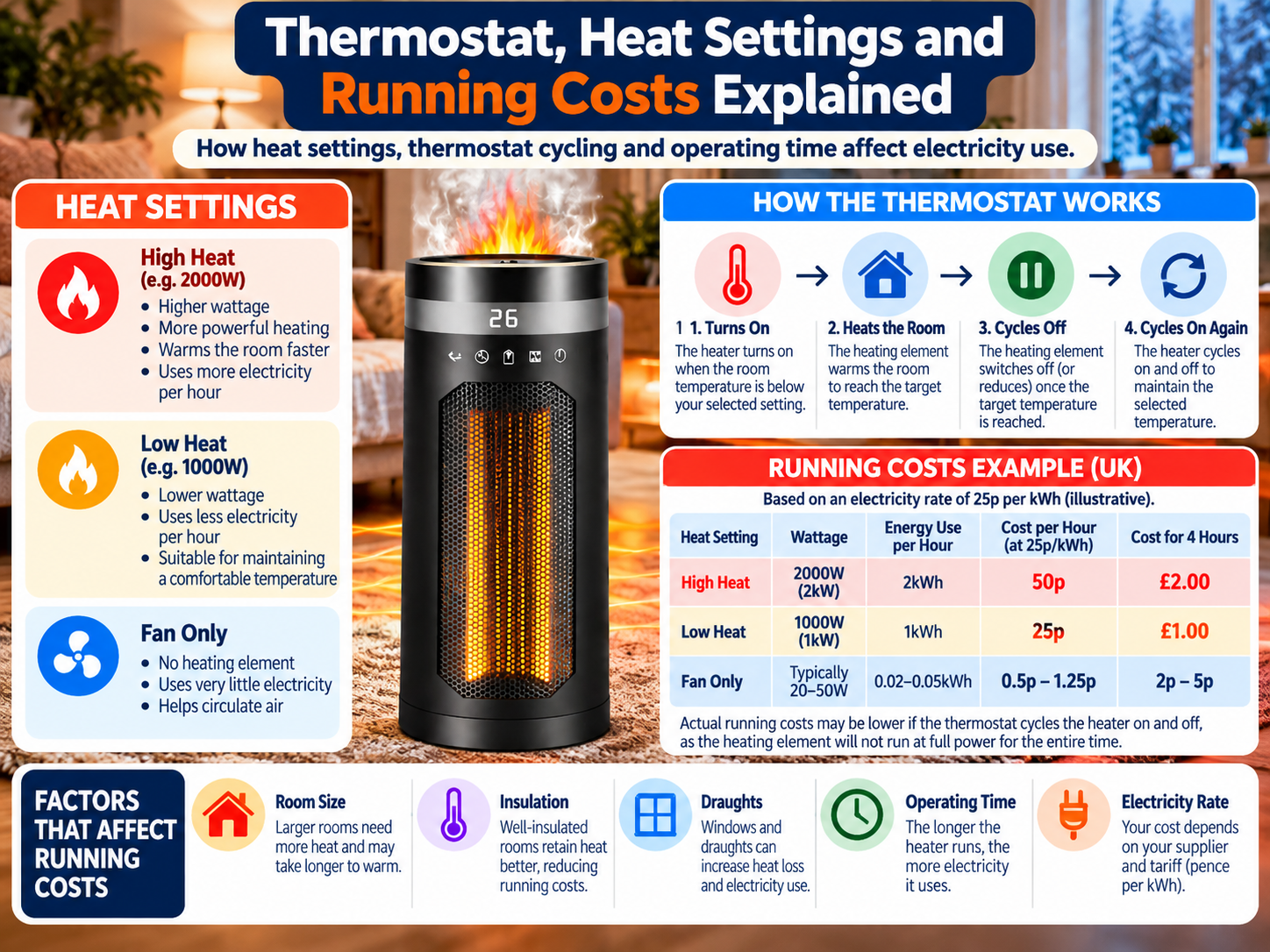
A thermostat regulates heating according to a selected temperature.
Suppose you set your heater to 21°C.
Depending on the model, the appliance may:
Monitor the temperature near its sensor.
Operate the heating element while additional heat is required.
Reduce or stop heating as the selected temperature is approached.
Resume heating when the sensed temperature falls sufficiently.
This process is commonly called thermostat cycling.
The thermostat can affect the proportion of time the heating element operates, which influences total electricity consumption.
A 2000W heater doesn't necessarily consume 2kWh during every clock hour that it remains switched on.
If its heating element is inactive for part of that hour, total energy consumption can be lower.
Should You Use High Heat First, Then Switch to Low?
Using high heat initially and then switching to a lower mode can be a practical approach in some situations.
For example, you might use a higher setting while bringing a cold room toward your desired temperature, then select a lower setting if it can maintain comfortable conditions.
However, this strategy doesn't guarantee electricity savings.
For a conventional resistance heater, the total energy required depends largely on how much heat the room needs and loses.
A thermostat-controlled heater may already regulate heating automatically.
When high heat may be useful
The room is initially cold.
Faster warming is desirable.
The heater is designed to support the selected mode.
The room's heating demand exceeds the lower mode's output.
When low heat may be sufficient
The room is already comfortable.
Heating demand is relatively modest.
The room is well insulated.
A lower output can maintain the desired temperature.
Follow the manufacturer's operating instructions rather than assuming every heater should use the same sequence.
Does Room Insulation Change the Best Setting?
Yes. Insulation can influence how much heat is required to maintain a comfortable room temperature.
A poorly insulated room may lose warmth through:
External walls
Windows
Roofs
Floors
Doors
Draughty openings
If heat escapes rapidly, a lower-power mode may struggle to maintain the selected temperature.
In a well-insulated room, the same lower-power mode may be sufficient.
This doesn't change the electrical wattage of the heating element. It changes the room's heating demand and potentially the heater's operating time.
The appropriate heat setting depends on the room's heating requirements and the heater manufacturer's instructions.
For example, a lower mode may provide adequate supplementary warmth while you're awake in a well-insulated bedroom.
However, heater placement and safe operation are especially important around:
Bedding
Pillows
Curtains
Clothing
Furniture
Carpets and rugs
Electrical Safety First recommends keeping portable heaters at least one metre away from combustible materials and advises against leaving them operating overnight or unattended.
A thermostat or timer doesn't make unattended sleeping use automatically safe.
Choosing between low and high heat is only one part of managing electricity consumption.
Several practical habits can help avoid unnecessary heating.
Use a Comfortable Thermostat Setting
Avoid selecting a much higher temperature than you actually require.
Control Operating Time
Use the heater while supplementary warmth is needed, following its safety instructions.
Reduce Draughts
Seal avoidable gaps around windows and doors while maintaining necessary ventilation.
Improve Heat Retention
Better insulation can reduce the amount of heat required to maintain room temperature.
Use Suitable Heating Output
Choose a heater that can meet your room's heating needs without unnecessary operation.
Keep Airflow Unobstructed
Follow the manufacturer's clearance instructions and avoid blocking air intakes or outlets.
Check Your Electricity Tariff
Calculate running costs using your actual pence-per-kWh rate.
For a complete explanation, read our How to Use an Electric Heater Efficiently in Winter guide.
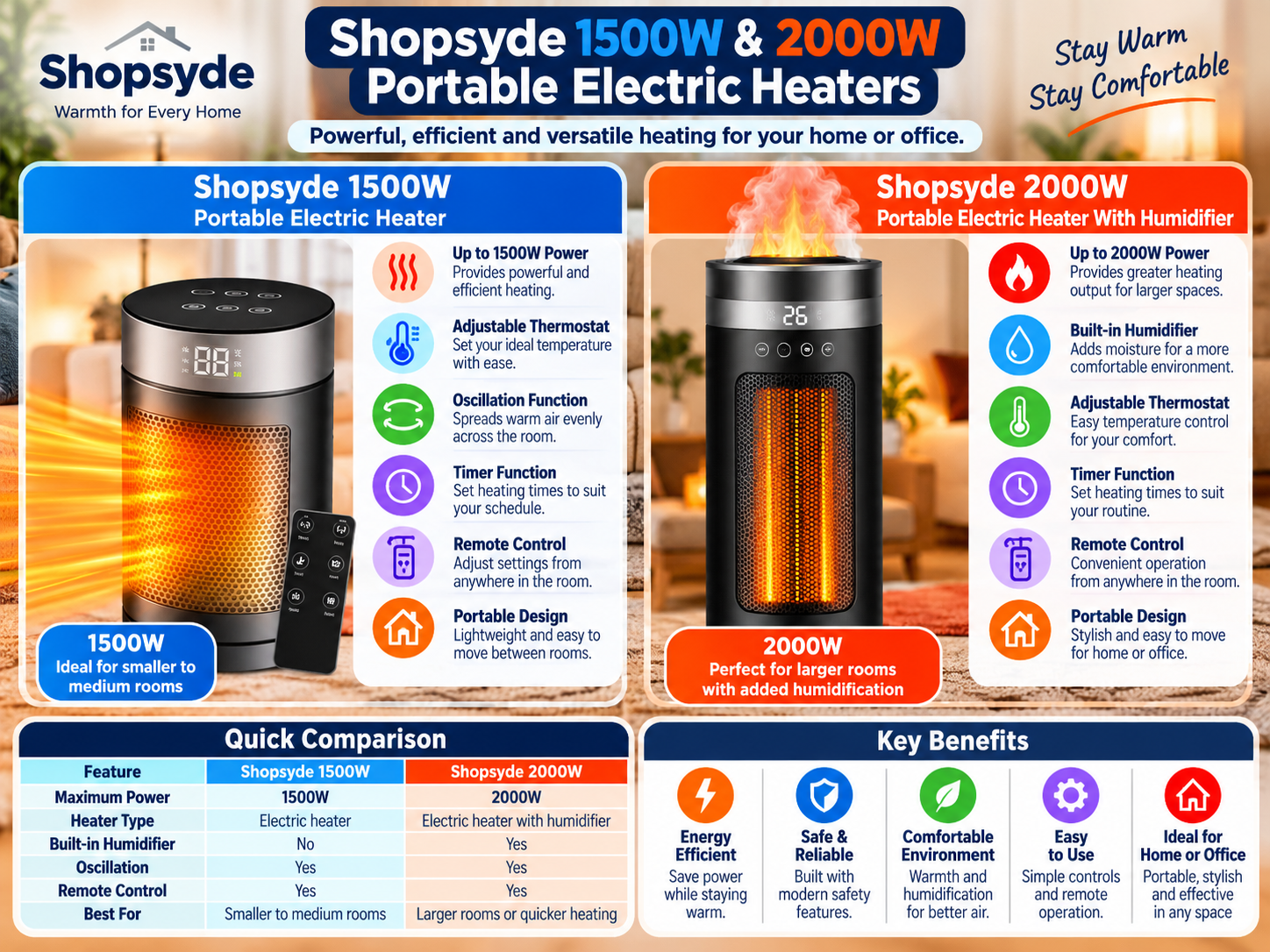
Shopsyde 1500W Portable Electric Heater
The Shopsyde 1500W Portable Electric Heater with Thermostat, Oscillation, Timer & Remote Control offers convenient supplementary heating with adjustable controls.
Key features
Up to 1500W heating power
Ceramic heating
Digital thermostat
Multiple heat settings
Oscillation
Timer
Remote control
Portable design
At continuous full 1500W output, the heater consumes approximately 1.5kWh per hour.
If your electricity rate is 25p/kWh, the illustrative full-power running cost is:
1.5 × £0.25 = 37.5p per hour
Actual consumption depends on operating mode and thermostat cycling.
The exact wattage of each lower heat setting should be confirmed from the product specifications.
Shopsyde 2000W Portable Electric Heater With Humidifier
For customers seeking greater maximum heating output, Shopsyde offers the 2000W Portable Electric Heater with Humidifier, Thermostat, Timer & Remote Control.
Key features
Up to 2000W heating power
Thermostat control
Timer
Remote operation
Built-in humidifier
Portable design
At a continuous electrical draw of 2000W, electricity consumption is approximately 2kWh per hour.
Using an illustrative 25p/kWh rate:
2 × £0.25 = 50p per hour
Actual consumption may vary with operating modes, thermostat cycling and auxiliary functions.
The 2000W model provides greater maximum heating output than the 1500W model, but the right choice depends on the room's heating requirements.
Electric Heater Low vs High: Quick Comparison Checklist
Factor
Low Heat
High Heat
Electrical power
Lower, if designed that way
Higher
Electricity per active hour
Usually lower
Usually higher
Maximum heating output
Lower
Higher
Room warming speed
May be slower
May be faster
Ability to maintain temperature
Depends on heat loss
Depends on controls
Total electricity cost
Depends on operating time
Depends on operating time
Thermostat cycling
Model-dependent
Model-dependent
Best application
Lower heating demand
Higher heating demand
The most useful comparison is the total kWh required to provide similar comfort over the same period, rather than simply the hourly wattage.
The Bottom Line
So, is it cheaper to run an electric heater on low or high?
Low mode generally costs less per active heating hour when it uses fewer watts. However, the cheapest way to maintain a comfortable room temperature depends on the heater's controls, total operating time and the room's heat loss.
High heat may warm a cold room faster, while low heat may be sufficient once the room is comfortable.
The key is to understand the difference between instantaneous electrical power and total electricity consumption.
Use a suitable heating mode, sensible thermostat settings and appropriate operating times rather than assuming low or high is always the cheapest choice.
For portable heating options with adjustable controls, explore the Shopsyde Electric Heaters collection.
FAQS
Frequently Asked Questions
1Is It Cheaper to Run an Electric Heater on Low?
A lower-power mode costs less per active heating hour, but total cost depends on how long the heater operates and how much heat the room requires.
2Does High Heat Use More Electricity?
Yes, if high mode draws more electrical power. For example, 2000W consumes twice the electricity of 1000W over an equal period of continuous operation.
3Is It Better to Use High Heat for a Short Time?
High heat can warm a room faster, but it doesn't automatically use less energy. Compare total kWh and comfort over the same period.
4Can Low Heat Cost More Than High Heat?
Yes, if low mode operates for sufficiently longer. However, comparisons should account for the warmth provided over the entire period.
5Does a Thermostat Reduce Electricity Consumption?
It can reduce consumption by controlling heating time according to temperature, but actual results depend on the room and heater.
6Does a Timer Make a Heater More Efficient?
A timer doesn't change the heating element's efficiency. It can help prevent unnecessary operating time.
7Is a Ceramic Heater Cheaper on Low?
Not automatically. A ceramic heater consumes electricity according to its actual electrical power and operating time.
8Should I Use Low Heat in a Small Room?
A lower-power mode may be sufficient for a room with modest heating demand, but room size, insulation and heat loss all matter.
9How Much Does a 2000W Heater Cost on High?
At an illustrative electricity rate of 25p/kWh, a heater drawing 2000W continuously costs approximately 50p per hour.
10Can I Leave an Electric Heater on Low Overnight?
No heat setting makes unattended overnight portable-heater use automatically safe. Electrical Safety First advises against leaving portable heaters running while you're asleep or otherwise unattended.